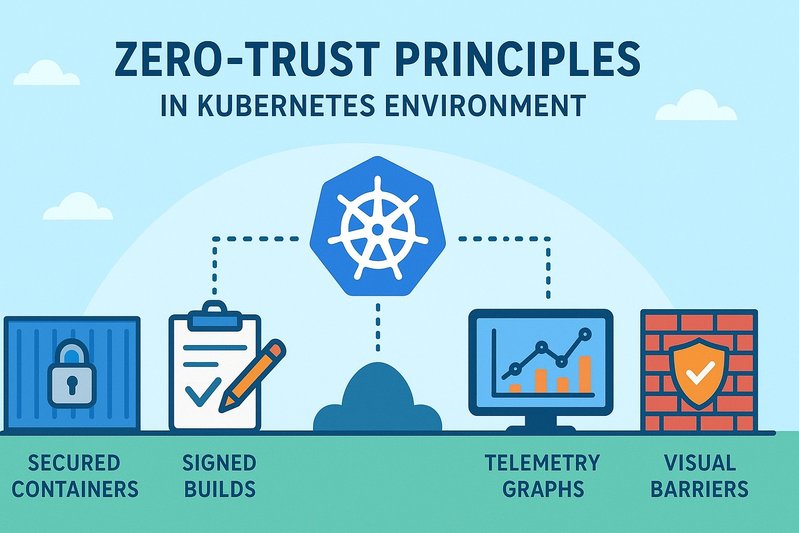
Zero‑Trust Diffusion Serving on Kubernetes Ships with Signed Builds, Sandboxed Pods, and Real‑Time Telemetry
A pair of recent supply‑chain shocks—the XZ Utils backdoor and the PyTorch‑nightly dependency compromise—reminded teams that a single poisoned component can subvert an entire AI serving fleet. Add in regularly published GPU driver/runtime CVEs and cross‑tenant leakage issues like LeftoverLocals, and you have a threat picture that demands zero‑trust by default across build, deploy, and runtime. 🛡️
This hands‑on guide shows how to harden diffusion model serving on Kubernetes with verifiable provenance (SLSA, SBOMs, signature enforcement), deep isolation (seccomp/AppArmor, sandboxed pods, GPU tenancy), segmented networking and egress controls, attested secrets/identity, policy‑as‑code gates, and fleet‑wide telemetry (OpenTelemetry, DCGM) tied to abuse controls and patch SLAs. Grounded in NIST SSDF and SP 800‑53 practices and threat‑informed sources like MITRE ATLAS and OWASP’s LLM Top 10, it operationalizes a zero‑trust posture from CI to GPU.
You’ll learn how to: 1) enforce build provenance and image trust, 2) isolate containers and accelerators, 3) lock down network posture and egress, 4) protect secrets and seeds via attestation, 5) gate deployments with policy‑as‑code, 6) instrument real‑time observability and abuse resistance, and 7) run patch/rollback hygiene and incident drills aligned to credible threats.
Architecture/Implementation Details
Build provenance and image trust: SLSA, SBOMs, and signatures
- Require SLSA Level 3+ provenance for all serving artifacts (sampler binaries, model containers) with hermetic pipelines and verifiable attestations; block promotion on attestation failure.
- Generate and store SBOMs (SPDX or CycloneDX) for containers and model‑adjacent artifacts to accelerate blast‑radius analysis during advisories.
- Sign container images with Sigstore Cosign and enforce signature verification at deployment; treat unexpected hashes or unsigned images as policy violations.
- Maintain golden hashes for model weights, solver binaries, and configuration bundles; verify on pod start and periodically at runtime (gated by admission controllers).
- Why this matters now: ecosystem incidents (PyTorch‑nightly compromise, safetensors advisory, token exposure) show how build chains and artifacts can be abused without obvious runtime symptoms. SLSA+SBOM+signatures create pre‑flight and runtime tripwires.
Container and node isolation: minimal images, sandboxed pods, read‑only FS
- Run minimal, non‑root images with seccomp and AppArmor profiles, and enforce read‑only filesystems to reduce the writable attack surface (align to CIS Kubernetes hardening).
- Use sandboxing layers such as gVisor/Kata for stronger syscall/isolation boundaries when sensitive plugins, parsers, or custom CUDA ops are present (report recommends considering these options).
- Separate training/finetuning planes from online serving; avoid cross‑plane credentials and keep artifact registries private (per secure operations guidance).
Network posture: gateways, egress allow‑lists, segmentation, zero‑trust
- Front public traffic with an API gateway and apply WAF/DDoS protections; inside the cluster, segment services and apply least‑privilege routing.
- Enforce egress allow‑lists from sampler pods to prevent data exfiltration to arbitrary endpoints.
- Align policies to NIST SP 800‑53 control families for access control (AC), system and communications protection (SC), audit (AU), and configuration management (CM).
GPU tenancy: exclusive assignment, MIG partitions, validation of isolation
- Prefer exclusive GPU assignment or NVIDIA MIG partitions to reduce cross‑tenant leakage and constrain the blast radius; avoid weak sharing modes for sensitive workloads.
- Continuously validate isolation behavior and track errors/anomalies via NVIDIA DCGM; integrate DCGM health and error signals with alerting pipelines.
- Monitor vendor advisories for GPU/driver/runtime CVEs and keep mitigations current; incidents like LeftoverLocals (CVE‑2023‑4969) underscore the need for controlled tenancy and patch discipline.
Secrets management and workload identity: KMS/HSM and seed hygiene
- Store model keys and sensitive RNG seeds in KMS/HSM and scope access via short‑lived workload identities and least‑privilege IAM.
- Use cryptographic DRBGs for security decisions and watermark‑adjacent randomness per NIST SP 800‑90A; prohibit seed/key logging and ensure per‑tenant, per‑request PRNG isolation.
- Follow framework guidance for randomness isolation: scope PyTorch generators appropriately to avoid global state leaks; in JAX, pass PRNG keys explicitly.
Attested execution and secret release (optional hardening)
- On CPUs, back serving nodes with confidential computing (e.g., SEV‑SNP/TDX‑backed confidential VMs from major clouds) and bind KMS secret release to verified attestation measurements.
- Where available, enable NVIDIA GPU confidential computing to add memory encryption and attested execution domains for models/data in use; integrate GPU attestation into admission policies before provisioning model weights.
Policy‑as‑code: gating deployments on signatures, attestations, and hashes
- Encode admission rules that require: valid Cosign signatures, SLSA attestations, approved registries, non‑root users, and read‑only rootfs; fail‑closed on violations.
- Record model/solver/config hashes in telemetry and alert on drift; require two‑person review and change records for sampler algorithms, step/noise schedules, and guidance ranges (per report’s configuration governance guidance).
Comparison Tables
Trust and provenance controls
| Control | What it proves | Where enforced | Primary risks reduced | Key refs |
|---|---|---|---|---|
| SLSA L3+ provenance | Artifact built in a controlled, hermetic pipeline with verifiable attestations | CI/CD, deploy admission | Supply‑chain tampering in build chain | |
| SBOM (SPDX/CycloneDX) | Component inventory and versions | CI/CD, asset inventory | Rapid CVE impact mapping, dependency drift | |
| Cosign image signatures | Artifact authenticity and integrity | Registry/admission/pod startup | Unsigned/mutable images, typosquatting | |
| Golden hashes (models/solvers/config) | Runtime integrity against approved baselines | Pod startup/periodic checks | Silent tampering, safety drift | (report guidance + ) |
Isolation and tenancy options
| Layer | Option | Security posture | Operational trade‑offs | Key refs |
|---|---|---|---|---|
| Container | Non‑root + seccomp/AppArmor + read‑only FS | Reduces kernel/syscall and write surface | Profile tuning, potential compatibility work | |
| Sandbox | gVisor/Kata | Stronger isolation boundary for untrusted code paths | Overhead and compatibility considerations | (report guidance) |
| GPU | Exclusive assignment | Strong tenant isolation | Lower utilization, capacity planning | (report guidance) |
| GPU | NVIDIA MIG partitions | Hardware‑enforced partitioning of compute/memory/cache | Requires compatible GPUs and ops maturity |
Telemetry primitives
| Telemetry | What it provides | Example signals | Key refs |
|---|---|---|---|
| OpenTelemetry | End‑to‑end traces/metrics/logs across services | Model/solver/config hashes, guidance distributions, step counts, filter outcomes | |
| NVIDIA DCGM | GPU health/perf/error telemetry | ECC errors, Xid events, anomalous utilization | |
| Audit/controls (SP 800‑53) | Governance for monitoring and audit | AU/SI controls for continuous monitoring and alerting |
Best Practices
Fleet‑wide observability wired to enforcement
- Instrument OpenTelemetry in gateways, preprocessors, samplers, and post‑filters to emit: model version and hash, solver/config hashes, guidance scale distributions, step counts, moderation outcomes, and admission policy decisions. Correlate spikes or drift with recent deployments.
- Ingest DCGM GPU metrics and errors side‑by‑side with application telemetry; treat sudden error spikes or unexpected utilization patterns as potential exploit or isolation warnings.
- Map logging/monitoring to NIST SP 800‑53 AU and SI controls to ensure auditability, alert tuning, and compliance‑ready evidence.
Abuse resistance in production
- Enforce per‑tenant quotas, concurrency caps, burst limits, and adaptive throttling based on prompt risk signals to blunt automated probing and jailbreak campaigns.
- Use behavioral analytics at the gateway and maintain allow/deny‑lists for known exploit patterns; sandbox or delay high‑risk requests for deeper inspection (as the report recommends).
- Note: specific abuse metrics vary by deployment; “specific metrics unavailable.” OWASP’s LLM Top 10 provides patterns to monitor (injection, data leakage, insecure integrations) that map to multi‑modal conditioning and serving gateways in diffusion systems.
Patch and vulnerability operations (GPU/framework/OS)
- Track vendor PSIRTs (NVIDIA/AMD/Intel) and correlate advisories with your SBOM inventory; prioritize based on CISA KEV listings indicating exploitation in the wild.
- Use blue/green or canary rollouts for driver/runtime/container updates; regression‑test sampler behavior and safety metrics after changes (report guidance).
- Validate multi‑tenant isolation after GPU firmware/driver updates and reapply mitigations for known leakage modes (e.g., LeftoverLocals).
Drills that stick: incident runbooks and RTO/RPO discipline
- Pre‑build and exercise runbooks for: sampler tampering, RNG/seed compromise, post‑deployment data poisoning, model weight exfiltration, safety filter bypass at scale, and GPU/driver CVE exploitation (scenarios enumerated in the report).
- Align to NIST SP 800‑53 IR controls and NIST AI RMF governance; set explicit RTO/RPO targets for online diffusion serving (the report cites RTO of 4–8 hours for safety‑impacting incidents; RPO ≤ 1 hour for model/config state snapshots).
- Table‑top exercises should include vendor notification paths, legal/comms thresholds, and rollback safety checks (report guidance).
Practical Examples
While the report does not include code snippets, it documents concrete ecosystem incidents and hardware risks that illustrate how the above controls reduce likelihood and blast radius:
-
PyTorch‑nightly supply‑chain compromise (Dec 2022): A malicious dependency exfiltrated credentials from developer environments. With SLSA‑attested builds, Cosign signatures, and SBOM enforcement, unsigned or provenance‑missing artifacts would be blocked at promotion/admission, and inventory would accelerate containment. Audit logs aligned to SP 800‑53 AU controls enable rapid scoping.
-
safetensors parser advisory: A vulnerability in a core ML format’s parser underlines the need for defense‑in‑depth. Running samplers in non‑root, seccomp/AppArmor‑confined, read‑only pods and, where feasible, under gVisor/Kata, reduces exploit impact even if a parser vulnerability is triggered. SBOMs surface affected versions for targeted patching.
-
Hugging Face 2024 token exposure: Build artifacts accidentally exposed tokens. Least‑privilege IAM, short‑lived workload identities, and egress allow‑lists limit the damage window; secret rotation and leakage monitoring are part of the report’s recommended secret hygiene program.
-
XZ Utils backdoor: A base image component compromise demonstrated how non‑ML layers can subvert the entire chain. Provenance verification for all layers, not just ML code, plus golden hash checks at runtime, raises the chance of detecting unexpected modifications before they reach serving clusters.
-
LeftoverLocals (CVE‑2023‑4969): Cross‑tenant leakage from GPU local memory on affected devices. The report recommends exclusive GPU assignment or MIG, continuous validation, and vendor mitigations; DCGM health/error telemetry and policy to avoid risky sharing modes further reduce exposure.
-
Routine GPU/driver/runtime CVEs: Vendor bulletins frequently include privilege escalation, memory corruption, or DoS issues with implications for inference clusters. The report advises patch SLAs, canary testing, and rollback safety tied to SBOM‑driven inventories and CISA KEV prioritization.
These examples reinforce a central theme: zero‑trust controls must interlock across CI/CD, admission, runtime isolation, and telemetry to catch and contain failures that no single layer can fully prevent.
Conclusion
Diffusion serving in 2026 runs through a minefield of supply‑chain, GPU runtime, configuration, and abuse risks. A zero‑trust posture on Kubernetes—anchored in signed and provenance‑verified builds, sandboxed pods and hardened GPUs, attested secrets, policy‑as‑code gates, and real‑time telemetry—materially reduces both likelihood and blast radius for the most consequential scenarios documented in the report.
Key takeaways:
- Treat samplers and configs as high‑integrity artifacts: mandate SLSA, SBOM, Cosign, and golden hash verification.
- Enforce multi‑layer isolation: seccomp/AppArmor, read‑only pods, and strong GPU tenancy (exclusive/MIG) validated via DCGM.
- Lock down egress and identities; protect seeds/keys with KMS/HSM and DRBGs (NIST 800‑90A), and isolate PRNG state per tenant/request.
- Wire OpenTelemetry + DCGM into alerting and abuse analytics, and tie patch/rollback operations to PSIRTs and CISA KEV.
- Drill incident playbooks aligned to NIST SP 800‑53 IR and NIST AI RMF with explicit RTO/RPO targets.
Next steps:
- Inventory your serving plane with an SBOM; enable Cosign verification in admission.
- Roll out seccomp/AppArmor and read‑only FS to sampler pods; plan a gVisor/Kata pilot.
- Segment your network and implement egress allow‑lists; tune gateway rate limits and analytics.
- Choose exclusive or MIG GPU tenancy and integrate DCGM into your telemetry stack.
- Define policy‑as‑code gates for signatures, attestations, and config hashes; run your first incident tabletop.
Zero‑trust diffusion serving isn’t a single feature—it’s a discipline. Teams that ship with provenance, isolation, monitoring, and abuse controls already in place are positioned to absorb inevitable vulnerabilities and adversary pressure with resilience and speed. 🔧
Sources & References
