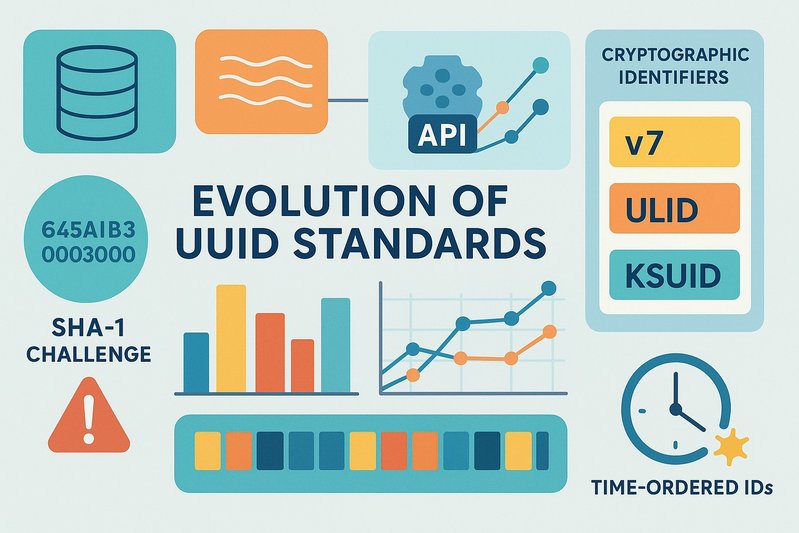
Post‑RFC 9562 Identity: v7 Ascendancy, SHA‑1 Headwinds, and the Next Wave of Deterministic IDs
Standards, cryptography, and privacy trends reshaping identifier design through 2030
The quiet rewrite of ID strategy is underway. In 2024, the IETF modernized the UUID standard, introducing new versions and explicit security guidance that reframes how teams choose identifiers for databases, streams, and APIs. In parallel, SHA‑1’s collision-resistance headwinds changed the risk profile of deterministic name‑derived identifiers. The result: a decisive shift toward time‑ordered IDs for operational performance, a more constrained role for deterministic UUID v5, and new room for custom layouts and privacy‑preserving derivations.
This article maps the post‑RFC 9562 landscape and looks ahead to 2030. Expect a clear view of what changed in the standard, how evolving cryptographic realities alter threat models, why sortable IDs like v7, ULID, and KSUID are becoming defaults, and how privacy‑preserving determinism can be done safely. We also chart observability roadmaps, the opportunity surface in v8, the open research questions the community still needs to answer, and pragmatic forecasts for enterprise defaults and procurement checklists over the next 3–5 years.
From RFC 4122 to 9562: A Reframed ID Landscape
The IETF’s UUID update in RFC 9562 obsoletes RFC 4122 and formalizes three new versions—v6, v7, and v8—alongside retaining legacy v1, v3, v4, and v5. The practical outcome is a clarified, future‑oriented taxonomy:
- v3/v5 (deterministic): Hash‑derived from a namespace and name, with v5 using SHA‑1. These remain useful for reproducible mappings but are explicitly cautioned against as substitutes for cryptographically collision‑resistant IDs in adversarial or privacy‑sensitive domains.
- v7 (time‑ordered): Combines a sortable timestamp with randomness to improve database and system characteristics without coordination. This is the center of gravity for new, ingestion‑heavy systems.
- v8 (customizable): A flexible layout for domain‑specific experimentation within standard boundaries.
This reframing matters operationally. Across relational engines, a consistent pattern holds: random‑like UUIDs (v4 and cross‑name v5) as clustered primary keys cause more B‑tree page splits, index bloat, and write amplification than time‑ordered schemes. Vendor guidance reinforces this: MySQL’s UUID_TO_BIN with time‑ordered byte swapping benefits time-based formats; SQL Server differentiates between random NEWID() (fragmenting) and NEWSEQUENTIALID() (locality‑friendly); PostgreSQL’s posture is similar in practice even as function sources vary. In short, RFC 9562 codifies what operators have learned: pick time‑ordered IDs for clustered keys and range scans; keep deterministic IDs when you truly need stable name→ID mapping.
That division of labor extends beyond SQL. MongoDB’s default ObjectId is time‑ordered for efficient inserts on a single primary; Cassandra distinguishes uuid from timeuuid to support ordered clustering columns and time‑sliced queries. Search engines optimize ingestion when they generate IDs themselves; bringing external IDs, deterministic or otherwise, carries throughput trade‑offs. In message systems, partition routing by key means determinism can help compaction and idempotency—but it also surfaces skew that needs management.
The structural takeaway: the standard now validates a dual‑ID architecture. Use v7 (or similar) for locality and performance, and retain a deterministic key as a unique secondary when reproducibility or idempotency is essential.
Cryptographic Trajectory: SHA‑1 Headwinds and Changing Threat Models
The cryptographic posture around SHA‑1 is settled: deprecation for collision resistance is the norm, and chosen‑prefix collisions have moved from theory to practice. Deterministic UUID v5, which hashes a namespace UUID and name with SHA‑1, inherits this weakened collision‑resistance posture. While a 128‑bit UUID has negligible random collision probability in typical scales, the effective safety of v5 relies on SHA‑1’s properties. Given the feasibility of chosen‑prefix collisions, an attacker who can target the same namespace and craft inputs can, in principle, produce distinct names with the same v5 output.
This doesn’t make v5 obsolete; it scopes it. Within governed namespaces and trusted inputs, v5 remains a powerful tool: idempotency keys, reproducible imports, deterministic cache keys, and cross‑region reconciliation all benefit from stable name→ID mappings without coordination. But where inputs are public or adversarial, or where the mapping could leak personally identifiable information (PII), the calculus changes.
Three mitigation pillars define the path to safer determinism:
- Scoped namespaces and governance: Maintain a registry of allowed namespaces with clear ownership and purpose. Version changes to avoid accidental rekeying. Restrict who can mint namespaces to prevent cross‑contamination.
- Canonicalization: Enforce consistent name normalization across stacks—Unicode normalization form, case folding, whitespace policy, and encoding rules—to keep derivations reproducible and to narrow the surface for crafted inputs.
- Salting within trust boundaries: Incorporate a secret salt or pepper into the derivation for any public‑ or user‑controlled inputs. This preserves determinism for authorized parties while preventing external inference and making chosen‑prefix attacks infeasible outside the boundary. The trade‑off is cross‑organization reproducibility.
Even with mitigations, risk posture should dictate defaults. For public‑facing IDs, v7 or v4 is the safer choice. For governed, internal domains where determinism is a requirement and privacy is controlled, v5 remains fit‑for‑purpose—in particular when paired with salting and strict canonicalization.
Open question for the community: can we design collision‑mitigation mechanisms for deterministic IDs that don’t rely on secrets yet remain practical and reproducible across organizations? Today, no standardized answer exists; specific metrics unavailable.
Time‑Ordered Rise, Privacy‑Preserving Determinism, and Observability
The gravitational pull toward time‑ordered IDs is clear. UUID v7 anchors the standard path: it preserves the 128‑bit space, mixes timestamp and randomness for high‑probability uniqueness, and—most importantly—delivers better write locality and range‑scan behavior without coordination. For teams already using ULID or KSUID, the operational story is similar: sortable identifiers reduce B‑tree fragmentation and improve cache friendliness; range queries are straightforward; ingestion is smoother. ULID and KSUID remain de facto rather than IETF standards, but their ergonomics and widespread use make them pragmatic choices when standardization isn’t the deciding factor.
Where does that leave v5? As a specialized instrument. In SQL, the pragmatic pattern is to keep v5 as a unique secondary for determinism and use a time‑ordered surrogate—v7, timeuuid, or a sequential identity—as the clustered key. In streams (Kafka, Pulsar), v5 keys shine for idempotent upserts and compaction, collapsing duplicates across regions; but watch for key skew, since partitioning is derived from the key’s hash. When skew emerges, introduce composite keys or additional salting within the key space to rebalance load while preserving idempotency semantics. In search engines (Elasticsearch/OpenSearch), accept that supplying IDs (v5 or otherwise) typically reduces peak indexing throughput compared to engine‑generated IDs; either embrace auto‑IDs and store logical identifiers in the document body, or tune bulk ingestion when determinism is required.
On the observability front, one theme is unanimous: trace IDs remain separate. W3C Trace Context and OpenTelemetry specify a 16‑byte trace‑id and 8‑byte span‑id with strong uniqueness and randomization requirements, without tying themselves to any UUID version. Replacing trace IDs with v5 or v7 would undermine those guarantees and interop. The modern pattern is clear: propagate standard trace context for distributed tracing and log domain identifiers (v5, v7, or otherwise) as attributes for correlation and idempotency diagnostics. This separation preserves tracing invariants while enabling business‑level linking for debugging and analytics.
Quick comparison of the dominant options
| Identifier | Deterministic from name | Time‑ordered for locality | Collision posture (adversarial inputs) | Interop status | Typical strengths |
|---|---|---|---|---|---|
| UUID v5 | Yes (namespace + name) | No | Weakened by SHA‑1 chosen‑prefix feasibility; mitigations required | IETF RFC 9562 | Idempotency, dedup, reproducible imports within governed domains |
| UUID v7 | No | Yes | Strong probabilistic uniqueness | IETF RFC 9562 | Write locality, range scans, ingestion‑heavy OLTP |
| ULID | No | Yes | Strong probabilistic uniqueness | De facto | Human‑friendly, sortable |
| KSUID | No | Yes | Strong probabilistic uniqueness | De facto | Sortable with extended time range |
| Snowflake‑like | No | Yes | Strong if worker IDs and clocks governed | Architecture‑specific | High‑throughput ordered IDs; compact |
UUID v8, Custom Layouts, Open Questions, and the 3–5 Year Forecast
Standardization of UUID v8 opens a new lane: domain‑specific innovation within interop boundaries. The promise is a well‑defined sandbox for organizations to encode application‑specific structure—room for embedding coarse timestamps, sharding hints, or domain tags—without inventing wholly bespoke formats. The opportunity is real; so are the caveats. Coordination and clock discipline challenges, familiar from Snowflake‑like schemes, don’t disappear simply because a layout is standardized. Library support for v8 will matter; broad availability is uneven today, and specific adoption metrics are unavailable.
Several open research questions will shape the next wave:
- Collision mitigations without secrets: Can we keep cross‑org reproducibility and raise the bar against chosen‑prefix attacks? No consensus approach exists yet.
- Canonicalization standards: Beyond local policies, common profiles for Unicode normalization, case folding, and whitespace would reduce cross‑stack mismatches for deterministic IDs.
- Cross‑organization reproducibility: When multiple parties must derive the same ID from a shared name, how do we balance privacy, governance, and attack resistance without sacrificing determinism?
Even with those uncertainties, the medium‑term forecast is visible:
- Enterprise defaults converge on v7 for new, write‑heavy databases and services where clustering and range queries matter. ULID/KSUID remain viable where human‑friendliness or de facto tooling dominates.
- v5 contracts to governed domains with salting and strict namespace registries. It persists as a secondary key for idempotency, deduplication, and reproducible imports across regions—especially where deterministic reconciliation lowers operational complexity.
- Observability hardens around Trace Context/OTel for trace IDs, with domain IDs logged and correlated, not substituted.
- Procurement checklists evolve. Expect platform and library requirements to include: v7 support and correct byte‑order semantics; robust v5 APIs, including name canonicalization helpers; namespace registry tooling; first‑class salting/pepper management; database features that optimize time‑ordered storage (e.g., byte‑swapping utilities); and conformance with Trace Context for observability. Support for v8 layouts becomes a differentiator, but buyers should validate semantics rather than assume plug‑and‑play.
- Benchmark culture strengthens. Teams increasingly validate ID choices with in‑environment tests: insert TPS, page splits, index growth, cache hit ratios, range‑scan latencies, and stream partition skew. Where vendors optimize for auto‑IDs (search engines), procurement weighs determinism against throughput explicitly. 🔭
The pragmatic architecture emerging through 2030 is dual‑track: a time‑ordered primary key for operational efficiency and a deterministic key where reproducibility drives correctness. RFC 9562 aligns the standard with this reality and leaves room—via v8—for careful, domain‑specific iteration.
Conclusion
The UUID era didn’t end; it crystallized. With RFC 9562, the path forward is clearer: use v7 when locality and range scans dominate, and reserve v5 for deterministic mappings within governed, privacy‑preserving boundaries. SHA‑1’s chosen‑prefix feasibility narrows v5’s safe perimeter, while time‑ordered identifiers rise as the new operational default across databases and services. Observability keeps trace IDs separate, and v8 invites thoughtful experimentation without abandoning interoperability. The next 3–5 years will reward teams that treat IDs as part of system design, not an afterthought.
Key takeaways:
- Default to time‑ordered IDs (v7) for clustered storage and range scans; keep v5 as a secondary when determinism is required.
- Treat SHA‑1 headwinds as a design constraint: apply salts, strict canonicalization, and namespace governance for any deterministic derivations.
- Keep trace IDs independent and correlate domain IDs via attributes, not as replacements.
- Explore v8 for domain‑specific layouts, but validate library support and operational semantics carefully.
- Institutionalize benchmarks and checklists to evaluate ID strategy in your environment.
Next steps:
- Inventory current IDs by workload (OLTP, streams, search, observability); identify where locality or determinism truly matters.
- Pilot v7 for write‑heavy tables and range queries; measure fragmentation, page splits, and TPS.
- Establish a namespace registry and canonicalization policy; introduce salting where user input is involved.
- Align tracing with W3C Trace Context/OpenTelemetry and propagate domain IDs as attributes.
- Evaluate v8 support in your language stack and consider targeted experiments where domain hints can simplify operations.
The future of identifiers is more deliberate design, not more entropy. Organizations that embrace this shift—grounded in modern standards and realistic threat models—will ship faster systems with clearer guarantees and fewer surprises.