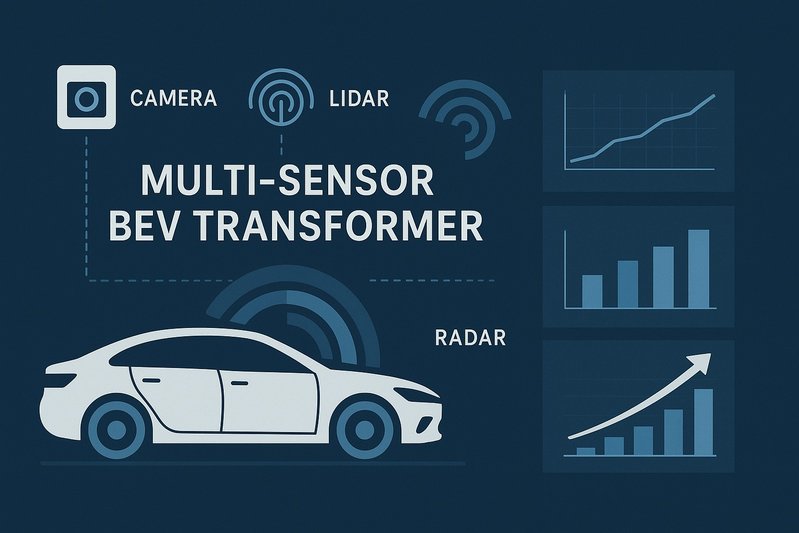
Multi‑Sensor BEV Transformers Beat Task‑Specific Detectors on nuScenes and Waymo
Autonomous stacks in 2026 are converging on a clear answer for robust perception: multi‑sensor BEV (bird’s‑eye view) transformers that fuse camera, LiDAR, and radar now consistently outscore task‑specific detectors on public benchmarks like nuScenes and remain competitive on the Waymo Open Dataset. The most visible gains show up where it matters most—long‑tail object categories, night and rain subsets, and tracking stability—while the bill comes due in compute, memory, and power. That trade-off is manageable on current automotive SoCs with compression and compilation, and it’s pushing perception design toward unified, multi‑task BEV backbones.
This article dives into how BEVFusion/TransFusion‑style architectures integrate complementary sensors, why occupancy volumes and map priors stabilize reasoning under occlusion, how video‑centric streaming impacts timing and MOT metrics, where empirical trends stand on nuScenes and Waymo, and what the runtime and failure‑mode signatures look like before deployment optimizations. Readers will come away with a blueprint for building, comparing, and shipping multi‑sensor BEV transformers in real‑time stacks—and a sober view of their limits.
Architecture and Implementation Details
From task‑specific detectors to unified BEV transformers
Task‑specific detectors excel when tailored to a single modality: LiDAR‑first designs like CenterPoint and VoxelNeXt deliver top‑tier localization (mATE/mASE) off precise geometry; camera BEV models such as BEVFormer and BEVDepth deliver strong category mAP in good lighting. But they fragment representation and duplicate compute across tasks.
Unified BEV transformers consolidate multi‑sensor inputs into a common BEV space and share a backbone across multiple heads (detection, tracking, occupancy, lanes, traffic elements). Two patterns dominate:
- Camera‑centric BEV video transformers that lift multi‑view images into BEV with temporal aggregation and strong visual pretraining (e.g., DINOv2‑style backbones) for long‑tail recognition.
- Full fusion BEV transformers (e.g., TransFusion, BEVFusion) that bring LiDAR point clouds and radar signals into BEV, integrating camera semantics, LiDAR geometry, and radar velocity within one spatiotemporal representation.
Unified multi‑task frameworks push this further. Designs inspired by UniAD share spatiotemporal features for joint detection–tracking–mapping, which reduces ID switches by enforcing consistency in the same BEV space. Across families, occupancy heads (Occ3D‑style) predict free space and volumetric occupancy, giving the network a geometry‑aware intermediate target to reason through occlusions. Map priors—vector lane graphs and drivable surfaces (VectorMapNet‑style)—add layout regularization that sharpens localization and reduces false positives at boundaries.
A useful mental diagram of these systems:
- Multi‑view camera encoder projects to BEV features (depth‑guided or attention‑based lifting).
- LiDAR voxel/pillar encoder produces BEV features aligned in the same grid.
- Radar encoder contributes coarse spatial cues and early velocity priors.
- Mid‑level BEV fusion merges streams, optionally with cross‑modal attention.
- Temporal module (streaming video transformer) maintains a compact state across frames.
- Multi‑task heads read from the shared BEV to emit 3D boxes, tracks, occupancy, lanes, and ego‑centric map updates.
Cross‑sensor BEV fusion: who contributes what
- Camera: high‑bandwidth semantics and category coverage; sensitive to illumination and occlusion; benefits most from strong pretraining.
- LiDAR: metric‑accurate geometry for position/size/orientation; robust to lighting; challenged by heavy precipitation and very long‑range sparsity.
- Radar: low angular resolution but excellent for radial velocity and weather penetration; stabilizes early motion estimates (mAVE) and recalls fast movers.
BEVFusion/TransFusion integrate these roles at BEV mid‑fusion. The shared grid enforces spatial consistency across modalities, improving mATE/mAOE and offering redundancy against sensor dropout and mild calibration drift. Occupancy heads further regularize the fused scene by predicting free/occupied cells, which helps maintain tracks through temporary occlusions.
Temporal streaming: warm‑up, stability, and MOT metrics
Streaming BEV transformers keep a lightweight state over time, reducing track fragmentation and ID switches and improving MOT metrics like HOTA and IDF1. There is a startup cost: time‑to‑first‑detect (TTFD) can be slightly higher during state warm‑up, but thereafter detections stabilize earlier and remain consistent. Practical mitigations include keyframe caching, memory‑efficient states, and stride scheduling to bound latency without collapsing the temporal horizon.
Occupancy volumes and map priors
Occupancy prediction acts as a geometry‑first scaffold. By modeling free space and volumetric occupancy explicitly, networks learn to recover partly occluded objects and suppress spurious hypotheses in non‑drivable regions. When combined with lane and boundary priors, the BEV backbone resolves layout ambiguities faster, reducing planner‑visible flicker during occlusions and complex intersections.
Comparison Tables
Modality and model style: typical trends on public benchmarks
| Modality | Model style | Quality (mAP/NDS; mATE/mAOE) | Long-tail/night/rain | Tracking (HOTA/IDF1; ID switches) | Runtime/Compute | Notes |
|---|---|---|---|---|---|---|
| Camera-only | Task-specific BEV | Good mAP in daylight; weaker mATE/mAOE | Weaker; sensitive to lighting/occlusion | Moderate; more fragmentation | Low–moderate | Minimal BOM; benefits from maps |
| Camera-only | FM (video BEV, VFM backbones) | Higher mAP; mATE/mAOE improved but still behind LiDAR/fusion | Better long-tail; improved night/rain but still limited | Fewer ID switches; better stability | Moderate–high | Needs strong compression for SoCs |
| LiDAR-only | Task-specific | Strong mAP/NDS; excellent mATE/mASE | Robust; precipitation can degrade | Stable tracks | Low–moderate | Efficient and reliable geometry |
| LiDAR-only | FM (temporal/occupancy) | Slightly higher mAP/NDS; better occlusion | Better rare-class handling | Improved HOTA/IDF1 | Moderate | Add occupancy for occlusion |
| Radar–camera | Fusion task-specific | Higher recall of fast movers; limited semantics | Robust to weather; relies on camera | Improved velocity estimates | Low–moderate | Good cost–robustness balance |
| Full fusion (Cam+LiDAR±Radar) | FM (BEVFusion/TransFusion) | Highest mAP/NDS; better mATE/mAOE | Strongest robustness; redundancy helps | Best stability; lowest ID switches | High (manageable with compression) | Best overall; more integration complexity |
Directionally, fusion BEV FMs improve composite metrics (mAP/NDS) by low‑single‑digit to low‑teens percentage points over strong single‑sensor baselines on nuScenes‑class evaluations, with larger relative gains on rare classes and adverse‑condition slices. Camera‑only FMs close much of the category mAP gap to LiDAR in daylight for larger objects, but localization (mATE) and orientation (mAOE) remain stronger with LiDAR and full fusion.
Empirical Performance and Temporal Behavior on nuScenes and Waymo
nuScenes remains the reference for multi‑sensor comparisons thanks to its comprehensive metrics (mAP, NDS, mATE/mASE/mAOE/mAVE/mAAE) and day/night/rain slices. On that protocol, BEV fusion transformers—typified by TransFusion and BEVFusion—deliver the strongest composite scores and reduce localization and orientation errors through cross‑modal consistency in BEV. Occupancy‑aware heads and map‑prior conditioning further stabilize tracks under occlusion and complex layouts.
On the Waymo Open Dataset, these systems remain competitive, with similar qualitative patterns: camera‑only BEV video transformers benefitting from long‑horizon temporal aggregation and visual pretraining, LiDAR‑centric models leading precise localization, and fusion approaches offering the most balanced trade‑off across classes and conditions. Waymo’s tracking protocols and temporally aware evaluations make the advantages of streaming clear in reduced ID switches and improved HOTA/IDF1.
Long‑tail and adverse conditions. Pretrained visual backbones (e.g., DINOv2‑style features) and semi/self‑supervised objectives lift recall at a fixed false‑positive rate for unusual categories and appearances. The largest relative gains for fusion FMs appear on rare classes and night/rain subsets, where radar’s velocity cues and LiDAR’s geometry compensate for vision’s illumination sensitivity. Safety‑oriented thresholding and calibrated uncertainty remain essential to avoid false‑positive spikes as recall increases.
Temporal dynamics and TTFD. Streaming BEV transformers typically need a brief warm‑up for the temporal state, which can slightly delay first detections. After initialization, they detect and persist entities earlier and more consistently than frame‑by‑frame baselines, reducing fragmentation and planner‑visible oscillations. Designs in the field mitigate warm‑up costs using keyframe caches and stride scheduling so periodic high‑fidelity updates amortize compute across frames.
Velocity estimation and radar’s role. Radar fusion notably improves early motion estimates, reflected in reduced velocity errors (mAVE) and more stable heading at the onset of tracks. Combined with LiDAR’s persistent geometry, this yields cleaner track births and fewer early ID switches. Joint detection–tracking–mapping backbones akin to UniAD add another layer of temporal regularization by sharing spatiotemporal features and enforcing BEV‑space consistency across tasks.
Best Practices for Building and Shipping BEV Fusion FMs
Architecture and training
- Fuse in BEV mid‑level. Consolidate camera, LiDAR, and radar into a shared BEV backbone to eliminate duplicated compute across detection, tracking, occupancy, and lanes.
- Add occupancy heads. Predicting free space and volumetric occupancy (Occ3D‑style) improves occlusion handling and reduces planner flicker.
- Incorporate map priors. Vector lane and drivable‑area priors sharpen localization near boundaries and simplify reasoning in complex intersections.
- Leverage strong vision pretraining. Camera encoders with high‑capacity visual features (e.g., DINOv2‑like) improve long‑tail recognition and adverse‑condition robustness.
- Stream temporal context. Use video transformers with memory‑efficient states; accept small warm‑up costs in exchange for better HOTA/IDF1 and earlier stable detection.
- Use radar for motion cues. Even with low spatial resolution, radar stabilizes early velocity and improves recall of fast movers in poor weather.
Runtime and deployment
- Budget realistically. End‑to‑end perception‑to‑planner handoff commonly targets 30–100 ms at 10–30 Hz, with jitter control across sensing, fusion, and post‑processing. Multi‑camera video transformers can consume several GB during inference before optimization.
- Fit to 2026 SoCs:
- NVIDIA DRIVE Orin: INT8 camera backbones + INT8/FP16 BEV fusion reach roughly 10–20 Hz on 6–8 cameras plus one LiDAR, with about 30–60 ms model latency and sub‑100 ms end‑to‑end when the full pipeline is optimized.
- NVIDIA DRIVE Thor: FP8 Transformer Engine supports larger temporal windows or higher camera counts at similar or better latency.
- Qualcomm Snapdragon Ride/Ride Flex: Compact BEV fusion models deployed in INT8 can hit the 10–20 Hz tier with optimized compilation and real‑time scheduling.
- Mobileye EyeQ Ultra: Vision‑first BEV stacks with map priors; LiDAR/radar fusion depends on configuration.
- Optimize the full stack. Combine parameter‑efficient fine‑tuning (LoRA/adapters) with distillation into compact students, structured pruning and N:M sparsity, and INT8/FP8 quantization (per‑channel calibration or QAT). Compile with TensorRT/ONNX Runtime/TVM to fuse attention/layernorm kernels and schedule across heterogeneous accelerators. Stream temporal states, reduce sequence lengths with strides, and coarsen BEV grids in non‑critical regions to bound memory and power.
Limits and failure modes to evaluate rigorously 🔎
- Illumination sensitivity. Camera‑centric components degrade at night and in glare; fusion reduces but does not eliminate the effect.
- Precipitation impacts. Heavy rain and snow can diminish LiDAR returns; radar mitigates some degradation but introduces low‑resolution clutter.
- Long‑range sparsity. Far‑field LiDAR sparsity and camera scale limits constrain detection of distant small objects; map priors and temporal aggregation help but don’t fully close the gap.
- Calibration drift. BEV fusion shows graceful degradation and benefits from redundancy and sensor‑dropout augmentation; cross‑modal self‑alignment and online monitors should gate affected sensors until recalibrated.
- Initialization and TTFD. Expect slightly higher TTFD during state warm‑up; use keyframe caches and stride scheduling to manage startup behavior.
Conclusion
BEV fusion foundation models have reshaped 3D perception: by unifying camera semantics, LiDAR geometry, and radar motion in a single temporal BEV backbone, they consistently surpass task‑specific detectors on composite metrics and tracking stability. The biggest wins arrive on long‑tail categories and adverse‑condition slices, while occupancy heads and map priors tame occlusions and complex layouts. The cost—higher latency, memory, and power—lands within real‑time budgets on 2026‑class SoCs when teams lean on distillation, sparsity, quantization, and compiler‑level fusion.
Key takeaways:
- Mid‑level BEV fusion with occupancy and map priors delivers the best balance of accuracy, robustness, and tracking stability.
- Streaming temporal context reduces ID switches and improves HOTA/IDF1 after a brief warm‑up.
- Radar fusion materially improves early velocity estimates and adverse‑weather recall.
- Real‑time deployment is feasible at 10–20 Hz on Orin/Ride‑class SoCs with INT8/FP8 and full‑pipeline optimization.
- Illumination, precipitation, long‑range sparsity, and calibration drift remain core failure modes that demand explicit testing and monitoring.
Next steps for engineering teams: prototype a medium‑capacity BEVFusion/TransFusion variant with occupancy and map priors; instrument TTFD, HOTA/IDF1, and mATE/mAOE alongside energy and memory profiles; run adverse‑condition and sensor‑failure suites; then distill and quantize with vendor toolchains before HIL and closed‑loop trials. The forward path is clear: more efficient, longer‑horizon video transformers and safety‑grade open‑vocabulary features integrated into the same BEV backbone will define the next two years of progress. 🚗