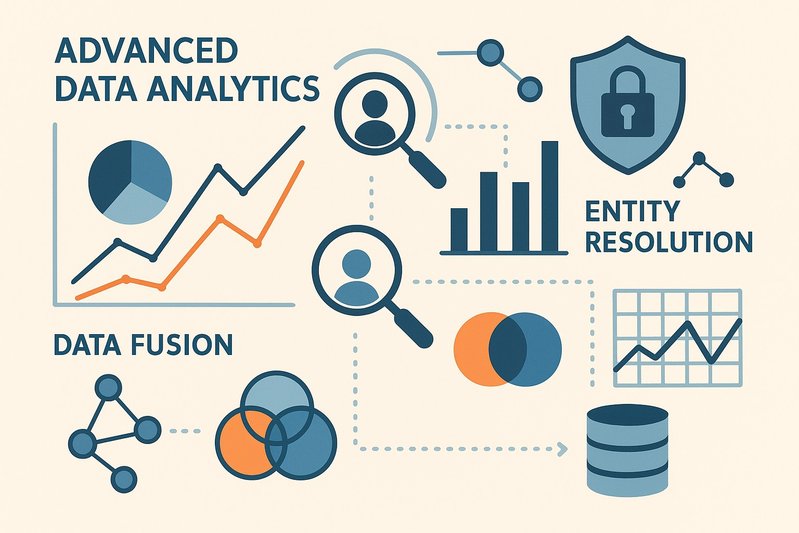
Gotham Graph Analytics and Object-Level Security Power ICE HSI’s Investigative Stack
Investigations today hinge on stitching together people, places, and events spread across dozens of systems, each with its own rules and risks. Inside Homeland Security Investigations (HSI), that challenge is met by a two‑tier architecture built on Palantir’s Gotham: FALCON Search & Analysis (FALCON‑SA) for data fusion and analytics, and Investigative Case Management (ICM) for evidentiary workflow and accountability. As federal AI governance standards tighten and location privacy jurisprudence evolves, these platforms provide a telling case study in how advanced analytics, object‑level security, and immutable auditability can support complex casework without automating the final call.
This technical deep dive explains how FALCON‑SA and ICM complement each other; how their data integration pipelines, configurable ontologies, and multi‑source entity resolution work; how graph and geospatial analytics power hypotheses; and how object‑level security, lineage, and auditing enable supervision and reproducibility. It also surfaces design tradeoffs—performance, freshness, and false linkages—and outlines implementation patterns for dashboards, workflows, cloud posture, and change management at scale.
Architecture/Implementation Details
A two‑tier system: analytics upstream, case management downstream
FALCON‑SA operates as HSI’s consolidated analytical environment: a governed workspace for searching, correlating, and analyzing multi‑source data to generate leads and develop hypotheses. ICM is the official case system of record, where agents organize investigations, track evidence and chain of custody, and embed analytical outputs as part of documented case files. The platforms are intentionally decoupled in decision authority. FALCON‑SA surfaces relationships, patterns, and geospatial context; ICM captures human judgments, supervisory sign‑off, and operational actions. This separation enforces the policy posture that analytics inform but do not automate adjudication or final determinations.
Data flows mirror this division of labor. FALCON‑SA ingests and correlates datasets from DHS components, interagency partners, and approved commercial and open‑source sources under formal agreements. Outputs—links, entities, timelines, and maps—are exported or referenced into ICM to support case narratives, evidence inventories, and investigative steps. Each system enforces role‑based access and policy constraints consistent with the governing records notices and interconnection agreements.
Data integration and configurable ontologies for heterogeneous sources
Ingestion pipelines accommodate structured law enforcement records, biometrics, travel and border data, communications and financial metadata, and other approved datasets. Social media and other online data are restricted by DHS‑wide policy that requires explicit approvals, training, and purpose limitation for operational use. Across sources, Gotham’s configurable ontology lets HSI administrators define and evolve the types of objects (people, organizations, vehicles, events, communications), their attributes, and permissible relationships. That abstraction aligns each dataset to a common graph without flattening away provenance.
Policy tags and object metadata bind governance to the data. As records enter, they inherit tags reflecting origin system rules, use limitations, retention constraints, and sensitivity. Those tags travel with objects and edges, enabling fine‑grained access control and downstream enforcement inside both FALCON‑SA and ICM. Critically, provenance fields expose original source identifiers and timestamps so analysts can inspect the lineage of a joined result and determine whether to corroborate or exclude it.
Entity resolution and deconfliction across multi‑source graphs
Entity resolution sits at the heart of FALCON‑SA’s value proposition. The platform correlates records that refer to the same real‑world subject across disparate systems, then flags potential conflicts for review. Because multi‑source matching can produce both false positives and false negatives, the operating model requires verification and corroboration—especially when commercial or aggregated data might be stale or inaccurate. Supervisory review and workflow checkpoints in ICM reinforce that safeguard before high‑impact actions.
Quantitative performance metrics—precision, recall, false match rates—are not publicly available for HSI’s deployments. Instead, controls focus on process integrity: provenance inspection, cross‑source corroboration, and supervisory sign‑off. That human‑in‑the‑loop approach is by design given the investigative context and the known risks of error and feedback loops when past outcomes shape future prioritization.
Graph and geospatial analytics: relationships, movements, hypotheses
Gotham’s graph model allows analysts to traverse people, organizations, financial flows, communications, vehicles, places, and events. Link analysis can reveal shared addresses, common identifiers, or sequential interactions that suggest a network or scheme. Geospatial tooling layers in maps, timelines, and movement patterns, enabling scenario building around routes, co‑locations, or proximity to critical events. License plate reader systems are governed by specific minimization, auditing, and retention policies; when appropriately authorized, such datasets help reconstruct vehicle movements and associations.
Legal boundaries shape geospatial practice. Sensitivity around historical location information—underscored by Supreme Court jurisprudence—reinforces the need for appropriate legal process, necessity, and minimization before accessing or operationalizing location‑linked analytics. FALCON‑SA’s provenance and tagging provide a technical backbone for enforcing those constraints in the analytics layer and for demonstrating compliance during later reviews.
Object‑level security and policy tags: from principle to enforcement
Gotham’s object‑level security enforces need‑to‑know at the most granular level: every object and edge can carry access policies tied to user roles, attributes, and source restrictions. That model is indispensable when combining DHS, interagency, and commercial records under varying authorities and routine uses. In FALCON‑SA, policy tags gate visibility into objects and specific fields; in ICM, they govern what can be attached to a case, who can view it, and what can be shared. Because tags encode provenance and purpose, they also serve as a machine‑enforceable representation of privacy and records rules.
Lineage, provenance, reproducibility, and evidence inspection
Lineage is not an afterthought; it is a first‑class feature. Analysts can drill from a fused view back to the original contributing records and transformations. That capability supports reproducibility—critical when a hypothesis becomes evidence—and allows supervisors and attorneys to validate the sufficiency and legality of the data trail. In ICM, preserved context, chain of custody, and linkage back to source systems help ensure that investigative steps can be reconstructed and defended.
Immutable audit logs and workflow instrumentation
Both FALCON‑SA and ICM rely on immutable audit logs to track access, queries, exports, and changes. These logs support internal oversight, investigations of potential misuse, and post hoc accountability. Workflow instrumentation captures key decision points—lead creation, verification steps, supervisory approvals—so that reviews can assess whether evidentiary standards and policy requirements were met. The combination of object‑level security, provenance, and immutable auditing creates a defensible control plane aligned with DHS privacy and accountability expectations.
Human‑in‑the‑loop by design: leads, verification, and decisions
Across the stack, outputs are framed as investigative leads or hypotheses, not determinations. Dashboards and queries surface patterns based on investigator‑defined criteria and policy guidance; agents are expected to corroborate with underlying records and document their reasoning in ICM. Supervisors review and approve high‑impact steps, reinforcing the principle that technology assists but does not replace human judgment. This pattern pervades entity resolution, link analysis, and prioritization workflows.
Performance considerations: scale, freshness, and false linkages
At scale, two dynamics dominate: data freshness and linkage quality. Freshness matters because stale records in commercial or aggregated sources can propagate errors; policy and practice therefore stress validation against authoritative systems where possible. False linkages arise when partial identifiers, shared addresses, or common devices conflate distinct individuals or entities. Mitigations include conservative matching thresholds, multi‑factor corroboration, and explicit verification stages before operational use. Specific system benchmarks are not publicly available; instead, emphasis falls on testing, evaluation, and monitoring requirements now mandated across federal AI uses when applicable.
Feedback loops represent a subtle risk: prioritization tuned to past enforcement may amplify historical patterns rather than real‑time risk. Governance now requires agencies to inventory such analytics, assess impacts, and monitor for discriminatory effects where they meet the policy definition of AI. For HSI’s configurations, that translates into documenting the logic of dashboards and business rules, tracking changes, and measuring outcomes where feasible.
Dashboards, business rules, and prioritization without automated adjudication
Analysts assemble dashboards that filter and rank entities or events based on investigator‑defined criteria, policy directives, and mission needs. These are not risk scores that directly trigger actions; rather, they order the investigative queue and spotlight where corroboration may be warranted. Clear labeling, links to provenance, and one‑click drill‑through to source records reduce overreliance on abstract rankings and help preserve explainability.
Cloud posture and deployment: continuity and monitoring
HSI’s Palantir deployments run on a FedRAMP‑authorized cloud service that implements NIST control baselines and continuous monitoring. Within DHS risk management, the systems obtain authorities to operate, integrate with agency incident response, and undergo ongoing assessment. Immutable logs, fine‑grained permissions, and encryption provide defense‑in‑depth; operationally, strong release controls and quality assurance remain essential in a high‑volume environment where a single misconfiguration can expose sensitive data. Publicly reported system‑specific breach details are sparse, but the broader lesson across DHS systems is clear: guardrails must extend from platform controls to process rigor.
Technical debt and change management for analytics at scale
In a configurable platform, ontologies, match rules, and dashboard logic evolve. Without disciplined change management, that flexibility becomes debt. Best practice in this context includes: versioning ontologies; maintaining configuration change logs; documenting business‑rule rationales; and aligning updates to testing, evaluation, and monitoring plans. The emerging federal regime for governing agency AI makes these expectations more explicit, calling for inventories, impact assessments, and ongoing performance monitoring for safety‑impacting uses—standards that map well onto link analysis and prioritization configurations.
Comparison Tables
FALCON‑SA vs. ICM: roles, controls, and outputs
| Dimension | FALCON‑SA | ICM |
|---|---|---|
| Primary role | Consolidated search, correlation, and analysis | Official investigative case management |
| Core objects | Multi‑source graph: people, orgs, vehicles, events, communications | Cases, evidence records, chain of custody, tasks |
| Decision locus | Lead generation and hypotheses | Human decisions, approvals, and operational documentation |
| Governance focus | Data fusion with provenance, policy tags, and object‑level security | Evidentiary integrity, supervisory review, recordkeeping |
| Outputs | Leads, link charts, timelines, maps | Case files, evidence inventories, approvals, audit trails |
| Access control | Fine‑grained, policy‑tagged object security | Role‑based case and record access with policy enforcement |
| Auditability | Immutable query and access logs | Immutable workflow, action, and access logs |
Analytics capabilities, risks, and guardrails
| Capability | Typical risks | Guardrails embedded in the stack |
|---|---|---|
| Entity resolution | False matches; identity conflation | Provenance inspection, multi‑source corroboration, supervisory review |
| Link analysis | Spurious associations; proxy variables | Policy‑bound data use; drill‑through to source; human validation |
| Geospatial analysis | Location privacy; overbroad collection | Legal process, minimization, retention limits, provenance tagging |
| Prioritization dashboards | Feedback loops; overreliance | Human‑in‑the‑loop; transparent criteria; no automated adjudication |
| Data ingestion | Staleness; inconsistent quality | Source‑aligned SORNs/agreements; data minimization; role‑based access |
Best Practices
Implementing Palantir‑enabled investigations at scale demands a disciplined fusion of platform controls and procedural guardrails. The following practices align technical capabilities with policy expectations and investigative realities:
- Start with governance in the ontology. Encode source system rules, routine uses, and retention constraints as policy tags and object metadata from the moment of ingestion. This ensures need‑to‑know is enforced at the edge of every query and export.
- Apply data minimization and purpose limitation. Only ingest datasets necessary for defined investigative purposes; restrict social media and other open‑source content to approved, trained users operating under explicit scopes.
- Make provenance your default view. Design dashboards with drill‑through to underlying records a single click away. Require corroboration from authoritative systems when commercial or aggregated data are used.
- Institutionalize deconfliction. Use structured workflows for resolving identity conflicts and overlaps across cases, with documented rationale and supervisory approvals captured in ICM.
- Keep humans in the loop—and keep it visible. Label dashboards as leads, not determinations. Require evidentiary verification before operational actions, with audit‑ready justifications.
- Monitor for performance and bias, even when metrics are hard. Where analytics meet the policy definition of AI, implement testing, evaluation, and monitoring plans, track changes to configuration, and regularly review outcomes for disparate impact.
- Treat geospatial data as sensitive by default. Apply legal process and minimization rigorously; retain only what is necessary and documented.
- Leverage immutable audit logs proactively. Instrument workflows so supervisors can trace decisions, approvals, and data access. Use logs for both deterrence and after‑action learning.
- Align cloud posture with continuous risk management. Maintain up‑to‑date authorities to operate, integrate with incident response, and stress‑test release controls and data handling workflows.
- Manage configuration change like code. Version ontologies and business rules, maintain change logs tied to oversight reviews, and coordinate updates with TEV/M activities. 🧭
Conclusion
HSI’s Palantir‑enabled stack shows how modern investigations can harness data fusion, graph reasoning, and geospatial context without surrendering decisions to automation. FALCON‑SA and ICM divide responsibilities cleanly: analytics upstream, evidentiary workflow downstream, with object‑level security, provenance, and immutable auditability binding them together. The architecture aligns with privacy and accountability principles through policy tags, role‑based access, and comprehensive logging, while human‑in‑the‑loop practices and supervisory review anchor operational judgment. What remains is the hard work of measuring performance and fairness, sustaining freshness and linkage quality at scale, and operationalizing rigorous change management under evolving federal AI governance.
Key takeaways:
- Two‑tier design keeps analytics and adjudication separate, preserving human decision‑making and evidentiary integrity.
- Configurable ontologies, policy tags, and object‑level security enforce granular, source‑aligned governance in a multi‑source graph.
- Provenance, lineage, and immutable audit logs make analytics explainable, reproducible, and reviewable.
- Prioritization dashboards guide workloads without automating determinations; verification and supervision close the loop.
- Continuous monitoring, TEV/M, and disciplined configuration management are essential to control performance, bias, and drift.
Actionable next steps for practitioners:
- Map each dataset to necessity‑justified uses and encode controls as policy tags at ingestion.
- Establish deconfliction and verification playbooks with documented supervisory checkpoints in ICM.
- Stand up testing and monitoring plans for analytics that influence prioritization; maintain configuration change logs.
- Strengthen cloud and release controls with targeted red‑team exercises and regular audit log reviews.
Looking ahead, the convergence of graph analytics, object‑level security, and federal AI governance offers a blueprint for investigative systems that are both powerful and accountable. The next frontier will be turning process‑focused safeguards into measurable, monitored performance and fairness outcomes—without compromising the human judgment at the heart of complex casework.