Exploited iOS and Android Zero‑Days Expose WebView Sessions and App Sandboxes
A technical dissection of early‑2026 exploit chains—from WebKit renderer bugs to kernel escapes—and the architectural defenses that blunt token theft and cross‑app data exfiltration
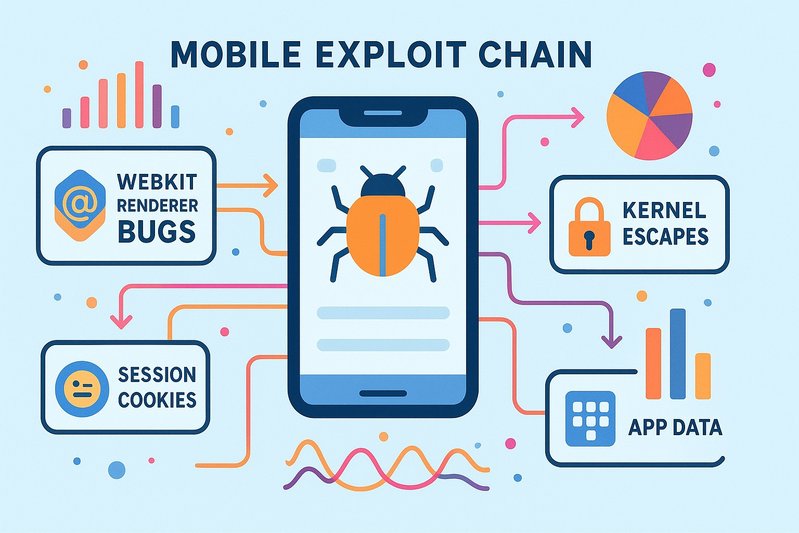
In early 2026, multiple iOS and Android advisories arrived with a familiar but unsettling refrain: critical vulnerabilities in WebKit, OS frameworks, and kernel or vendor drivers, some marked as “may have been actively exploited” and quickly added to the CISA Known Exploited Vulnerabilities catalog. For mobile apps that authenticate users inside WebViews or deeply integrate with native frameworks, these platform‑level zero‑days are not abstract OS problems—they are direct pathways to session cookies, refresh tokens, and private app data. The modern exploit chain is also iterative: a renderer compromise triggers code execution, a sandbox escape unlocks broader file and sensor access, and a privilege escalation to system or kernel tears down the walls between app sandboxes.
This article traces how today’s exploit chains move from content parsing bugs to device‑wide access and explains why WebView‑centric workflows are high‑value targets for token theft and account takeover. It then turns to defense: the architectural decisions—short‑lived tokens, narrow scopes, attestation‑backed binding, and server‑side re‑checks—that reduce the payoff of stolen credentials while OS engines are still unpatched. Readers will learn the exploiter’s path, the realistic exposure window created by patch fragmentation, and a practical playbook for containment, observability, and incident response that preserves privacy without crushing UX.
Architecture/Implementation Details
Threat model and why platform zero‑days matter for authenticated apps
Modern mobile apps present two lucrative surfaces to attackers:
- Reachable content engines inside the app process, most commonly WebKit‑backed WebViews on iOS and Chromium‑based WebViews on Android.
- OS frameworks and drivers that govern permissions, IPC, and access to high‑value sensors and data.
When Apple signals a WebKit or kernel bug as potentially exploited, or when an Android framework/driver issue is triaged as critical with evidence of in‑the‑wild use, the impact for authenticated apps is immediate. A renderer flaw reachable via a WebView can hand an attacker code execution inside the app’s process. Chained with a sandbox escape or privilege escalation, that foothold spills into the broader device: reading the app’s cookie jar and local web storage, scraping OAuth/session tokens from memory or disk, and, at higher privileges, traversing other apps’ sandboxes and touching cameras, microphones, precise location, photos, and contacts without user consent.
Critically, none of this requires a user to install a malicious app. Routine content rendering—an embedded checkout page, a support site, a social timeline—can be enough to trigger a WebKit bug. That is why advisories specifically mentioning WebKit, OS sandbox escapes, or kernel/vendor drivers land at the top of every mobile security team’s queue.
Exploit chain anatomy: renderer compromise, sandbox escape, privilege escalation
Attackers typically assemble three stages:
- Renderer compromise
- Entry point: Untrusted content parsed by the in‑app WebView (e.g., HTML, JavaScript, images, or other media). WebKit bugs like use‑after‑free or type confusion are recurrent examples.
- Effect: Code execution in the renderer context, which, in many apps, equates to code running inside the app process.
- Sandbox escape
- Entry point: A flaw in the OS sandbox or IPC mechanisms, or a vulnerable framework service.
- Effect: Breaks out of the app’s containment, allowing process injection, broader filesystem access, or the ability to interface with system services that would otherwise be restricted.
- Privilege escalation (PE)
- Entry point: Kernel bugs or vendor driver vulnerabilities (GPU, camera, Wi‑Fi/modem) on Android; kernel/sandbox escapes on iOS.
- Effect: Elevated privileges, sometimes reaching kernel. At this point, permissions and sandbox boundaries erode; cross‑app data access and sensor activation become possible depending on the bug class.
These stages are modular. A single zero‑day might combine steps two and three; conversely, a renderer bug might be paired with a publicly known but unpatched driver issue on certain Android OEM builds. The net result is the same: confidential session material and private user data become readable and exfiltrable without visible prompts.
Data exfiltration paths once elevated
Once an attacker gains sufficient privileges, the extraction paths are depressingly straightforward:
- WebView stores: Cookie jars and local web storage tied to authenticated sessions.
- App secrets: Access tokens and refresh tokens held in process memory, preferences, databases, or cache files.
- App sandboxes: Files across the compromised app; at higher privileges, browsing other apps’ sandboxes or shared storage on Android.
- Sensors and PII: Precise location histories, photos/media libraries, contacts, and, in some cases, live camera/microphone streams via policy bypasses.
Specific metrics about relative prevalence are unavailable, but the data types at risk are clear and consistent. Session materials are especially sensitive because they provide remote, replayable access to user accounts even after the device is back under the user’s control.
Why WebView‑centric workflows are high value
Apps offload critical workflows—login, payments, settings, support—to WebView because it enables rapid iteration and reuse of web surfaces. Those same workflows centralize the crown jewels: cookie‑based sessions and tokens scoped broadly enough to keep users logged in across mobile and web. A renderer‑to‑sandbox chain extracts these assets directly, bypassing app‑level defenses and user friction. Because tokens can be replayed from an attacker’s infrastructure, account takeover persists long after the device is patched unless the service rotates or invalidates those sessions.
Session token theft and replay mechanics
The mechanics are simple and devastating:
- Theft: Read cookies and local web storage from the WebView context; dump access/refresh tokens from app memory or disk.
- Replay: Present stolen cookies or tokens to the web or mobile API from a different device or VM. If the backend accepts them without additional binding checks, the attacker gains full account access.
- Persistence: Maintain access by holding refresh tokens or long‑lived session cookies. Without binding or re‑verification, attackers can renew sessions indefinitely.
Binding tokens to the device/app—as opposed to treating them as bearer tokens—shrinks the replay window. When the server expects device‑tied presentation (attestation, key proof, or known device posture), tokens stolen from a compromised device become harder to reuse elsewhere.
Comparison Tables
iOS vs. Android exploit stages and surfaces
| Chain stage | iOS/iPadOS primary surfaces | Android primary surfaces | Resulting capability |
|---|---|---|---|
| Renderer compromise | WebKit content processing in WebViews | Chromium‑based WebView, media codecs in app context | App‑process code execution; access to in‑app storage and memory |
| Sandbox escape | OS sandbox/sandboxd flaws, IPC mishandling | Framework IPC (e.g., Binder), permission bypasses | Filesystem and service access beyond the app boundary |
| Privilege escalation | Kernel/sandbox escape bugs | Kernel or vendor drivers (GPU, camera, Wi‑Fi/modem) | System‑level privileges; cross‑app data and sensors |
Data targets vs. access level
| Data target | Access needed | Typical path once compromised |
|---|---|---|
| WebView cookies/local storage | App process | Read WebView stores; scrape session materials |
| Access/refresh tokens | App process or sandbox escape | Dump process memory, preferences, or DB; harvest refresh tokens |
| Other app sandboxes | Elevated/system | Traverse sandboxes (bug‑dependent); read cached content |
| Photos/media/contacts/location | Elevated/system | Call frameworks or read stores; policy bypasses vary by bug |
Mitigation controls and limitations
| Control | Mitigates | Where it lives | Limitations |
|---|---|---|---|
| Short‑lived tokens and narrow scopes | Token replay window, blast radius | Server and auth layer | Requires robust refresh flows and rate‑limited re‑auth |
| Token binding with device/app attestation | Off‑device replay | Server; device attestation service | Must handle device variance and offline cases |
| Hardware‑backed Keystore/Keychain storage | At‑rest theft of tokens/secrets | App and OS secure hardware | Not a shield against live app‑process compromise |
| Server‑side re‑checks and action gating | Abuse of stolen sessions for sensitive actions | Server; risk engine | Adds friction; tuned to minimize false positives |
| Feature flags/killswitches for WebView flows | Exposure during zero‑day window | App and backend controls | Requires pre‑built toggles and rapid comms |
| Emergency token rotation/invalidation | Persisted ATO via refresh tokens | Auth/session management | Disruptive; needs staged rollout and comms |
Best Practices
App‑layer containment that assumes the OS may be temporarily untrustworthy
When a platform advisory flags an exploited WebKit, framework, or kernel bug, assume the worst: an attacker can get code into the app process and, potentially, escalate. The following measures blunt the payoff:
-
Short lifetimes and least privilege
-
Make access tokens short‑lived and scope them narrowly. Sensitive API calls (money movement, password change, PII export) should require fresh proof of possession and server‑side policy checks beyond the presence of a bearer token.
-
Rotate session cookies more aggressively while WebView engines are unpatched to reduce the value of stolen material.
-
Bind tokens to device/app
-
Couple tokens with device/app attestation so they cannot be trivially replayed from a different environment. Treat attestation failures as high risk; require step‑up verification or block.
-
Consider proof‑of‑possession approaches where supported to raise the bar for off‑device reuse.
-
Harden storage—but don’t rely on it alone
-
Store secrets (refresh tokens, keys) in hardware‑backed Keystore/Keychain. Encrypt sensitive data at rest and avoid writing tokens to SharedPreferences/UserDefaults or SQLite without strong protection.
-
Never log tokens or PII. Remove verbose logging paths and redact analytics.
-
Gate high‑risk workflows during exposure windows
-
Use server‑controlled flags to require additional verification for sensitive actions rendered in WebViews until engines are patched. For example, require re‑authentication or out‑of‑band verification for account changes, payment setup, or data export.
-
Prepare to degrade features safely
-
Include jailbreak/root checks and degrade nonessential features when device posture is risky. Avoid blocking critical user access unless necessary; prefer reducing attack surface (e.g., disable embedded browsing for sensitive flows) while a zero‑day is outstanding.
🛡️ The goal is not to perfectly prevent compromise during the window—it’s to make stolen material less reusable and to constrain what an attacker can do with it.
Incident response to an “exploited” advisory
When Apple or Android releases a patch with indications of in‑the‑wild exploitation—or when a CVE lands on CISA’s KEV—time matters:
-
Emergency token rotation
-
Invalidate or shorten the lifetime of existing sessions and refresh tokens. Prioritize accounts active on affected OS versions; stage the rollout to balance security with user disruption.
-
WebView feature flags and killswitches
-
Disable or harden high‑risk WebView flows server‑side. Redirect sensitive actions to native surfaces with additional server checks where feasible until engines are patched and adoption is sufficient.
-
Risk‑based authentication prompts
-
Increase step‑up prompts for sensitive actions and for sessions originating from new devices or atypical networks. Don’t blanket‑prompt every user; tune for risk signals.
-
Communications and compliance
-
Notify users to update OS versions and apps promptly. If personal data confidentiality is likely compromised, follow applicable breach‑notification requirements. Specific jurisdictional thresholds and timelines depend on the user base; align with legal counsel and established runbooks.
Observability for compromise
Detection relies on a blend of behavior and posture:
-
Anomalous session reuse
-
Same token or cookie presented from multiple devices or geographies in short intervals. Look for impossible travel and geovelocity spikes.
-
Device posture and attestation drift
-
Tokens tied to one device suddenly appear without expected attestation signals. Treat attestation failures during an exposure window as high‑priority alerts.
-
Sensitive action monitoring
-
Spikes in account‑change attempts, data exports, or payment setup from sessions created on affected OS versions. Gate and review.
-
External signal tracking
-
Track Apple security updates and Android Security Bulletins weekly. Cross‑reference with KEV entries and consider exploitation‑likelihood signals to prioritize response. Align engineering SLAs with the most urgent advisories.
Exposure window dynamics and patch adoption realities
Patching closes vulnerabilities, but exposure persists until users update. iOS adoption is relatively fast but not uniform across devices and regions. Android carries additional fragmentation risks: OEM and carrier rollouts vary by model and device age, leaving some cohorts unpatched for weeks or longer. Apps with large global audiences should expect staggered remediation and plan controls that remain in place through the tail of adoption. That can include extended token shortening, stricter action gating, and elevated monitoring for devices known to be lagging on security updates.
Performance and UX trade‑offs
Security controls that neutralize stolen tokens can stress mobile UX:
-
Frequent refresh vs. flaky networks
-
Short token TTLs increase refresh traffic and can fail under poor connectivity. Cache encrypted, hardware‑protected refresh tokens and implement resilient retry with backoff to avoid lockouts.
-
Background limitations
-
Mobile platforms restrict background execution, which limits proactive refresh. Design flows to renew on foreground and to fail gracefully, with clear prompts rather than silent errors.
-
Step‑up prompts and friction
-
Over‑prompting drives abandonment. Use risk engines to trigger step‑up only when signals warrant, and consider graduated challenges (e.g., biometric on device, then out‑of‑band confirmation for the most sensitive actions).
-
Feature gating side effects
-
Disabling WebView‑based flows can block legitimate users. Prefer nuanced gating (extra verification, scoped restrictions) over blanket shutdowns, and communicate clearly inside the app.
The right balance keeps daily usage smooth while shrinking the window of opportunity for attackers to convert stolen session materials into durable account control.
Conclusion
Platform‑level zero‑days in WebKit, OS frameworks, and kernels are the fastest routes from untrusted content to private data on mobile devices. Exploitation in the wild turns everyday WebView sessions into conduits for cookie and token theft, while sandbox escapes and privilege escalations widen access to app sandboxes, media, contacts, and precise location. Because patch adoption is staggered—especially across diverse Android fleets—exposure windows can span weeks. The most effective defense is architectural: constrain token usefulness, bind sessions to the device/app, and gate the riskiest actions while engines are unpatched. Paired with rapid incident response, observability tuned to session anomalies and device posture, and clear user communications, these measures blunt the impact of even well‑chained zero‑days.
Key takeaways:
- WebView renderer bugs chained with sandbox escapes enable direct theft of cookies and tokens powering persistent account takeover.
- Short‑lived, narrowly scoped tokens and device/app binding reduce the replay value of stolen session material.
- Feature flags and server‑side gating let teams harden or pause sensitive WebView flows during active exposure windows.
- Observability should center on anomalous session reuse, geovelocity, and attestation drift tied to affected OS versions.
- UX‑aware implementation—resilient refresh, targeted step‑up, and nuanced gating—delivers security without derailing daily use.
Next steps:
- Audit token lifetimes and scopes; implement device/app binding where absent.
- Build and test WebView feature flags and killswitches for sensitive workflows.
- Tighten storage boundaries: move secrets to hardware‑backed stores and purge sensitive logging.
- Establish advisories monitoring, KEV tracking, and a playbook for emergency rotation and action gating.
Looking ahead, platform vendors will continue to harden WebKit, frameworks, and drivers—but memory‑safety regressions and complex IPC surfaces guarantee more break‑fix cycles. Teams that assume periodic zero‑day exposure and engineer for containment will keep user data safer, even when the platform momentarily fails them.