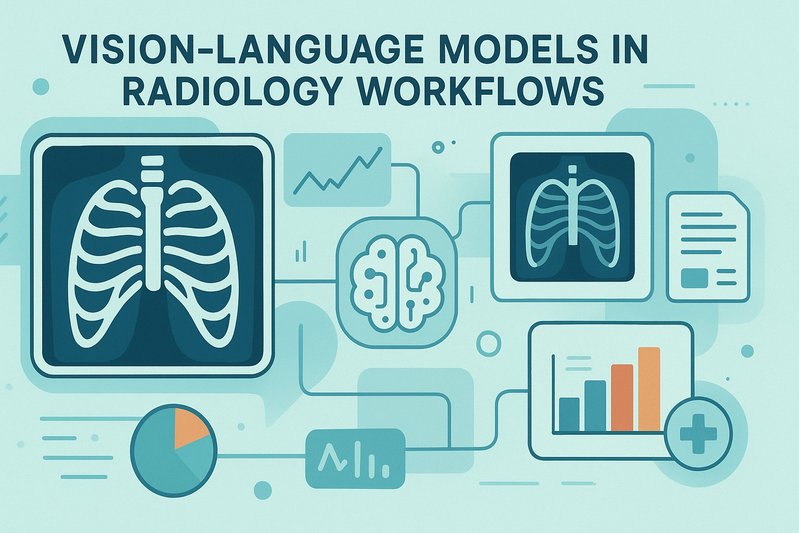
Vision–Language Report Generators Enter Radiology Workflows
BLIP‑2 and LLaVA‑Med deliver grounded drafts with measurable factuality, moving hospitals toward safer, faster reporting
Radiology is crossing a threshold: vision–language models (VLMs) can now draft chest X‑ray reports that are measurably more factual and better grounded in the image than earlier systems. These models, led by BLIP‑2‑style decoders and LLaVA‑Med, pair strong medical image encoders with language models to turn scans into first‑pass reports that radiologists can verify and finalize. The timing matters. Hospitals face mounting imaging volumes, tightening staffing, and rising expectations on safety and documentation. Improving throughput without compromising clinical quality is a business imperative, not a research curiosity.
This article explains why the shift from classical encoder–decoder architectures to VLM decoders changes the clinical value equation, how operations leaders can model ROI and risk, and what safety instrumentation and integrations are required for deployment. It also lays out a practical blueprint for procurement: the regulatory stance to demand, the data governance to insist on, the RFP criteria for 2026, and the outcome metrics to track. The central takeaway: VLM‑based report generation is ready to function as a drafting and second‑reader assistant when instrumented with factuality metrics, selective prediction, and abstention policies, and when integrated into DICOM‑aware, PHI‑safe pipelines.
From encoder–decoder to VLM decoders: what changed for clinical value
The biggest shift is architectural and it directly impacts enterprise value. Traditional encoder–decoder systems for report generation (e.g., R2Gen) encode the image and autoregressively decode text. VLM decoders like BLIP‑2 and instruction‑tuned variants such as LLaVA‑Med connect a strong medical image encoder to a language model via a lightweight bridge, enabling better image–text grounding and factuality. Two properties stand out for hospital adoption:
-
Higher factuality and grounding: VLM decoders improve clinical correctness when evaluated with radiology‑specific metrics. CheXbert F1 assesses whether generated text captures key chest X‑ray observations, and RadGraph F1 measures entity–relation correctness and phrase‑to‑finding grounding. VLM decoders score better on these measures than encoder–decoder baselines, narrowing the gap between a machine draft and a safe, verifiable radiologist report.
-
Inspectable rationales: Cross‑attention maps can link phrases like “right pleural effusion” to specific regions, offering a form of explainability that supports radiologist verification and audit. This phrase‑region linking makes model behavior legible in clinical review and strengthens documentation for quality and compliance.
Autoregressive decoding remains the method of choice for generating text. Deterministic beam search with length normalization yields concise drafts, while stochastic top‑p sampling increases diversity at the cost of factuality. Hospitals can bias toward safety by favoring beam search or employing lexicon constraints for safety‑critical sections, then confining variability to impression‑level phrasing where appropriate.
For executives, the implications are practical: grounded drafts shorten read‑prep, and measurable factuality enables performance baselining and continuous quality monitoring—two prerequisites for responsible adoption.
Operational ROI: draft speed, throughput, and second‑reader augmentation
Administrators want to know if these systems shorten turnaround times and increase radiologist throughput. Exact speedups vary by site; specific metrics unavailable. But several operational levers are clear:
-
Latency drivers and levers: Autoregressive decoders scale with token length. Efficient attention, caching of image features, quantization, and batch inference reduce latency at inference time. These are tunable deployment choices that translate directly into cost and throughput.
-
Draft‑first workflows: A grounded first draft reduces dictation time and cognitive load, particularly for common patterns (normal studies, single‑finding studies). Even when a radiologist rewrites a section, the draft serves as a scaffold, accelerating structured content like “comparison,” “technique,” and templated “findings.”
-
Second‑reader augmentation: Selective prediction with abstention allows the system to draft high‑confidence sections while flagging uncertain or out‑of‑distribution (OOD) cases for full human authorship. Coverage–risk reporting quantifies the trade‑off between automation rate and expected error, letting operations leaders tune policies to workload and risk appetite.
-
Balanced resourcing: By absorbing routine drafting and serving as a consistent second reader, VLMs can free subspecialists to focus on complex studies and emergent cases. This is an operational hedge in staffing‑constrained environments without over‑automating clinical judgment.
Financial modeling should treat VLM reporting as a throughput multiplier with safety guardrails: cost per study is governed by token length, batch size, and hardware efficiency; benefit accrues from time saved per report and reduced addenda from overlooked findings (specific hospital‑level metrics unavailable). A pragmatic approach is to pilot on normal and single‑finding CXRs with conservative abstention, monitor coverage–risk curves, and gradually expand coverage as calibration improves.
Safety instrumentation: factuality KPIs and audit trails
No draft enters a clinical workflow without instrumentation that surfaces clinical quality in real time and at audit.
-
Factuality KPIs: Track CheXbert F1 across 13–14 clinical observations and RadGraph F1 for entity–relation fidelity and grounding. Pair with BERTScore for lexical similarity to ensure fluency does not mask factual drift. These KPIs should be computed on rolling samples and across subgroups.
-
Calibration and reliability: Monitor expected calibration error and Brier score. Apply temperature scaling post‑hoc to improve probability calibration. Pair reliability diagrams with selective prediction coverage–risk curves to manage where the system drafts and where it abstains.
-
OOD detection and drift: Use energy‑based scores, ODIN temperature/perturbation, and Mahalanobis distances in encoder feature space to flag near‑ and far‑OOD cases. Trigger abstention and human‑in‑the‑loop review when OOD signals exceed thresholds.
-
Explainability and grounding: Surface cross‑attention heatmaps for phrase‑region alignment in the drafting UI. Where bounding boxes or masks exist, evaluate grounding quantitatively; otherwise, collect qualitative feedback from radiologists as part of continuous monitoring.
-
Audit trails and model cards: Maintain immutable logs of inputs, outputs, model versions, decoding parameters, and calibration settings. Publish model cards that document data provenance, pretraining, training recipes, evaluation metrics (including subgroup and OOD), and known limitations. These artifacts anchor internal safety reviews and external regulatory dialogue.
Together, these controls convert a generative model into a clinically instrumented assistant with measurable, traceable performance.
Integration blueprint: PACS/RIS/EHR, DICOM‑aware ingestion, PHI safeguards
Deploying VLM‑based reporting is a systems integration task as much as a modeling task.
-
DICOM‑aware ingestion: Standardize CXR DICOM to a linearized intensity range; remove burned‑in text; normalize orientation; record acquisition metadata (AP vs PA, lateral, portable, unit). These covariates should flow into the model and the audit layer for both performance and drift monitoring.
-
Imaging systems: Integrate with PACS for image retrieval and annotation overlays (e.g., attention heatmaps). Drafts should round‑trip to RIS dictation systems with clear labeling as AI‑assisted content and easy acceptance/editing.
-
EHR connectivity: Use HL7/FHIR to pull prior reports and push finalized notes. Prior studies and comparisons are central to radiology prose; the drafting system must present and condition on comparison context within safe limits.
-
PHI and security: Enforce PHI minimization and strict data handling—ensure models do not train on PHI without IRB and governance, and ensure inference logs redact or tokenize identifiers. Keep inference on‑prem or in a dedicated VPC with strict access controls as per institutional policy (specific deployment modes vary by site; details not enumerated here).
-
Observability: Expose dashboards for factuality KPIs, coverage–risk, OOD rates, subgroup metrics, and abstention reasons. Observability tightens the feedback loop between clinical operations and model governance.
The architectural goal is a closed loop: DICOM‑aware ingestion and preprocessing, VLM drafting with safety constraints, clinician‑in‑the‑loop verification, EHR integration, and continuous monitoring with auditability.
Regulatory readiness: intended use, locked models, change control, post‑market monitoring
Regulatory posture in 2026 favors disciplined deployment with explicit governance.
-
Intended use and indications: Document the device’s intended use as a report drafting and second‑reader assistant for chest radiography, emphasizing clinician oversight and abstention behavior.
-
Locked models at launch: Deploy a “locked” initial model with fixed parameters, tokenizer, decoding settings, and calibration. Any change requires pre‑defined change control.
-
Change control and lifecycle: Establish a change management plan that specifies when calibration updates, decoding parameter adjustments, or retraining trigger revalidation versus regulatory notification. Log every change with versioning.
-
Post‑market monitoring: Operate a continuous monitoring program that tracks factuality KPIs, calibration, OOD rates, subgroup fairness, and abstention coverage, with documented triggers for corrective action.
-
Good Machine Learning Practice: Align processes to widely recognized principles—data management, model design, performance evaluation, and deployment monitoring should be well documented and auditable.
This governance stance protects patients, clinicians, and institutions while enabling incremental improvement.
Cost modeling: compute, scaling with token length, and inference batching
VLM economics are driven by tokens and throughput.
-
Token‑length scaling: Autoregressive text generation scales linearly with token count. Reports with longer sections and comparisons cost more compute; careful prompt/draft design and section‑level constraints can bound length without compromising content.
-
Batch inference and caching: Batch similar studies to amortize compute across tokens. Cache image features from the vision encoder and reuse across drafting variants or when regenerating sections, reducing latency and cost.
-
Quantization and efficient attention: Apply quantization to language model weights and use efficient attention to lower memory and speed up generation, particularly beneficial under peak loads.
-
Hardware planning: Capacity planning should tie studies per hour to tokens per second at target latency with safety buffers for OOD spikes and abstentions (specific pricing figures unavailable). Track utilization and queue wait times to maintain clinician‑acceptable SLAs.
These levers allow CFOs and CIOs to predict cost per draft, optimize hardware allocations, and maintain predictable service levels.
Adoption risks and mitigations: hallucinations, coverage–risk, and abstention policies
Generative systems carry specific risks that must be addressed up front.
-
Hallucinations: Generators can produce plausible but incorrect statements. Mitigations include conservative decoding (beam search with length normalization), lexicon or template constraints for safety‑critical sections, and auxiliary factuality objectives during training. Real‑time scoring with CheXbert and RadGraph can flag suspect drafts for mandatory human rewrite.
-
Coverage–risk management: Not every study should be drafted. Use selective prediction to confine automation to high‑confidence cases, with clear abstention policies that route uncertain or OOD studies to full human authorship. Publish coverage–risk curves to clinicians and leadership to build trust.
-
OOD and drift: Acquisition shifts (AP vs PA, portable vs fixed) and population shifts can degrade performance. Monitor covariates and OOD signals, and tune thresholds or retrain under change control.
-
Fairness and hidden stratification: Performance can vary across sex, age, race (where available), and acquisition factors. Conduct subgroup audits and address gaps via targeted data collection or training strategies. Early stopping and model selection should account for subgroup performance, not just overall metrics.
These controls move risk from implicit to explicit, enabling thoughtful policy and governance.
Data governance: provenance, model cards, and external validation requirements
Hospitals should demand robust data governance and independent evidence before deployment.
-
Provenance and documentation: Vendors must document data sources, preprocessing (including DICOM normalization and PHI handling), and pretraining strategies. Model cards should detail training recipes, evaluation metrics, subgroup analyses, OOD results, and limitations.
-
External validation: Require institution‑held‑out testing and external validation across public benchmarks and, where feasible, across hospital systems. Design splits to reflect real‑world generalization (e.g., train on one corpus, test on another). Use 95% bootstrap confidence intervals with paired tests; correct for multiple comparisons across labels.
-
Reliability first: Insist on calibration metrics (ECE, Brier), selective prediction coverage–risk curves, and abstention behavior documented alongside headline fluency/factuality metrics.
-
Explainability: Expect phrase‑region grounding evidence and a plan to surface interpretability artifacts in clinical tools.
This governance raises the bar for procurement and sets a standard for market maturity.
Vendor selection and RFP criteria for 2026
RFPs should translate governance expectations into concrete requirements:
-
Clinical performance: Report CheXbert F1, RadGraph F1, and BERTScore on public and institution‑held‑out data; provide subgroup and OOD evaluations; share decoding settings used.
-
Safety and reliability: Provide calibration metrics and temperature scaling results; coverage–risk curves with abstention policies; OOD detection methods and thresholds; audit logging design.
-
Explainability and UX: Demonstrate phrase‑region grounding in the drafting interface and provide APIs for overlays in PACS.
-
Integration: Detail DICOM‑aware preprocessing, PACS/RIS/EHR interfaces (HL7/FHIR), and PHI safeguards. Provide deployment options and security architecture.
-
Lifecycle and compliance: Supply model cards, change control plan, post‑market monitoring commitments, and alignment to good machine learning practices.
-
Cost and capacity: Provide capacity planning guidance—tokens per second, latency distributions under batching, and the effects of quantization—with clear SLOs (exact pricing varies; figures not included here).
Such criteria give buyers a structured way to compare offerings beyond demos and web copy.
Outcome tracking: clinical KPIs and medico‑legal metrics
Once deployed, hospitals need to track outcomes beyond model‑centric scores.
-
Clinical KPIs: Measure factuality and grounding via CheXbert and RadGraph; track calibration (ECE/Brier) and coverage–risk as leading indicators of safe automation. Turnaround time, addenda rates, and discrepancy rates are natural operational metrics, though specific benchmark values are unavailable here and should be set relative to each site’s baseline.
-
Safety and equity: Monitor OOD rates and subgroup performance deltas across sex, age, race (where available), and acquisition factors. Establish triggers for intervention when gaps widen.
-
Medico‑legal posture: Maintain complete audit trails of drafts, edits, and model versions. Track incident reports related to AI‑assisted notes and correlate with calibration and abstention logs. Specific legal incidence rates are unavailable, but proactive logging is essential for defensibility.
-
Continuous improvement: Feed monitored metrics into change control, prioritizing calibration updates or targeted data collection over full retrains, to minimize regulatory overhead while improving safety.
Outcome tracking turns a pilot into a managed service with known performance envelopes.
Conclusion
Vision–language report generators have crossed into operationally relevant territory for chest radiography. The combination of grounded drafts, measurable factuality, and selective deployment lets hospitals pursue throughput gains without compromising safety. The key is to treat VLM drafting not as an end in itself but as a governed capability: DICOM‑aware integration, calibration and OOD monitoring, abstention policies, and robust documentation are the differentiators that matter in a radiology department.
Key takeaways:
- VLM decoders such as BLIP‑2 and LLaVA‑Med deliver more factual, grounded drafts than prior encoder–decoders, enabling measurable quality control.
- Operational ROI hinges on token‑length economics and batching, with selective prediction acting as the safety valve for automation.
- Safety instrumentation—CheXbert/RadGraph, calibration, OOD detection, and audit logs—transforms generative output into clinically reliable assistance.
- Regulatory‑ready deployments require clear intended use, locked models, change control, and post‑market monitoring aligned with good ML practices.
- RFPs should center on factuality/grounding, calibration, OOD robustness, explainability, integration readiness, and lifecycle governance.
Next steps for leaders:
- Run a tightly scoped pilot on normal and single‑finding CXRs with conservative abstention and full instrumentation.
- Establish governance: model cards, audit logging, and a change control process before scaling.
- Set site‑specific baselines for turnaround and addenda, then track CheXbert/RadGraph and coverage–risk to tune deployment.
- Bake safety and fairness audits into quarterly reviews, updating thresholds or data as drift emerges.
The market will reward vendors who ship not just models, but complete, governable systems that make radiologists faster while keeping patients safer. Hospitals that adopt with discipline will set the standard for how generative AI belongs in clinical care. 🏥