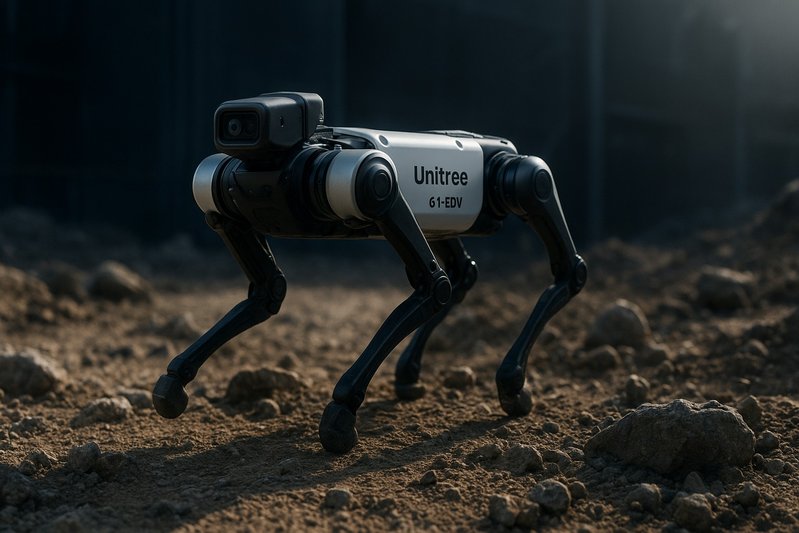
Unitree G1‑EDU Delivers 50 Hz Adaptive Locomotion on Real Terrain, But Core Timing and Safety Numbers Remain Unpublished
Independent 2025 deployments of BeamDojo, HOMIE, and ResMimic verify real‑time capabilities on Jetson Orin NX with Livox MID‑360, while stock G1 latency, replanning, disturbance, and HRI benchmarks are still missing
A compact humanoid running a learned locomotion policy at 50 Hz on real terrain, in real time, on an embedded computer is no longer a demo‑only fantasy. Unitree’s G1‑EDU has now executed autonomous foot placement on challenging sparse footholds with onboard sensing and compute, while sustaining high‑rate, single‑operator teleoperation for whole‑body tasks. Those are not sizzle‑reel moments; they’re method‑anchored results on shipping hardware.
And yet, the most consequential numbers for dynamic, unstructured deployment remain absent. There’s still no public, quantitative accounting of stock G1 perception‑to‑action latency, low‑level control cadence, motion replanning horizons, push‑recovery thresholds, dynamic‑obstacle avoidance, manipulation bandwidth, energy headroom, or HRI safety behaviors. For labs and pilot programs, the message is twofold: the G1‑EDU is a credible embodied‑AI research platform with verified real‑time behaviors, and it still demands a disciplined verification campaign before being trusted around moving people and unpredictable environments. 🤖
The platform, at a glance: what G1 and G1‑EDU actually ship
Unitree’s “G1” line is a compact biped with two closely related offerings:
- The consumer/basic G1 with 23 degrees of freedom (DoF) and a closed onboard motion‑control computer.
- The developer‑oriented G1‑EDU, which supports 23–43 DoF configurations (including added waist/wrist DoF and optional three‑finger hands) and preserves the same closed motion controller while adding an open NVIDIA Jetson Orin NX compute for perception and high‑level control.
Sensing and I/O are modern and researcher‑friendly:
- Integrated Livox MID‑360 3D LiDAR and Intel RealSense D435i depth camera.
- Connectivity includes Wi‑Fi 6, Bluetooth 5.2, dual GbE, multiple USB‑C 3.x, and regulated 12/24 V auxiliary power for expansion and logging.
- The SDK is built on DDS and exposes real‑time topics and RPCs for the low‑level controller and the optional Dex3‑1 three‑finger hand.
Field inspection of shipping G1 units shows a real‑time‑oriented software baseline: Ubuntu 20.04.5 with a PREEMPT_RT kernel, ROS 2 Foxy with CycloneDDS, and a supervised process graph orchestrated by a central service. Named processes include motion control (ai_sport), state estimation, robot_state, WebRTC, OTA, and voice/NLP components, all under supervision. This verifies an industry‑standard middleware foundation, but it does not, by itself, reveal motion‑performance timing or safety thresholds.
What’s proven on real hardware: 50 Hz locomotion, 500 Hz tracking, high‑rate whole‑body behaviors
Three independent deployments have established what the G1‑EDU can do today, with the official LiDAR and depth camera and the onboard Orin NX running the research stacks locally:
-
BeamDojo executed autonomous locomotion on sparse footholds with a 50 Hz learned policy on the Orin NX, tracking actions with a 500 Hz PD loop and updating a robot‑centric elevation map at 10 Hz. The real‑world success profile on physical G1 includes:
-
Stepping stones: 4/5 successful traverses; traverse 92.18%
-
Balancing beams: 4/5; 88.16%
-
Stepping beams: 3/5; 70.00%
-
Gaps: 5/5; 100% Commanded linear velocities of 0.5/0.75/1.0 m/s produced realized speeds ~0.45/0.65/0.88 m/s with low tracking error, including a 2.8 m stepping‑stone traverse in 3.17 s at a 1.0 m/s command. The system showed robustness while carrying a 10 kg payload, under external pushes, and through missteps, with the perception loop at 10 Hz and control at 50 Hz backed by 500 Hz PD tracking.
-
HOMIE demonstrated single‑operator whole‑body teleoperation at high rates on G1, streaming arm commands at 263 Hz and hand commands at 293 Hz. The on‑robot locomotion policy ran at 50 Hz; upper‑body targets updated at 10 Hz and were interpolated to 50 Hz. First‑person video from the RealSense delivered roughly 30 Hz. In addition, an imitation‑learned autonomous visuomotor policy running at 10 Hz achieved 73.3% and 80.0% success on two short pick tasks over 15 trials each. Teleoperation enabled bimanual pick‑and‑place, hand‑overs, and appliance interaction.
-
ResMimic deployed autonomous whole‑body loco‑manipulation on G1 by layering residual reinforcement learning atop a large motion‑tracking prior. Field sequences include lifting and carrying a 4.5 kg box via whole‑body contact (exceeding wrist payload) and interacting with irregular objects such as chairs. The most detailed quantitative results for this work are in simulation; real‑world sequences show feasibility but are not reported as aggregate success rates.
Together, these results establish two concrete pillars: (1) real‑time foot placement adaptation on difficult foothold layouts at 50 Hz with 10 Hz mapping, executed on the Orin NX and tracked by a 500 Hz PD loop; and (2) sustained, high‑rate whole‑body teleoperation with partial autonomous manipulation via imitation.
The unmeasured core: perception‑to‑action timing, control cadence, and replanning horizons
Critical timing data for the stock G1 remain unpublished. There is no official disclosure of:
- End‑to‑end perception‑to‑action latency under load.
- Low‑level joint control rates and whole‑body control (WBC) loop rates for the closed motion controller.
- Planning/replanning cadence and horizons for onboard autonomy.
The SDK’s LowState structure includes a 1 ms tick counter, indicating a millisecond internal timebase. That is not evidence of a 1 kHz control loop, nor a guarantee of 1 kHz telemetry. Independent deployments report their own operating frequencies (50/500/10 Hz, 263/293 Hz, etc.), but those figures characterize the research stacks running on the G1‑EDU’s Orin NX, not the internal performance of the proprietary motion controller or the stock robot’s perception‑to‑action latency.
For organizations evaluating unstructured, dynamic settings, the absence of published timing and replanning numbers is not a paperwork detail; it is a material unknown that directly impacts collision‑avoidance, stability margins, and human‑robot interaction safety.
Terrain adaptation, yes—dynamic‑avoidance metrics, no
Variable terrain performance is no longer hypothetical. Sparse‑foothold locomotion has been verified on physical G1 units with explicit success rates, speeds, and operating frequencies. However, standardized dynamic obstacle‑avoidance metrics are still missing:
- No public benchmark shows success rates, time‑to‑replan, minimum clearance at speed, or tracking error distributions when avoiding moving people/objects.
- Video demonstrations without methods cannot substitute for protocol‑driven results.
- Stair/incline distributions with success statistics and safety margins have not been published for G1 in peer‑reviewed form.
BeamDojo’s results are a meaningful proof of adaptive foot placement in constrained foothold scenarios, but they are not a stand‑in for crowd‑navigation or unstructured outdoor deployment with dynamic agents.
Manipulation today: high‑rate teleoperation and early imitation—without bandwidth numbers
On manipulation, the G1‑EDU supports an optional three‑finger hand (Dex3‑1, 7 DoF) with nine tactile/pressure arrays (stated perception range 10 g–2500 g) and DDS‑based programmability. Conceptual hybrid force–position control is documented. What remains unspecified are the fundamental bandwidth and responsiveness metrics:
- No published end‑effector force/impedance control bandwidths.
- No tactile‑driven slip detection latencies.
- No moving‑target grasp success rates or reaction times versus target trajectories.
What is verified is substantial: single‑operator whole‑body teleoperation at 263/293 Hz for arms/hands; a 50 Hz locomotion loop coexisting with rapid upper‑body commands; a 10 Hz imitation policy with 73–80% success on two pick tasks. These results show that high‑rate teleoperation and basic onboard autonomy can cohabit the platform. The missing bandwidth numbers, however, limit risk assessment for dynamic manipulation (e.g., catching, tool handovers to moving humans, or robust slip‑averse grasps on accelerating targets).
Software stack and connectivity: ROS 2 Foxy, CycloneDDS, PREEMPT_RT—and persistent cloud links
Shipping G1 units run a contemporary stack for real‑time robotics:
- Ubuntu 20.04.5 with a PREEMPT_RT kernel (Linux 5.10‑series).
- ROS 2 Foxy with CycloneDDS.
- A supervised service graph with a central master controller and named services for motion (ai_sport), estimation, communications (including WebRTC), OTA, and voice/NLP.
The platform maintains persistent outbound TLS connections for telemetry and OTA, and exposes WebRTC and voice/NLP endpoints under supervision. This architecture is practical for field support and remote assistance in principle, but it also introduces enterprise‑grade security considerations. For pilots, network segmentation, outbound egress controls, and privacy reviews are not optional extras—they are first‑order requirements to manage operational risk. Note that these connectivity findings validate the middleware and service posture; they are not motion‑performance benchmarks.
Energy and thermal headroom: specifications without measurements
On power, Unitree specifies a 13‑series 9000 mAh smart battery with around two hours of runtime contingent on scenario. Beyond this headline figure, there are no public measurements of:
- Cost of transport or energy overhead of adaptive policies.
- CPU/GPU utilization and thermal throttling margins during sustained onboard perception and control.
- Compute headroom while running 50 Hz locomotion, high‑rate teleoperation, and additional autonomy simultaneously.
Retailer pages sometimes list 2.5–3.5 hour runtimes and IP54 ingress protection, but those claims are not corroborated by Unitree’s primary documentation and should be treated as unverified until methods and test conditions are disclosed.
Safety behaviors and fail‑safes: cautions instead of certified thresholds
Unitree emphasizes general safety cautions—powerful actuators, keep a safe distance, OTA updates, and “civilian product” boundaries—but it does not publish:
- Obstacle‑clearance margins versus speed.
- Protective stop (P‑stop) or emergency‑stop (E‑stop) response times.
- Separation‑monitoring behaviors or conformity with HRI standards.
Retail pages reference emergency stop/damping modes and signal‑loss behavior, but absent primary documentation or independent test protocols, these remain marketing statements. No third‑party certifications or safe‑stop latency measurements for G1 have been identified publicly.
Marketing claims vs. method‑anchored results
Across storefronts and social channels, the G1 is associated with claims including a 500 Hz “control loop,” 2 ms DDS latency, >2 m/s bipedal speed, IP54 ratings, 25° stairs/slopes, 2.5–3.5 h runtime, push recovery, and “anti‑gravity recovery technology.” Unitree’s own pages do not quantify these with protocols.
What is method‑anchored and verified today:
- Real‑world sparse‑foothold locomotion on G1‑EDU at 50 Hz with 10 Hz LiDAR‑based mapping and 500 Hz PD tracking, including success rates, speeds, and robustness under payload and perturbations.
- High‑rate, single‑operator whole‑body teleoperation at 263/293 Hz for arms/hands, with a 50 Hz locomotion policy co‑running; a 10 Hz imitation policy achieving 73–80% success on two pick tasks.
- Feasible autonomous whole‑body loco‑manipulation via residual learning on G1, with qualitative field results and quantitative detail primarily in simulation.
Everything else—timing, replanning, disturbance thresholds, manipulation bandwidths, environmental robustness, energy/thermal margins, and safety behaviors—remains unreported in ways that decision‑makers can act on.
Snapshot: what’s verified and what’s missing
| Category | Verified on G1 (numbers/modes) | Major gaps |
|---|---|---|
| Timing and control loops | 50 Hz locomotion policy on Orin NX; 500 Hz PD tracking; 10 Hz elevation mapping; 263/293 Hz teleop outputs (arms/hands); 10 Hz imitation policy | No stock perception‑to‑action latency; no stock low‑level/WBC rates; no replanning horizons |
| Terrain and avoidance | Sparse‑foothold success: Stones 4/5 (92.18%), Beams (bal.) 4/5 (88.16%), Beams (step) 3/5 (70%), Gaps 5/5 (100%); speeds up to ~0.88 m/s realized | No quantified moving‑obstacle avoidance; no stair/incline distributions with margins |
| Disturbance | Qualitative push robustness during sparse‑foothold walking | No impulse thresholds or capture‑step margins |
| Manipulation | High‑rate teleoperation; 10 Hz imitation with 73–80% success on two pick tasks; tactile hand option with 10 g–2500 g sensing | No force/impedance bandwidths; no slip‑latency; no moving‑target grasp metrics |
| Stack and connectivity | ROS 2 Foxy, CycloneDDS, PREEMPT_RT; supervised services; persistent outbound connections | No disclosure of proprietary WBC internals; no VIO/SLAM drift metrics |
| Energy/thermal | 13S 9000 mAh battery; nominal ~2 h runtime | No cost of transport; no thermal/compute headroom data |
| Safety | General cautions | No certified thresholds or HRI behaviors |
What it means for labs and pilot deployments
For research labs, the message is encouraging: with the official LiDAR, depth camera, and onboard Orin NX, the G1‑EDU executes real‑time adaptive locomotion at 50 Hz on genuinely tricky foothold layouts, while supporting sustained, high‑rate whole‑body teleoperation and basic imitation‑driven autonomy. The middleware is standard ROS 2/DDS over a real‑time kernel, and the I/O is ready for instrumentation.
For pilots in dynamic, unstructured environments, caution is warranted. There is no public evidence yet that the stock G1 controller delivers the end‑to‑end latency, replanning cadence, dynamic avoidance, disturbance rejection, manipulation bandwidth, environmental robustness, energy/thermal headroom, or HRI safety behaviors that regulators and safety officers will ask for. Security posture is modern but connected; plan network and privacy controls up front.
A focused verification checklist to close the gaps
Teams preparing evaluations should implement a short, methodical campaign. Record the exact robot configuration (G1 vs G1‑EDU), DoF options, and software/firmware releases.
-
Timing and loops
-
Instrument end‑to‑end perception‑to‑action latency using synchronized visual triggers and foot/hand contact sensors.
-
Log median and 95th percentile under representative workloads.
-
Record actual low‑level and whole‑body loop rates during tasks, plus worst‑case planner time‑to‑replan and horizon lengths.
-
Dynamic avoidance and terrain
-
Script moving‑obstacle trials over at least 100 episodes.
-
Report success rates, time‑to‑replan, minimum clearance at speed, and tracking‑error distributions.
-
Standardize stair/incline/compliant/uneven surfaces; report slip rates and recovery actions.
-
Disturbance rejection
-
Run instrumented push tests with impulse ramps from multiple directions.
-
Quantify no‑fall impulse thresholds and capture‑step margins.
-
Manipulation bandwidth and tactile response
-
Benchmark moving‑target grasp success versus target speed/acceleration.
-
Measure reaction latency to trajectory changes and end‑effector force/impedance control bandwidth.
-
Quantify tactile/slip detection latencies with the Dex3‑1 hand if used.
-
Environmental robustness
-
Sweep lighting, occlusion, reflectivity, and controlled outdoor weather.
-
Publish degradation curves across sensing and control stacks.
-
Energy and thermal headroom
-
Log power draw, cost of transport, and CPU/GPU clocks/temperatures during sustained adaptation tasks.
-
Identify throttling onset and compute headroom for additional autonomy.
-
Safety and HRI behaviors
-
Measure protective‑stop and E‑stop response times.
-
Characterize speed‑dependent clearance behaviors.
-
Document any conformance or variance relative to applicable HRI standards.
Bottom line
Unitree’s G1‑EDU has crossed a meaningful threshold: real‑time adaptive locomotion at 50 Hz with onboard mapping and sensing, plus high‑rate whole‑body teleoperation and early imitation‑based autonomy, all executed on the robot. That’s a credible platform for embodied‑AI research and carefully scoped pilots. The missing half of the picture is the one that governs deployment in the wild: stock timing, replanning, dynamic avoidance, disturbance limits, manipulation bandwidth, environmental robustness, energy/thermal headroom, and safety. Until those numbers are measured and shared, treat the G1 as an impressive research workhorse—not a ready‑to‑roam teammate around moving people—without the verification campaign outlined above.