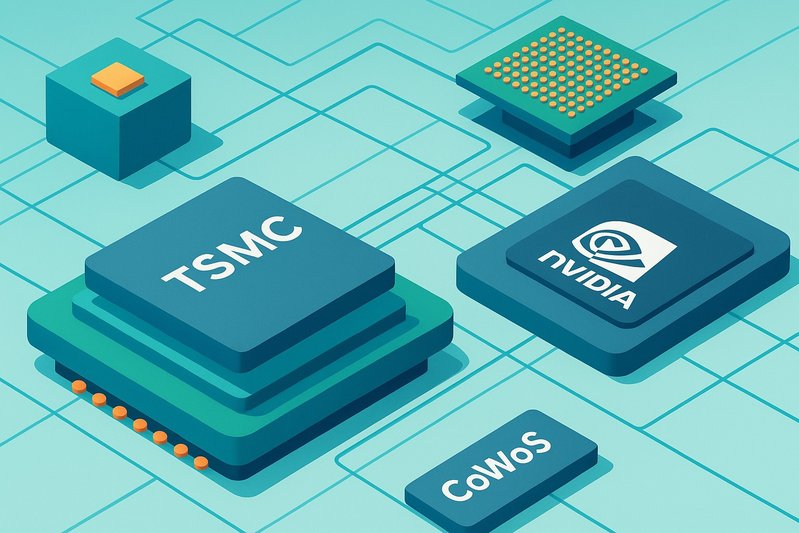
TSMC Packaging Economics Rewire Nvidia’s Supply in 2026
Capacity doubling, HBM commitments, and prepayments shift delivery to 12–20 weeks while module output climbs 25–50% year over year
TSMC’s advanced packaging pivot is reshaping Nvidia’s accelerator availability in 2026. With CoWoS capacity doubled in 2025 and further expansion underway, the bottleneck that defined the past two years is loosening. At the same time, HBM vendors are scaling output—but the fastest 12‑high parts remain the scarcest resource and are largely spoken for. Add in Nvidia’s sizable multi‑year capacity commitments and prepayments, and the delivery math changes: mainstream SKUs trend toward 12–20 week windows and total packaged module output rises roughly 25–50% year over year in the base case.
What’s new isn’t just more equipment. It’s a shift toward CoWoS‑L that reduces full‑interposer area, a stronger substrate pipeline for mega‑formats, and long‑term agreements that secure priority across wafers, packaging, substrates, and memory. This article maps the business levers behind Nvidia’s 2026 supply—capacity, allocation, supplier commitments, lead times, and cost—so enterprise buyers can time orders, choose SKUs, and coordinate vendors to lock in the right slots.
Advanced Packaging at Scale: CoWoS Doubling and Revenue Mix Tailwinds
TSMC’s advanced packaging is the fulcrum for 2026 accelerator availability. CoWoS capacity doubled in 2025 and remains on an expansion path in 2026, bringing supply and demand closer to balance after a prolonged crunch. Two changes stand out:
- Customers are increasingly transitioning from legacy full‑interposer CoWoS‑S to CoWoS‑L, which uses localized silicon bridges to preserve high‑bandwidth die‑to‑die connectivity while shrinking total interposer area. That footprint reduction lifts effective throughput per line.
- TSMC continues to scale multiple 3DFabric sites in Taiwan and guide advanced packaging/test as a growing share of revenue—rising from over 8% in 2024 to more than 10% in 2025, and into the low‑teens percent in 2026. Capital is following: a meaningful slice of annual capex is earmarked for packaging, testing, masks, and other enabling functions.
The implications for Nvidia are direct. As CoWoS‑L ramps and assembly flows mature, packaging cycle times shorten, rework stabilizes, and more modules per square meter can move through the lines. While CoWoS‑R and hybrid‑bonded SoIC stacks are gaining traction for future flexibility, the 2026 volume lift for accelerators largely comes from CoWoS‑L’s area savings and more balanced capacity.
Bottom line: advanced packaging is no longer the single chokepoint. It remains tight—but on a trajectory that supports mid‑double‑digit output growth for finished accelerator modules.
Output and Delivery Outlook: From Scarcity to Manageable Windows
Nvidia’s packaged accelerator output is set to rise by roughly 25–50% year over year in 2026 in the base case. That growth reflects the combination of CoWoS capacity increases, maturing assembly flows, and a more predictable substrate pipeline. Delivery performance improves with it:
- Door‑to‑door cycle times trend from about 90–140 days in 2025 toward roughly 80–120 days in 2026 for mainstream accelerators.
- From firm purchase order, 12–20 week delivery windows become the norm for mainstream SKUs. In upside scenarios—where CoWoS‑L adoption is faster, rework rates decline, and memory availability broadens—windows can compress further into the low‑teens weeks for a larger share of the portfolio.
Two caveats shape the top end of the stack:
- The largest ABF mega‑substrates, with the finest line/space and highest layer counts, continue to stress yields and lead times. Even as the substrate ecosystem adds capacity, the biggest formats remain gating for the most complex modules.
- The tightest memory configurations—especially the top‑speed 12‑high HBM3E bins—are still constrained, keeping the very highest‑performance SKUs in shorter supply.
Taken together, the balance improves materially for mainstream accelerators, while availability at the absolute peak remains bounded by memory speed‑bin yields and mega‑substrate throughput.
HBM Supplier Landscape and Bookings: Growth With a Top‑Bin Squeeze
HBM supply expands across all three major vendors in 2026, but allocation and speed‑bin mix matter.
- SK hynix began mass production of 12‑layer HBM3E in 2024 and highlights its Advanced MR‑MUF process for improved warpage control and thermal characteristics—key to more predictable attach and reliability.
- Samsung has also announced mass production of 12‑high HBM3E, adding capacity and vendor diversity.
- Micron is shipping production‑capable 12‑high HBM3E with bandwidth above 1.2 TB/s at pin speeds over 9.2 Gb/s and targets an HBM4 ramp in 2Q26. Critically, Micron indicates its entire 2026 HBM output, including early HBM4, is fully committed.
The consequence: aggregate HBM availability rises, but the fastest 12‑high bins remain the scarcest and will continue to co‑determine Nvidia’s module output alongside CoWoS. Integration remains non‑trivial. HBM attach, underfill, and warpage steps inside CoWoS assembly can create rework and queue variability; the shift toward CoWoS‑L helps by reducing interposer area and simplifying the overall flow, but the top‑bin memory constraint still sets the pace at the high end.
For buyers, qualification breadth is the hedge. Securing approvals across SK hynix, Samsung, and Micron—and across both 8‑high and 12‑high stacks—creates room to re‑mix orders without idling assembly lines when one vendor’s speed bins tighten.
ABF Mega‑Substrate Availability: Booked Early, Still Tight at the Largest Sizes
Substrates are the quiet determinant of delivery timelines. For AI/HPC packages, the largest ABF mega‑substrates push panel sizes, layer counts, and line/space limits at the leading substrate houses. Investments are underway, but two data points frame the 2026 picture:
- Portions of 2026 ABF capacity at some suppliers, including Samsung Electro‑Mechanics, are already largely pre‑booked by major technology buyers.
- Unimicron, a key supplier, has redirected capacity toward CoWoS‑class demand and is ramping new AI GPU substrate lines.
These moves improve overall substrate availability, yet the most complex formats stay relatively tight. In the base case, lead times for substrates ease toward the 12–20 week range in line with packaging and memory, but the largest panels remain a planning item for top‑end SKUs. Buyers should expect that substrate reservations—alongside HBM—will continue to influence actual ship dates.
Commercial Posture: Long‑Term Agreements and ~$50.3B in Multi‑Year Commitments
Nvidia’s capacity strategy centers on long‑term manufacturing agreements, prepayments, and advances that span wafers, CoWoS packaging, ABF substrates, and HBM. As of late 2025, Nvidia disclosed approximately $50.3 billion in multi‑year commitments extending through FY2027 and beyond, with customer advances also supporting upstream suppliers.
These commercial levers carry operational weight in 2026. Suppliers are prioritizing partners who co‑invest in scarce assets—particularly CoWoS lines, interposers, mega‑substrates, and HBM bins. Nvidia’s commitments help secure predictable slots and improve access to the tightest mixes, which, in turn, supports the 25–50% output growth outlook and steadier 12–20 week delivery windows for mainstream SKUs.
Geographic Diversification: Taiwan‑Centric Assembly, Arizona Wafers in HVM
The geographic profile of Nvidia’s supply chain is evolving but remains Taiwan‑centric for 2026 module assembly. TSMC’s Arizona Fab 1 entered N4 high‑volume manufacturing in 4Q24 with yields comparable to Taiwan, adding wafer‑level resilience. TSMC and Amkor have also announced plans to establish advanced packaging and test in Peoria, Arizona—including InFO and CoWoS—to support Phoenix wafer customers.
However, packaging in the U.S. will lag wafer capacity, and it is unlikely to materially support Nvidia’s 2026 shipments. The practical takeaway for buyers: Arizona wafers improve geopolitical and logistics resilience, but final assembly and test for leading AI accelerators continue to run primarily in Taiwan through 2026.
Allocation Under Regulatory Constraints: Region‑Specific SKUs and Mix Management
Export‑control regimes remain a structural factor in Nvidia’s allocation. U.S. rules tightened licensing for advanced computing platforms in late 2023, and subsequent policy actions added worldwide licensing requirements to key ECCNs that cover many data center products. The operational result is straightforward:
- Region‑specific SKUs and performance limits require dual supply paths.
- Product re‑qualification or spec changes triggered by new rules can re‑queue builds and extend lead times.
Nvidia’s long‑term agreements help preserve priority through these pivots, but buyers should plan for compliance‑driven SKU differentiation and maintain flexibility in configurations to avoid mid‑queue redesigns.
Scenario Framing: Base, Upside, Downside for Operations and Finance
The 2026 outlook centers on two interlocking bottlenecks—advanced packaging and HBM—and the supporting substrate ecosystem. Three scenarios capture the operational and financial guardrails:
| Scenario | Assumptions | Output and Lead Times | Key Risks |
|---|---|---|---|
| Base (most likely) | CoWoS doubled in 2025; continued expansion in 2026 with broad CoWoS‑L adoption; HBM3E 12‑high yields improve; ABF tight but manageable; no extended Taiwan outage; regulatory status quo | Nvidia accelerator output +25–50% YoY; mainstream delivery windows ~12–20 weeks; top‑speed 12‑high still tight | HBM top‑bin availability; ABF yields at largest formats; packaging rework variability |
| Upside | Faster CoWoS‑L/R and SoIC adoption; at least two HBM suppliers yield top 12‑high bins well; ABF yields stabilize | Output +50–80% YoY; broader 10–16 week delivery windows; more access to top‑speed 12‑high | Sustained cross‑vendor execution; effective floorplanning that maximizes CoWoS‑L/R benefits |
| Downside | 12‑high HBM materials or yields slip; mega‑substrate shortages persist; Taiwan disruption causes multi‑week downtime; tighter export controls | Output flat to +20% YoY; 18–28+ week lead times at the top end; forced SKU re‑mix toward lower HBM counts/speeds | Extended recovery; re‑qualification delays; regulatory re‑queueing |
Financial sensitivity stems from configuration mix and yields. CoWoS‑L’s interposer area reductions and N3 migrations for select smaller chiplets provide footprint and area savings, while 12‑high HBM stacks and very large interposers add several thousand dollars per module versus 2024‑vintage designs. Mix management—matching SKUs to available memory bins and substrate panels—will be critical to protect gross margin while sustaining shipment cadence.
Cost Drivers by Configuration: Where Savings and Pressures Land
- Packaging footprint: CoWoS‑L reduces full‑interposer area, increasing line productivity and helping amortize fixed costs across more modules.
- Memory stack height: 12‑high HBM3E carries a cost premium over 8‑high variants and can lift rework if attach or warpage windows tighten.
- Substrate complexity: The largest ABF mega‑substrates—fine line/space, high layer counts—add material cost and yield risk.
- Chiplet node choices: Keeping reticle‑scale compute on N4/4N through 2026 protects functional die economics, while selectively migrating smaller chiplets to N3 harvests power/area improvements without outsized cost per package.
Net effect: CoWoS‑L and selective chiplet migration offset part of the HBM and substrate cost pressure, but the most memory‑dense, largest‑interposer SKUs will carry higher unit costs and remain the tightest on allocation.
Procurement Guidance for Enterprise Buyers ✅
- Order timing: Treat 12–20 weeks as the mainstream delivery window in 2026. Place priority SKUs on rolling forecasts and lock allocations early, particularly where top‑speed 12‑high HBM or the largest ABF formats are required.
- SKU flexibility: Qualify both 8‑high and 12‑high HBM options across multiple speed bins. Maintain multi‑vendor HBM approvals (SK hynix, Samsung, Micron) to enable re‑mix without idling CoWoS lines.
- Substrate reservations: Coordinate ABF bookings for mega‑substrates alongside HBM POs; the substrate schedule can be the hidden critical path for top‑end modules.
- Regional compliance: Align configurations to region‑specific SKUs in advance. Avoid mid‑queue redesigns by securing appropriate licensing pathways early and building compliance buffers into schedules.
- Resilience playbook: Expect packaging to remain Taiwan‑centric in 2026. Use Arizona‑sourced wafers as appropriate, but plan for module assembly, test, and HBM attach in Taiwan with earthquake‑sized WIP and material buffers.
Conclusion
Nvidia’s 2026 accelerator availability is being rewritten by TSMC’s packaging economics and memory market realities. CoWoS capacity doubled in 2025 and is expanding again this year, with CoWoS‑L’s footprint savings lifting effective throughput. HBM supply grows across all three vendors, yet the fastest 12‑high bins remain the scarcest and continue to co‑gate the very top of the stack. Nvidia’s long‑term agreements—about $50.3 billion in multi‑year commitments—secure priority across wafers, packaging, substrates, and HBM, supporting a base‑case outcome of 25–50% year‑over‑year module growth and mainstream delivery windows converging around 12–20 weeks.
Key takeaways:
- Advanced packaging shifts from a hard choke to a managed constraint as CoWoS‑L and capacity expansions take hold.
- HBM is the swing factor; top‑speed 12‑high bins remain tight even as aggregate supply grows.
- ABF mega‑substrates are still gating for the largest formats; bookings into 2026 matter.
- Long‑term commitments and prepayments are the decisive allocation lever.
- Geographic diversification helps at the wafer level in 2026; assembly remains Taiwan‑centric.
Next steps for buyers: lock forecasts early, qualify flexible HBM mixes across vendors, coordinate substrate bookings with memory, and align SKUs to regional compliance to avoid re‑queueing. Looking ahead, continued CoWoS‑L/R adoption, progress in SoIC, and improving 12‑high HBM yields could pull delivery windows toward the low‑teens weeks for more SKUs in upside scenarios, while downside risks will revolve around memory yields, substrate bottlenecks, and policy changes.