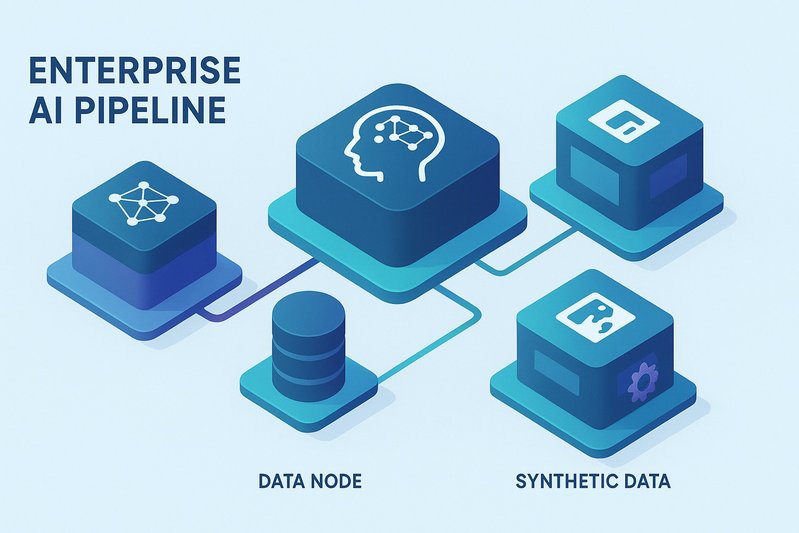
The Licensed‑and‑Synthetic Data Playbook for Enterprise AI Teams
A step‑by‑step operating procedure to plan, measure, and govern robust multimodal pipelines from pilot to production
Enterprise AI has crossed a threshold: the most reliable pipelines no longer rely on indiscriminate web crawls. Teams are shifting to rights‑cleared corpora for vision and 3D, license‑aware code datasets, and targeted synthetic generation that fills long‑tail gaps without compromising provenance. This transition isn’t cosmetic—it directly improves auditability, fairness evaluation, and downstream robustness, while aligning with tightening disclosure norms and takedown expectations. NVIDIA’s ecosystem shows how this comes together: rights‑cleared visual partnerships with Getty Images and Shutterstock, synthetic data scale‑ups via Omniverse Replicator and Isaac Sim, a license‑aware code corpus in The Stack v2 via StarCoder2, and enterprise deployment guardrails through NIM and NeMo.
This article provides a practical operating procedure to plan, measure, and govern such pipelines from pilot to production. You’ll set scope and risk posture before ingestion, build procurement SLAs for licensed sources, establish data inventory baselines, set diversity targets, design real–synthetic mixes with ablation milestones, run subgroup fairness audits with clear acceptance gates, and operationalize governance runbooks. Domain‑specific guidance spans code, text, vision, video, and audio. Finally, you’ll get a deployment rollout pattern with shadow testing, plus pitfalls and success metrics to track.
Define scope and risk posture before you ingest
Start by translating business goals into enforceable technical constraints:
- What modalities and tasks matter? Distinguish creative generation, perception/OCR, retrieval‑augmented generation, code assistance, robotics/industrial perception, and multimodal alignment.
- What sources are eligible? Prioritize rights‑cleared visual/3D and editorial libraries with contributor consent and takedown pathways; for code, mandate datasets with explicit license filtering and de‑PII; for text/audio, identify where open corpora suffice and where synthetic supplementation is required.
- What legal and compliance posture applies? Align to internal Responsible AI policies; ensure you can publish training‑data summaries where required; prefer sources and tooling that support provenance metadata and content authenticity.
- What provenance and safety controls are available at deployment? Plan for policy enforcement and logging; assume you will need to demonstrate content lineage and honor takedowns in production.
In practice, that means making licensed visual corpora a default for creative and editorial imagery and 3D/video conditioning; using a license‑aware corpus for code model training; and designing synthetic data generation for the tail. Wrap the entire pipeline in microservices that support controlled ingestion, safety filtering, and provenance‑aware deployment.
Procurement and inventory foundations
Procurement checklists and SLA design for licensed sources
For visual and 3D/video inputs, move beyond “permission to ingest” toward verifiable governance. Structure contracts to capture the following:
| Requirement | Why it matters | Signals to collect |
|---|---|---|
| Rights‑cleared content with contributor consent | Reduces legal risk and supports takedown honoring | Contributor consent program details; indemnification terms; release metadata coverage |
| Rich metadata (demographic, geographic, editorial/creative tags) | Enables diversity measurement and subgroup audits | Metadata schema; fill‑rates for demographics, geography, shot types |
| Provenance and content authenticity support | Secures lineage for training and generation outputs | Support for C2PA; watermarking or authenticity manifests |
| Takedown SLAs and clear request channels | Required for enterprise trust and regulatory expectations | SLA response times; escalation paths; affected asset identification process |
| Non‑exclusive terms | Reduces foreclosure concerns and aligns with industry norms | Confirmation of non‑exclusivity |
| Usage scope and indemnification | Clarifies downstream guardrails and liability | Scope clauses for training vs. conditioning; indemnification triggers |
For code, require datasets with license awareness, PII and malware filtering, and documented language/framework coverage. For text and audio where licensed options are limited, plan for synthetic augmentation and customer‑provided corpora with explicit consent and provenance.
Data cataloging and inventory baselines
Stand up a data catalog that records source, license, metadata richness, deduplication status, and real–synthetic ratios per task. Establish a measurable baseline before any mixing:
- Compute coverage counts by modality, domain, geography, and demographic attribute.
- Estimate distributional balance via category entropy and Gini indices (specific metrics unavailable without your dataset).
- Measure duplicate and near‑duplicate rates against existing corpora and public scrapes using exact/perceptual hashing for images/video and MinHash/SimHash/n‑gram filtering for text/code.
- Track overlap with any evaluation sets to reduce memorization risks.
- Log provenance coverage: how many assets carry authenticity metadata, releases, and complete tags.
Expect lower duplicate rates and higher effective category entropy as you consolidate around licensed visual corpora and apply systematic deduplication.
Diversity targets, mixes, and audits
Set diversity targets and measurement plans
Make diversity a first‑class KPI rather than an afterthought:
- Coverage targets: minimum counts and proportional shares across regions, demographics, domains, and shot types for vision/video; language and framework coverage for code; language variety for text and audio accent/noise profiles.
- Dedup/overlap targets: upper bounds for exact and near duplicates; zero overlap with held‑out tests.
- Real–synthetic targets by task: ratios that reflect domain realities (creative vs. industrial/robotics).
- Fairness targets: subgroup‑wise error parity for perception tasks, calibrated confidence across groups, and balanced generative output distributions under neutral prompts.
- Provenance targets: C2PA or equivalent coverage rates; percentage of assets with complete releases or consent indicators.
- Task performance targets: domain‑specific KPIs such as recall under rare conditions, OCR accuracy on challenging layouts, and code generation benchmarks comparable to license‑aware baselines (specific metrics unavailable here).
Tie every target to a repeatable measurement job and ensure results feed CI/CD gates.
Design real–synthetic mixes by task with ablation milestones
Real and synthetic data play different roles by domain. Use licensed real data to anchor distributions and synthetic data to fill the tail with perfect labels and controllable variation.
| Task domain | Default real:synthetic mix | Primary tools | Ablation milestones |
|---|---|---|---|
| Creative vision/3D generation/editing | Real‑dominant with targeted synthetic augmentation | Rights‑cleared stock/editorial libraries; synthetic styles/objects | 0%→10%→25% synthetic; monitor quality metrics and bias shifts |
| Industrial/robotics perception | Synthetic‑dominant with real validation anchors | Photorealistic synthetic scenes with accurate ground truth | 50%→70%→80% synthetic; monitor sim‑to‑real transfer on held‑out real sets |
| Video alignment and temporal tasks | Real with synthetic for rare temporal edge cases | Datasets with shot‑type diversity; synthetic kinematics | 0%→15% synthetic; monitor temporal consistency |
| Code modeling and assistants | Real license‑aware code with synthetic alignment data | License‑aware code corpus; synthetic instruction/preference data | Add synthetic alignment in steps; monitor benchmark parity and safety |
| Text LLM alignment | Real open corpora with synthetic instruction/preference data | Open text + synthetic alignment; customer domain corpora | Increment synthetic alignment; monitor toxicity/refusals and multilingual gains |
Run ablations at each milestone and maintain a changelog of mix ratios, sampling strategies, and observed impacts on KPIs. Expect synthetic‑to‑real transfer to improve robustness in perception tasks when validated on held‑out real sets. In creative workflows, synthetic augmentation helps long‑tail coverage without displacing licensed real anchors.
Subgroup fairness audits and acceptance gates
Use rich metadata from licensed visual/editorial libraries to audit for bias and to enforce acceptance gates:
- For classifiers and detectors: compute subgroup‑wise false positive/negative rates, calibration curves, and confusion matrices; check performance under rare conditions (lighting, weather, occlusions).
- For generative image/video: evaluate demographic representation and context balance under neutral prompts; inspect for “stock/editorial bias” where staged or high‑visibility events are over‑represented.
- For code assistants: examine language/framework parity and license‑sensitive behaviors.
- For text LLMs: measure toxicity/refusal rates and multilingual behavior; tie dataset changes to alignment data provenance.
Gate progression with explicit acceptance criteria:
| Stage | Tests | Gate to pass |
|---|---|---|
| Pre‑train ingestion | Dedup/overlap scan; provenance coverage; license checks | No evaluation‑set overlap; documented license compliance; acceptable provenance coverage |
| Fine‑tune build | Real–synthetic ablation; subgroup audits | No significant subgroup degradation; documented gains on target KPIs |
| Pre‑deploy | Red‑team prompts; policy conformance | Zero critical policy violations; acceptable generative bias profile |
| Post‑deploy shadow | Live traffic mirroring; drift detection | Stable metrics; no emergent bias or safety regressions |
Governance runbooks and domain specifics
Governance runbooks: policy, logging, takedowns, disclosure
Codify the controls that keep the pipeline compliant and auditable:
flowchart TD;
 A[Policy Enforcement] --> B[Logging Decisions];
 A --> C[Moderated Request Paths];
 D[Provenance Metadata] --> E[Content Authenticity];
 F[Takedown Workflows] --> G[Integrate SLAs];
 F --> H[Map Assets to Training Shards];
 H --> I[Support Retraining];
 J[Deployment Microservices] --> K[Standardize Logging];
 L[Responsible AI] --> M[Engineering Artifacts];
This flowchart illustrates the governance runbooks and domain specifics including policy enforcement, provenance management, takedown workflows, and deployment microservices related to responsible AI practices.
- Policy enforcement and safety filtering: apply guardrails at both training and inference; route high‑risk requests through moderated paths; log policy decisions and overrides.
- Provenance and authenticity: preserve and emit content authenticity metadata in creative pipelines; document training inputs in a form suitable for regulatory disclosure where required.
- Takedown workflows: integrate partner SLAs; map assets back to training shards and fine‑tune runs; support retraining or content filtering as needed; maintain an auditable trail of takedown handling.
- Deployment microservices: standardize on containerized services that expose consistent logging, safety controls, and provenance‑aware endpoints; segment environments for text, vision/3D, multimodal, and code.
- Responsible AI: align engineering artifacts (data cards, training summaries, evaluation reports) to internal and external expectations.
These runbooks are easier to implement when the stack supports policy and provenance primitives out of the box. Adopt content authenticity standards and enterprise guardrails so disclosure and audit obligations are routine rather than ad hoc. ✅
Code, text, vision, video, and audio domain specifics
- Vision and 3D: Rights‑cleared stock/editorial libraries materially improve category coverage, geographic diversity, and demographic labeling relative to open scrapes. Expect a bias toward commercially salient subjects and staged/editorial contexts; counteract with synthetic domain randomization and long‑tail scenes from photorealistic simulators.
- Video: Stock/editorial video with rich metadata strengthens shot‑type coverage and supports releases essential for enterprise use. Synthetic video fills temporal edge cases such as hazards or robotics kinematics with perfect labels.
- Text: Without broad exclusive publisher deals, coverage remains anchored in open corpora with synthetic alignment for instruction following and preference tuning. Multilingual gains depend on curated seed data and careful synthetic augmentation.
- Audio: Absent exclusive audio libraries, coverage tracks open baselines with synthetic augmentation via TTS/voice conversion to expand accents, noise profiles, and styles.
- Code: License‑aware training on a curated corpus with de‑PII and malware filtering improves compliance and language/framework coverage. Documented licensing boosts trust for enterprise deployment.
Deployment rollouts and shadow testing
Treat deployment as a multi‑stage safety release, not a switch flip:
flowchart TD;
 A[Start Deployment] --> B[Package Models as Microservices];
 B --> C[Run Shadow Deployment];
 C --> D[Collect Metrics];
 D --> E{Gate Promotion on Stability Checks};
 E -->|Stable| F[Implement Safety Filters];
 E -->|Unstable| G[Rollback];
 F --> H[Drift Detection];
 G --> A[Start Deployment];
 H --> I[End Deployment];
This flowchart illustrates the deployment rollout process, emphasizing the use of shadow testing and safety checks before promoting changes to production. It includes decision points for stability checks to ensure a safe transition.
- Package models as hardened microservices with consistent ingress, safety hooks, and logging. Segment per modality and expose provenance‑aware endpoints.
- Run a shadow deployment that mirrors a representative slice of traffic, capturing latency, safety, and quality metrics without affecting users. Gate promotion on stability and fairness checks.
- Instrument safety filters and guardrails at the edge. For creative workflows, propagate authenticity metadata in outputs; for code, enforce license‑sensitive behaviors and restrict unsafe generations.
- Implement drift detection on data and prompts. Alert on distribution shifts in inputs (e.g., region, demographic, or domain mix) and outputs (e.g., stylistic skew or rising refusal/toxicity rates).
- Maintain an incident runbook with rollback procedures, content takedown integration, and a clear roll‑forward plan once fixes land.
Pitfalls, red flags, and success metrics
Watch for recurring traps as you evolve the pipeline:
- Stock/editorial skew: Models may over‑represent staged contexts or high‑visibility events. Mitigate with targeted synthetic augmentation and metadata‑aware sampling.
- Illusory diversity: Coverage counts rise while near‑duplicate rates remain high. Enforce perceptual hashing and ANN‑based dedup at ingestion.
- Synthetic domain gap: High synthetic shares that aren’t validated on held‑out real sets can degrade real‑world performance. Always maintain real anchors for validation.
- Provenance gaps: Incomplete authenticity metadata or missing releases can block enterprise deployment. Track coverage and enforce minimum thresholds.
- Text/audio recency and domain gaps: Without exclusive licenses, coverage can lag. Use synthetic alignment to improve instruction following and preference alignment, but do not overclaim multilingual mastery without curated inputs.
- Governance debt: Weak takedown pipelines, ad hoc logging, or missing training summaries will surface under regulatory scrutiny. Bake governance into CI/CD.
Success metrics to monitor over time:
- Coverage and balance: category entropy and Gini indices; representation across geographies and demographics; language/framework breadth in code.
- Deduplication: exact and near‑duplicate rates; reduced overlap with evaluation sets.
- Real–synthetic effectiveness: ablation curves showing KPIs improving with controlled synthetic mixes.
- Fairness: subgroup‑wise error parity; calibrated confidence; generative output balance under neutral prompts.
- Provenance: authenticity metadata coverage; release completeness; takedown SLA adherence.
- Task performance: domain KPIs such as rare‑condition recall, OCR accuracy on challenging layouts, and code benchmarks aligned to license‑aware baselines (specific metrics unavailable here).
Conclusion
Licensed‑and‑synthetic pipelines are now the pragmatic default for enterprise‑grade AI. Rights‑cleared visual and 3D sources bring provenance, richer metadata, and clearer takedown pathways. License‑aware code corpora reduce legal risk while broadening language coverage. Synthetic generation—at scale and with high fidelity—fills long‑tail gaps and boosts robustness when validated against held‑out real data. Wrap all of it in deployment microservices with policy guardrails, authenticity metadata, and disciplined logging, and you have a pipeline that is both high‑performing and auditable.
Key takeaways:
- Establish scope and risk posture before ingestion, with procurement SLAs that codify provenance, consent, and takedowns.
- Measure diversity and deduplication upfront; set real–synthetic mix targets and prove them via ablations.
- Use rich metadata for subgroup fairness audits and enforce acceptance gates throughout the lifecycle.
- Operationalize governance with policy, logging, authenticity metadata, and disclosure‑ready training summaries.
- Tailor strategies by modality: licensed anchors for vision/3D/video, license‑aware datasets for code, synthetic alignment for text, and synthetic augmentation for audio.
Next steps:
- Build or upgrade your data catalog and dedup pipeline; baseline coverage and provenance metrics.
- Negotiate procurement SLAs that reflect your acceptance gates and takedown obligations.
- Pilot synthetic generation for one high‑impact long‑tail scenario and run the ablation plan.
- Harden deployment with microservices and guardrails; run a shadow test before any production cutover.
The forward play is clear: pair rights‑cleared, metadata‑rich corpora with controllable synthetic generation, enforce provenance and policy throughout, and measure relentlessly. Teams that do this will ship multimodal systems that are not only more robust but also more governable—a combination regulators, customers, and end users increasingly demand.