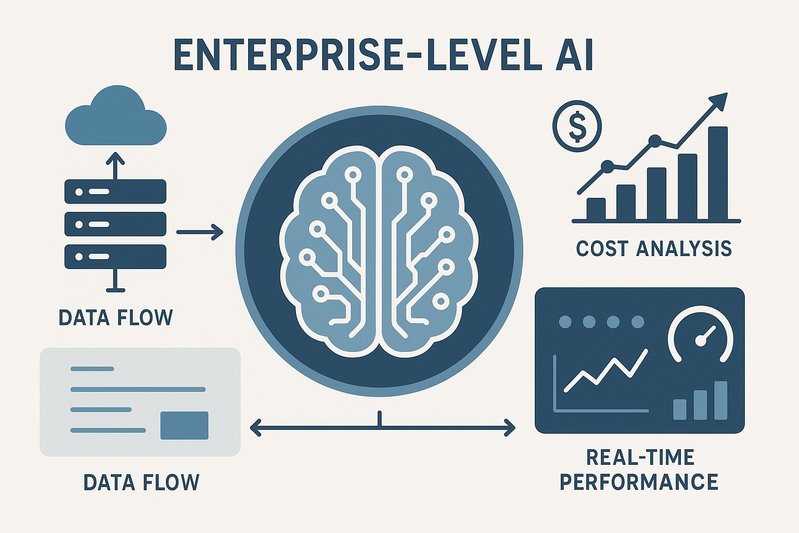
SLOs to Savings: Enterprise ROI Playbook for Real‑Time Gemini on Vertex AI and AI Studio
Executives are no longer impressed by demo wow moments; they’re asking for production SLOs like p95 time‑to‑first‑token ≤ 200 ms, p99 completion ≤ 2.5 s, and 99.9% availability—plus a credible path to cost per request and cost per token. Real‑time, multimodal Gemini pipelines now sit on revenue‑critical paths in customer channels and back‑office automations, where latency, reliability, and governance translate directly into brand trust and gross margin. The pragmatic question is no longer “Can we build it?” but “Which interface, which platform, which vector store—and how do we prove ROI while staying within risk and compliance boundaries?”
This playbook outlines a business‑first path to production adoption. It frames adoption drivers across multimodal, streaming, and tool‑augmented workflows; the decision criteria for choosing the Gemini API vs Vertex AI; why SLOs function as executive contracts; how to attribute costs down to the request and token; and which platform choices (ingress and vector search) fit your latency, scale, and analytics needs. It also lays out budget guardrails, reliability release controls, and compliance guardrails to clear enterprise hurdles without slowing teams down.
Adoption drivers and interface selection: multimodal, streaming, and governance fit
The strongest adoption wave clusters around three patterns that have clear reliability and ROI hooks.
-
Multimodal inputs in customer‑facing flows
-
Gemini accepts text paired with images, audio, or video frames. Business value lands when teams separate upload/processing overhead from inference time, so SLAs reflect the full wall‑clock, not just model think time. In workflows where rich media drives conversions or deflection (support, claims, field ops), measuring both time‑to‑first‑token (TTFT) and time‑to‑last‑token (TTLT) in streaming mode surfaces real customer impact.
-
Streaming experiences where time‑to‑value matters
-
Streaming reduces perceived latency by flushing tokens progressively. TTFT becomes the leading SLI; TTLT and tokens/sec close the loop on completion. In sales chat, co‑creation, or agent assist, faster TTFT correlates with measurable engagement improvements. Where exact metrics are needed, use TTFT/TTLT distributions rather than averages; specific conversion lifts are workload‑dependent and metrics unavailable.
-
Tool‑augmented orchestration and retrieval‑augmented generation (RAG)
-
Function calling connects model reasoning to transaction systems, databases, and vector stores. The ROI lever is accuracy and task success rate—especially when RAG retrieves the right evidence at the right speed. Business‑grade measurement tags tool latency and concurrency as first‑class SLIs; it also treats safety‑filtered outputs as explicit, trackable outcomes rather than generic failures.
A pragmatic benchmarking matrix mirrors these patterns: text and structured outputs, multimodal variants, streaming vs non‑streaming, tool‑calling, RAG, and long‑context requests. That coverage ensures decisions reflect your real usage mix rather than idealized demos.
Gemini API vs Vertex AI: choose by governance, quotas, and operational control
Both paths expose Gemini with streaming and function calling. The split decision is about governance boundaries, quota visibility, and operational integration.
-
Gemini API (Google AI Studio)
-
Best for speed and standardized client access via HTTP/SDKs. It’s a strong default for early pilots, development velocity, and portable integrations.
-
Vertex AI Generative AI
-
Designed for enterprise guardrails: IAM‑based access, VPC‑SC boundaries, quota visibility, monitoring integration, and deployment governance. It maps cleanly onto enterprise policies and central platform operations.
Rate‑limit behavior and quotas differ by configuration; client‑side rate limiting with jitter and carefully capped retries protect both error budgets and latency SLOs.
Interface selection snapshot
| Decision axis | Gemini API (AI Studio) | Vertex AI Generative AI |
|---|---|---|
| Development speed | Rapid iteration via HTTP/SDKs | Enterprise rollout aligned to platform controls |
| Governance | Standardized client access | IAM, VPC‑SC, quota visibility, deployment governance |
| Observability | Client‑side metrics and logs | Integrated monitoring and tracing alignment |
| Streaming/tool calling | Supported | Supported |
| Production standardization | Pilot‑friendly | Enterprise‑ready |
SLOs as executive contracts: reliability, release gating, and risk tolerance
SLOs translate engineering reality into business commitments. Treat them as the contract between the AI platform and the rest of the company—and wire promotions, alerts, and rollback to those numbers.
-
Define unambiguous SLIs across distribution‑aware metrics
-
For non‑streaming: end‑to‑end p50/p95/p99 latency from client send to final byte.
-
For streaming: TTFT (send → first token) and TTLT (send → stream completion), plus tokens/sec during output.
-
Availability: success ratio excluding client errors, segmented by error class (4xx, 5xx, safety blocks, timeouts, rate limits).
-
Use example SLOs as a starting template
-
Availability: 99.9% over 30 days.
-
Latency (text, non‑streaming): p95 ≤ 800 ms.
-
Streaming: p95 TTFT ≤ 200 ms; p99 TTLT ≤ 2.5 s.
-
Streaming/queue guardrails: Pub/Sub oldest unacked age ≤ 30 s; Dataflow watermark lateness p95 ≤ 10 s.
-
Gate releases with canaries and automated rollback
-
Low‑rate synthetic probes per critical path (text, multimodal, streaming, tool‑calling, RAG) run continuously in prod and pre‑prod. Mirror a small percent of live traffic to candidates; compare TTFT, TTLT/end‑to‑end p95/p99, availability, queue lag, and error profiles. If burn‑rate alerts fire or canary deltas exceed thresholds with statistical significance, roll back. This keeps portfolio risk bounded and customer experience stable.
-
Separate cold vs warm behavior and treat safety blocks as explicit outcomes
-
Cold‑start latency inflates tails; isolate cold samples or define separate SLOs for the first invocation. Safety‑filtered outputs aren’t transport errors; tag and report them distinctly to maintain clear error budgets and policy auditability.
-
Integrate queue and watermark signals into SLO enforcement
-
In streaming architectures, queue lag and watermark lateness are first‑class early warnings for downstream response times. Tie these to shed/load or throttle producers before customer SLAs burn.
Compliance and privacy posture that won’t slow you down
- Data classification and least‑privilege access via IAM and VPC‑SC boundaries.
- Redact PII in logs; restrict trace payloads to metadata. Keep trace/log identifiers while removing sensitive content.
- Treat safety pathways as measurable outcomes, not noise—critical for governance reporting.
Cost‑per‑token economics: attribution, budget guardrails, and ROI scenarios
The CFO’s bottom line requires a defensible map from spend to business outcomes. That starts with cost attribution, then builds guardrails and elasticity policies.
Cost attribution framework: compute cost per request and per token
- Count every request by workload and model: maintain per‑request counters capturing input and output token usage.
- Join to Cloud Billing export in BigQuery: allocate spend by SKU to workloads and models; add shared infrastructure allocations where justified.
- Compute cost per request, cost per input token, and cost per output token: enough to compare modes (streaming vs non‑streaming), interfaces (Gemini API vs Vertex AI), and workload types (text vs multimodal vs long‑context). Specific dollar amounts vary by pricing configuration; metrics unavailable here.
This framework enables unit economics dashboards that executives can trust, linking p95 latency, availability, and cost per request on the same page.
Budget guardrails and elasticity across workload mix
-
Define multi‑window cost guardrails
-
Example: a 6‑hour moving average cost per request must remain below budget with confirmation windows to avoid flapping. Tie breaches to progressive mitigations: scale back long‑context requests, reduce top‑k in RAG, or switch non‑critical flows to non‑streaming.
-
Quotas and rate limits as safety rails
-
Honor interface‑published quotas and rate limits. Implement client‑side rate limiting with jitter. Use exponential backoff with jitter, cap total retry time, and classify retryable vs non‑retryable errors. This prevents retry storms that inflate both tail latency and costs.
-
Backpressure protects both SLOs and budgets
-
When a queue metric (e.g., undelivered messages, oldest unacked age, consumer lag) crosses your SLO threshold, throttle producers. Cancelling speculative work early often saves tokens and downstream calls.
ROI scenarios by workload: when higher unit costs make sense
-
Streaming for customer‑facing experiences
-
TTFT drops in streaming mode, improving perceived responsiveness. ROI is strongest in interactive channels where engagement, deflection, or agent productivity rises with responsiveness. If completion time (TTLT) dominates business value, factor tokens/sec stability under concurrency.
-
Long‑context for accuracy when context truly matters
-
Packing more context increases TTFT and TTLT and raises unit costs. Use long‑context where correctness and recall are revenue‑critical. Otherwise, prefer retrieval strategies that keep prompts lean and cache hit ratios high.
-
Tool calling for task completion
-
Each tool invocation adds latency and potential failure points. The payoff is end‑to‑end task success (e.g., creating tickets, fetching account data), which often outweighs marginal latency. Model the downstream latencies; keep concurrency policies explicit to avoid surprise tail inflation.
-
RAG for grounded answers
-
RAG introduces vector query cost and latency, index freshness overhead, and optional reranking steps. It earns its keep when factual accuracy and recall prevent costly human escalations or brand risk. Choose the vector store that matches your latency tail and freshness requirements to avoid paying for over‑ or under‑provisioned capability.
-
Multimodal for evidence‑heavy workflows
-
Image/audio/video uploads add overhead. Where visual or audio context materially reduces errors or speeds resolution, the net benefit justifies the extra cost; otherwise, measure carefully and default to simpler modes.
Portfolio‑level levers to keep ROI positive
- Interface consolidation: standardize production on Vertex AI when governance, quotas, and monitoring maturity are required; keep Gemini API for sandboxes and pilots.
- Workload curation: prioritize streaming where TTFT drives outcomes; gate long‑context usage; apply RAG where it replaces expensive human verification.
- Vector store choice: use Matching Engine for lowest tails at scale, BigQuery vector search for analytics fusion, AlloyDB pgvector for transactional proximity.
- Resource adjuncts: for embedding or reranking services, accelerators can lower latency and raise throughput when utilization is high; confirm with utilization vs latency knee plots before committing capital (specific thresholds are workload‑dependent and metrics unavailable).
Platform choices that move the needle: ingress and vectors
Ingress selection: Pub/Sub vs Kafka is an operational alignment choice
Both messaging systems can satisfy low‑latency requirements for real‑time pipelines. The operational levers differ—so base decisions on the signals your team will run by, not on brand preference.
- Pub/Sub: monitor undelivered messages and oldest unacked age to catch consumer lag and protect end‑to‑end latency promises. Dead‑lettering and flow control support predictable backpressure.
- Kafka: track consumer lag per group/partition, ISR counts, and partition skew. These are early warnings for hidden backlogs that erode SLOs.
Staffing and TCO specifics are organization‑dependent and metrics unavailable here. What’s universal: define backpressure policies that tie queue lag and watermark lateness to automated shedding and alerts, so you avoid silent SLO erosion when load spikes.
Operational signals to run the business
| Platform | Key SLI‑adjacent metrics | What they mean for customers |
|---|---|---|
| Pub/Sub | Undelivered messages; Oldest unacked age | Rising values warn of delayed responses and SLA risk |
| Kafka | Consumer lag; ISR counts; Partition skew | Accumulating lag signals rising tail latency risk |
Vector database strategy: align to latency, scale, and analytics
RAG economics hinge on your vector store choice. The default should fit your latency targets, data model, and query patterns.
| Need | Best‑fit option | Why it aligns |
|---|---|---|
| Lowest tail latency at scale | Matching Engine | ANN tuned for scale; query tail behavior is the focus |
| Analytics + vector in one place | BigQuery vector search | SQL + vector fusion simplifies pipelines and governance |
| Transactional + vector in the same store | AlloyDB pgvector | Co‑resident vectors with transactional features |
For each option, measure p95/p99 query latency, throughput, and index freshness. Add ingestion throughput and refresh cadence if you operate on frequently changing data.
Conclusion
Real‑time Gemini success comes from treating reliability and cost as two sides of the same contract. The winning teams make interface choices based on governance and visibility, not fashion; they define SLIs and SLOs the business can read; they attribute costs per request and per token; and they wire release gates, alerts, and budget guardrails to those numbers. That discipline turns multimodal, streaming, tool‑augmented pipelines into predictable, governable services—with clear ROI.
Key takeaways
- Use SLOs as executive contracts: TTFT, TTLT/end‑to‑end latency, and availability define customer experience.
- Pick the interface by governance: Gemini API for speed; Vertex AI for IAM, VPC‑SC, quota visibility, and deployment governance.
- Attribute costs precisely: join per‑request counters with Billing export to compute cost per request and per token.
- Guard budgets with automation: multi‑window budget alerts, rate limits with jitter, and backpressure policies keep costs and tails in check.
- Align vectors and ingress to workload: choose the vector store and messaging platform that match latency tails, freshness, and operational signals.
Actionable next steps
- Stand up the cost attribution join in BigQuery and build a unit economics dashboard alongside SLOs. 🚦
- Define per‑workload SLOs (including TTFT and queue/watermark bounds) and implement burn‑rate alerts.
- Decide your production interface standard and document the promotion path from pilot to governed deployment.
- Run a limited canary comparing RAG vector options against your latency and freshness targets; choose based on tail behavior, not averages.