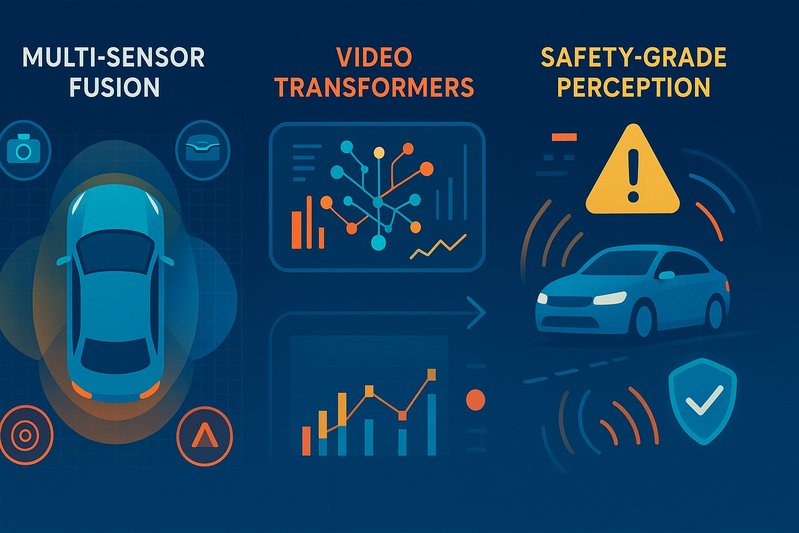
Safety‑Grade Open‑Vocabulary Perception and FP8 Video Transformers Set the 2026–2028 Agenda
Emerging multi‑sensor BEV transformers now hold the line on benchmark leaderboards while running at real‑time rates on 2026‑class automotive SoCs. Fusion backbones that integrate cameras, LiDAR, and radar deliver the strongest composite detection and tracking quality, especially in the long tail and in adverse conditions. The trade‑off is heavy compute: large temporal windows, cross‑modal attention, and occupancy heads push memory and power to the limits. Two thrusts define the next phase. First, safety‑grade open‑vocabulary detection must graduate from research promise to certifiable practice with calibrated uncertainty and explicit OOD gating. Second, FP8‑capable transformer engines and streaming‑efficient video models need to stretch temporal horizons without violating 30–100 ms handoff budgets at 10–20 Hz.
This article maps the research and engineering agenda for 2026–2028 across six fronts: safety‑grade open‑vocabulary perception; long‑horizon streaming at automotive power; robustness standardization; security hardening at the perception layer; cooperative perception with dynamic maps; and the hardware trajectory toward FP8 video transformers. Readers will find the breakthrough patterns to watch, a concrete roadmap with evaluation KPIs, and the open risks that could slow progress—or reveal new performance cliffs.
Research Breakthroughs
Safety‑grade open‑vocabulary detection moves into BEV backbones
Open‑vocabulary perception is crossing from prototype demos to integrated detection in BEV fusion models. The playbook is clear:
- Start with strong visual foundation features—particularly DINOv2—adapted to driving scenes to improve rare‑class recognition and long‑tail recall.
- Use segmentation priors, including generalist models like Segment Anything, to sharpen boundaries and feed BEV occupancy heads with cleaner free‑space cues.
- Make safety a first‑class objective: calibrate confidence with temperature scaling or evidential outputs and validate with Expected Calibration Error (ECE) on held‑out and adverse‑condition slices.
- Gate detections using OOD monitors evaluated with open‑set protocols (e.g., AUROC/AUPR on dedicated anomaly datasets) so the planner sees only trustworthy outputs.
The integration pattern: route camera features through BEV video transformers (e.g., BEVFormer/BEVDepth families) and fuse with LiDAR/radar in BEV (as in BEVFusion/TransFusion). Attach occupancy or volumetric heads to improve occlusion handling, and condition detection/tracking heads on both semantics and occupancy. The net effect is higher recall on rare categories at fixed false positives, with temporal stability improved by BEV‑space memory. Still, safety‑grade open‑vocabulary maturity remains an open question; production systems must demonstrate calibrated uncertainty and OOD gating that hold under night, rain, and domain shifts before relying on open‑set semantics in closed loop.
Long‑horizon video perception without blowing the power budget
Temporal models reduce ID switches and track fragmentation, and they consistently enable earlier stable detection after warm‑up. The hurdle is memory: multi‑camera video transformers with long context can consume several GB during inference. The emerging answer combines:
- Streaming attention with keyframe caching and stride scheduling to maintain context while shaving sequence length.
- Sparse or region‑of‑interest processing for camera BEV backbones (as explored in sparse/streaming camera BEV designs) to focus compute where it matters.
- Compact, shared BEV fusion that amortizes computation across detection, tracking, occupancy, lanes, and traffic elements.
On vehicle, the target remains deterministic perception‑to‑planner handoff within roughly 30–100 ms at 10–30 Hz, with bounded jitter. Medium‑capacity fusion stacks—distilled, pruned, and quantized—hit approximately 10–20 Hz on Orin‑/Ride‑class platforms for 6–8 cameras plus one LiDAR when the entire pipeline is compiled and scheduled carefully. Thor‑class platforms introduce FP8 transformer engines, enabling larger temporal windows or higher camera counts at comparable latency when models are designed for mixed precision. Actual throughput depends on sensor resolution, BEV grid size, and post‑processing, so runtime must be measured end‑to‑end on target toolchains.
Robustness gets standardized: adverse weather/night, sensor‑failure protocols, occupancy at scale
Fusion raises the floor under challenging conditions by leveraging modality complementarities: radar stabilizes early velocity, LiDAR anchors geometry, and cameras add semantics. To make robustness measurable and comparable, the field is converging on standardized suites:
- Benchmark slices for night/rain/fog to quantify degradation and recovery.
- Sensor‑failure protocols—e.g., camera blackout, partial LiDAR dropout, calibration drift—to verify graceful degradation and sensor gating.
- Occupancy/free‑space benchmarks (Occ3D and successors) that correlate with occlusion recovery and track stability in BEV pipelines.
These suites should be paired with calibration and OOD audits and exercised in closed loop, where the outcome measures include collision/infraction rates, time‑to‑collision margins, and planner oscillations.
Security hardening shifts left to the perception layer
Adversarial patches on cameras, LiDAR spoofing/injection, and radar interference are no longer theoretical. Defense‑in‑depth starts in BEV space:
- Cross‑sensor cross‑checks and temporal consistency filters catch implausible single‑sensor spikes.
- Plausibility constraints in BEV (e.g., impossible motion/size) suppress spoofed objects.
- Tamper‑resistant time synchronization and runtime anomaly detectors raise the bar for sensor/time spoofing.
Security must be integrated into the safety case alongside functional safety (ISO 26262) and SOTIF. UNECE R155 and R156 add organizational and technical obligations, including secure updates for in‑service fleets. Certification‑ready artifacts should cover robustness testing, calibration/OOD performance, and monitor verification—not just static benchmark scores.
Cooperative perception and dynamic maps find a practical footing
V2X‑aware fusion and dynamic map priors promise better occlusion recovery and stability in complex urban scenes. BEV‑native cooperative perception models demonstrate viable patterns for cross‑vehicle fusion, while learned map priors (e.g., vectorized lane topology) stabilize detection and tracking under partial observability. The practical caveat: any V2X path must respect real‑time constraints. That implies adaptive scheduling and strict QoS on communication—details vary by deployment, and exact scheduling methods are workload‑dependent. The immediate opportunity is to design BEV backbones that can ingest V2X and map context when available, while degrading gracefully when comms are delayed or absent.
Hardware: FP8 transformer engines change model design and compression
Two SoC eras now coexist on the road map. Orin‑/Ride‑class platforms favor INT8 camera backbones with INT8/FP16 fusion, plus aggressive distillation, pruning, structured sparsity, and per‑channel quantization calibration. Thor‑class platforms add FP8 transformer engines and higher transformer throughput, making larger temporal windows or multi‑task ensembles feasible within similar latency envelopes. Vendor compilers and SDKs—TensorRT, ONNX Runtime, and TVM—are essential to reach target Hz through kernel fusion, caching, and heterogeneous scheduling across GPU/DLA/NPU blocks. Model authors should treat mixed precision as a design constraint, using quantization‑aware training to avoid INT8/FP8 accuracy cliffs and explicitly budgeting memory for streaming state.
Roadmap & Future Directions (2026–2028)
What “safety‑grade open‑vocabulary” means in practice
- Integrate open‑vocabulary cues into BEV fusion, not as a bolt‑on. Camera features flow through BEV backbones that already support multi‑task heads.
- Demonstrate uncertainty calibration with ECE and negative log‑likelihood on held‑out and adverse weather/night splits. Thresholds are deployment‑specific; the key is documented calibration under the target ODD.
- Gate rare/open‑set detections with OOD monitors, reporting AUROC/AUPR on open‑set protocols. Use these gates to trigger safe fallbacks in closed loop.
Long‑horizon streaming that ships
- Adopt streaming attention and keyframe/stride schedules that bound state size, avoiding memory spikes from long unrolled sequences.
- Co‑design the BEV grid and temporal horizon with SoC capabilities. For Orin‑/Ride‑class, target medium‑capacity models with 10–20 Hz; for Thor‑class, increase temporal context or camera count in FP8.
- Distill temporal teachers into compact students; backfill any quantization loss with QAT and calibration.
Robustness, security, and cooperative perception as first‑class KPIs
- Standardize robustness reporting on night/rain/fog slices, sensor‑failure protocols, and occupancy accuracy.
- Build security‑hardening and runtime monitors into the perception layer, and include their verification in the certification package.
- Add cooperative perception and dynamic maps opportunistically, with clear QoS constraints and graceful degradation paths.
Evaluation playbook and KPIs
- Quality: mAP/NDS and component errors (mATE/mASE/mAOE; mAP/mAPH for Waymo), plus temporal metrics (HOTA/IDF1, ID switches).
- Runtime: end‑to‑end sensing‑to‑planner handoff latency, throughput (Hz), memory footprint, power draw, and jitter bounds on‑SoC.
- Safety: ECE and negative log‑likelihood for calibration; OOD AUROC/AUPR; closed‑loop outcomes (collision/infraction rates, TTC margins, comfort) in simulation/log‑replay.
- Robustness: performance on adverse‑condition slices, under sensor dropout and calibration drift, and occupancy/free‑space accuracy.
Priority experiments to unlock progress
- Compare streaming vs. non‑streaming BEV transformers at equal latency/memory, holding sensor suites constant.
- Quantify how occupancy heads improve occlusion recovery and tracking stability when fused with LiDAR/radar.
- Sweep INT8 vs. FP8 quantization under QAT on Orin vs. Thor, reporting any accuracy cliffs and memory savings.
- Exercise V2X/map priors in closed loop with communication delays and packet loss, measuring planner stability and TTC.
A compact comparison of the next‑wave techniques
| Area | What changes 2026–2028 | Techniques to watch | KPIs to track |
|---|---|---|---|
| Open‑vocabulary, safety‑grade | From demos to gated, calibrated deployment | DINOv2 features, SAM priors, ECE‑validated thresholds, OOD gates | ECE, NLL, OOD AUROC/AUPR, closed‑loop safety |
| Long‑horizon video | Longer context at fixed latency/power | Streaming/sparse attention, state compression, stride scheduling | End‑to‑end latency, Hz, memory/power, HOTA/IDF1 |
| Robustness standardization | Comparable robustness scores across stacks | Night/rain/fog slices, sensor‑failure protocols, Occ3D‑style occupancy | NDS deltas by slice, occupancy IoU/metrics, degradation curves |
| Security hardening | Perception‑layer monitors become cert artifacts | Cross‑sensor checks, BEV plausibility, runtime IDS | Attack success rates, false alarm rates, monitor coverage |
| Cooperative perception | V2X/map priors used when available | V2X‑ViT‑style fusion, vectorized map priors | Closed‑loop TTC/infractions with comms QoS |
| FP8 hardware shift | Larger temporal windows under budget | FP8 transformer engines, QAT, compiler fusion | Accuracy vs. INT8/FP16, latency/Hz on Orin/Thor |
Impact & Applications
BEV‑native fusion FMs have already demonstrated the strongest composite scores on widely used datasets, narrowing the gap in camera‑only setups and lifting robustness under adverse conditions. The 2026–2028 agenda translates these lab‑proven gains into production constraints:
- For cost‑/power‑constrained L2+, streamlined camera‑only BEV video models with strong pretraining and depth priors deliver competitive semantic mAP in daylight. OOD gating and calibration are mandatory to curb safety‑relevant false positives.
- LiDAR‑centric stacks remain highly efficient and excel at geometry (translation/orientation), with occupancy heads improving occlusion handling. Radar adds early velocity stability and adverse‑weather gains.
- Full fusion FMs (camera+LiDAR±radar) provide the best overall accuracy and tracking stability, and they degrade gracefully under partial sensor failures. Real‑time viability hinges on distillation, pruning/sparsity, and INT8/FP8 deployment via vendor toolchains.
Closed‑loop and hardware‑in‑the‑loop evaluation are essential to tie perception metrics to planner safety outcomes. Photorealistic simulation and log‑replay with measured perception noise allow threshold sweeping, sensor‑failure injection, calibration drift, and weather/lighting changes while tracking collisions, TTC margins, and comfort. Temporal fusion typically reduces planner interventions caused by track fragmentation or missed detections; any quantization‑induced loss should be mitigated with distillation and calibration to preserve these closed‑loop safety margins. 🛡️
Hardware shifts will reshape model design. Orin‑class deployments should favor medium‑capacity BEV fusion distilled into INT8 students with structured sparsity and kernel‑fused compilation. Thor‑class platforms invite FP8‑first transformer designs that expand temporal context or task breadth within similar latency budgets. Across both, mixed precision and streaming‑state budgeting become design‑time constraints, not afterthoughts.
Conclusion
Safety‑grade open‑vocabulary perception and FP8‑ready video transformers will define the next phase of autonomous perception. The throughline is rigorous engineering: calibrated uncertainty and OOD gates, streaming‑efficient BEV fusion that respects real‑time budgets, standardized robustness and security validation, and closed‑loop evidence that links perception quality to safer plans. Fusion FMs have already raised accuracy and stability; the 2026–2028 task is to harden and scale them without falling off quantization or memory cliffs—and to do so on the actual SoCs that will ship.
Key takeaways:
- Integrate open‑vocabulary cues into BEV backbones with explicit calibration and OOD gates before relying on them in closed loop.
- Use streaming/sparse attention, state compression, and shared BEV backbones to extend temporal horizons under fixed latency/power.
- Standardize robustness and security testing, including sensor‑failure protocols and runtime monitor verification.
- Plan for mixed precision: INT8 on Orin‑class, FP8 on Thor‑class, with QAT and compiler‑driven kernel fusion.
- Evaluate end‑to‑end with simulation/log‑replay to connect perception metrics to safety outcomes.
Next steps for teams: stand up an occupancy‑augmented BEV fusion baseline; add calibration and OOD evaluation to the CI pipeline; compile and schedule the full stack with vendor toolchains; quantify closed‑loop safety with threshold sweeps; and prototype FP8‑friendly temporal models for Thor‑class hardware. Expect fast iteration: the winners will ship calibrated, streaming‑efficient perception that holds its ground in rain, night, and under sensor faults—without missing a beat on the real‑time clock.