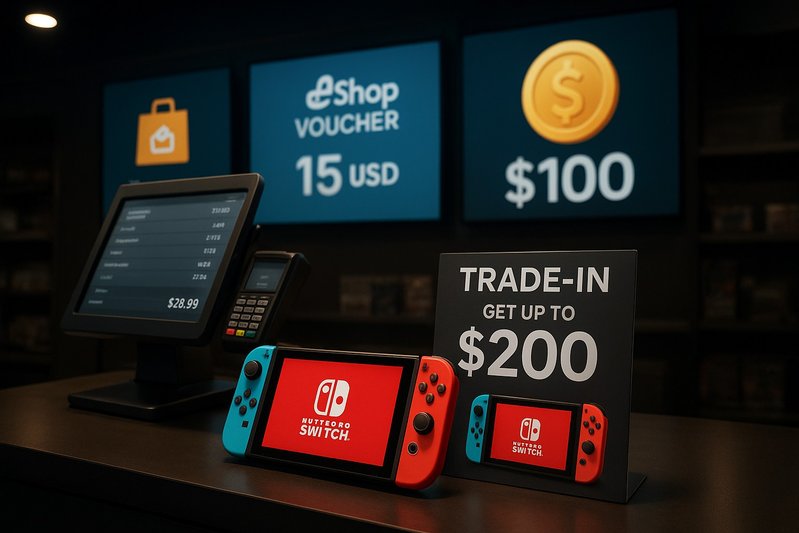
Retail POS Loopholes Convert Switch 2 Trade‑In Bonuses Into eShop Value, Pressuring ASPs 1–3%
Misconfigured point-of-sale rules at major retailers are quietly turning trade‑in incentives for Nintendo’s next‑gen Switch 2 into discounted eShop currency and vouchers. The result is a one‑way value leak that retailers fund, consumers pocket, and publishers ultimately feel through compressed average selling prices (ASPs) and deteriorating pricing power. If left open for a full promotional cycle, the effect is enough to bend digital economics at the margin—nudging ASPs down an estimated 1–3% on exposed titles while inflating unit volumes in short windows.
The leak doesn’t sit in Nintendo’s payment rails. It’s rooted in retail POS systems—specifically, how trade‑in bonus credit is allowed to be used and how digital refunds are handled. Nintendo’s terms lock redeemed codes to a region and make them generally non‑refundable once applied to an account. That means valid codes are honored at face value even if retail-side value capture fails. Retailers, not Nintendo, absorb the loss when bonus credit can be converted into digital currency or when a redeemed code is refunded without a redemption check. Publishers get pulled in through off‑calendar discounts that shape consumer behavior and erode realized pricing on Switch 2 software.
The One‑Way Value Asymmetry at the Heart of the Leak
Nintendo’s rules create a hard stop: once a gift card, voucher, or digital code is redeemed, the value becomes part of the Nintendo Account wallet and isn’t returned as cash or revoked casually. Codes are also region‑bound, meaning they must be redeemed in the country or region of purchase. In practice, when a code is valid and redeemed in the correct region, Nintendo delivers the full face value.
Retailers operate under a different regime. Trade‑in programs at major chains routinely offer bonus credit to drive hardware upgrades. Most intend to exclude digital currency and mark digital codes as non‑returnable. But those safeguards live and die by SKU hygiene and POS configuration. If exclusions aren’t enforced—or if a customer‑service override slips through—bonus store credit can be funneled into digital value that Nintendo will honor without recourse. The asymmetry is simple and costly: platform honors redemption; retailer fails to capture the intended economics; publishers feel the downstream pressure as more players buy digitally at an implicit discount.
Three Concrete Exploit Archetypes
Three patterns explain how value escapes. Each has distinct root causes, leak points, and validation signals.
-
Promo‑Stack (Store Credit → Digital Code Value Uplift)
-
Root cause: POS rules permit trade‑in bonus credit to be spent on Nintendo eShop gift cards, Switch Online Game Vouchers, or digital download codes. In some cases, this stacks with separate gift‑card discounts, further inflating purchasing power.
-
Leak step: Inflated, retailer‑funded credit converts into platform‑honored digital value at full face value.
-
Retailer impact: Negative promo margins or outright losses during trade‑in bonus windows.
-
Validation signals: Temporal spikes in digital gift card/code sales tracked to stores running trade‑in bonuses; high rates of promo credit applied to digital SKUs despite formal exclusions.
-
Refund‑After‑Redemption (Reversal Variant)
-
Root cause: Digital SKUs are misclassified as returnable or refunded via customer‑service overrides even after the code has been redeemed.
-
Leak step: Retailer issues refund but cannot revoke the already‑applied Nintendo wallet value because redeemed codes are generally final.
-
Retailer impact: Direct losses, plus potential chargebacks.
-
Validation signals: Refunds on digital SKUs time‑stamped after redemption events; rising card‑not‑present chargebacks tied to code purchases.
-
Cross‑Region Arbitrage via Store Credit and Gray‑Market Resale (Region/Gray‑Market Variant)
-
Root cause: Trade‑in credit funds region‑locked codes in a relatively lower‑price region that are then resold within the same region on gray‑market channels.
-
Leak step: Consistent below‑list pricing in gray markets undercuts official eShop pricing.
-
Constraints: Region locks and account region‑change restrictions limit cross‑border redemption, keeping arbitrage mostly intra‑region.
-
Validation signals: Elevated code issuance and gray‑market listings in specific regions; unusual rates of account region‑change attempts.
None of these flows require breaking Nintendo’s systems. They exploit gaps in retail configurations, refund discipline, and the timing mismatch between immediate platform redemption and delayed or unenforced retail controls.
How to Measure Prevalence—Retailer and Platform Sides
Prevalence can’t be inferred from anecdotes. It requires linked telemetry across retail POS, platform redemption logs, and market proxies. A workable measurement framework includes:
-
Retailer‑side linkage
-
Tie trade‑in transactions to subsequent digital code/gift card purchases in a 24–72‑hour window.
-
Track promo‑stack rates where store credit is applied to digital SKUs; flag violations of digital‑exclusion policies.
-
Audit customer‑service overrides and manager approvals on digital refunds; compare refund timestamps to code redemption events when possible.
-
Monitor chargebacks associated with code purchases.
-
Platform‑side telemetry
-
Segment code and voucher redemptions by issuance channel, timestamp, and region.
-
Track voucher redemption mixes by title and price tier to see if premium‑tier titles show anomalous redemption bursts during retail promo windows.
-
Flag bursts of redemptions on accounts linked to newly activated consoles or accounts showing primary‑console changes.
-
Market proxies and baselines
-
Use weekly digital unit and price band data in the US and Europe to isolate anomalies not explained by official eShop promotions. Compare to historical promo elasticity.
-
Apply structural baselines for digital share and price band distribution to avoid mistaking secular shifts for exploit effects.
-
Secondary‑market surveillance
-
Scrape gray‑market code listings, volumes, and price spreads versus official list prices; correlate spikes with active trade‑in promos.
-
Rule‑of‑thumb thresholds
-
If 5–10% of promo‑era store credit ends up on digital gift cards or codes despite exclusion policies, that retailer faces high prevalence.
-
If digital‑SKU refunds rise more than 50% during promo windows, the reversal variant is active.
-
If gray‑market code prices sit 10–15% below eShop list prices outside official sales, arbitrage pressure is likely.
Pricing, ASP, and Attach: Where the Economics Bend
The business impact concentrates in three places: price realization, unit mix, and early‑life console economics.
-
eShop pricing dynamics
-
When voucher/code redemptions swell during retail promos, consumers effectively get off‑calendar discounts outside Nintendo’s official sales cadence.
-
Premium first‑party releases eligible for vouchers see unit lifts without matching net revenue, narrowing the window where full price can be maintained.
-
ASP compression
-
Exploit‑linked cohorts displace full‑price transactions with redeemed value.
-
A decomposition that compares observed digital ASP to expected ASP (based on list prices and official sale cadence) will reveal a residual gap attributable to exploit cohorts when traced through code origin metadata.
-
In a sustained exposure scenario, expect 1–3% ASP compression on affected titles. Specific retailer‑ or title‑level metrics are unavailable without integrated data, but the directional effect is consistent across the archetypes.
-
Revenue mix and unit share
-
Digital share rises temporarily as more purchases are routed through gift cards, vouchers, and codes; physical sell‑through softens around promo windows.
-
As retailers harden POS rules, mix should normalize toward baseline levels.
-
Attach on Switch 2
-
Early cohorts of Switch 2 buyers may show elevated unit attach in the first 30–90 days due to subsidized vouchers or gift‑card‑funded purchases, while revenue per console lags.
-
Identifying these cohorts requires linking redemption timing to retail promo windows and to account status (new console activations or primary‑console changes).
-
Voucher/code leakage and fraud operations
-
Leakage surfaces when redeemed value outstrips retailer remittance for specific issuance cohorts.
-
Support and enforcement workloads typically rise during exploit periods as revocations, account reviews, and fraud‑related tickets increase.
-
Refunds and chargebacks
-
The reversal variant inflates both refund attempts on digital SKUs and card chargebacks on code transactions.
-
Tightening non‑returnability enforcement and adding real‑time redemption checks before any refund are the most effective controls.
-
Publisher segment exposure
-
First‑party titles see the most pronounced ASP pressure where Nintendo’s Game Vouchers apply to high‑ASP releases, trading unit gains for revenue per unit declines.
-
Third‑party AA/AAA exposure scales with voucher eligibility and code distribution breadth.
-
Indie titles, less often included in voucher programs, feel effects through gray‑market code funding that broadens unit share but dilutes revenue.
Geography Matters: US vs. EU vs. Japan
-
United States
-
Store‑level discretion on trade‑in bonuses and digital refunds is broad. POS policy enforcement varies by chain and often by location.
-
That variability creates the largest surface area for promo‑stack and reversal variants. Expect higher initial prevalence where manager overrides and rapid‑fire promos are common.
-
European Union
-
EU digital content law generally extinguishes the consumer’s withdrawal right once performance begins—i.e., after code redemption—when disclosures are clear and retailers enforce them.
-
Stronger, standardized refund controls and stricter POS enforcement reduce reversal risk and moderate promo‑stack exposure.
-
Prevalence should be lower than in the US but uneven across member‑states depending on execution and compliance rigor.
-
Japan
-
Trade‑in ecosystems are conservative, with tighter controls on using store credit for digital currency and more disciplined refund practices.
-
Combined with region‑locked codes and stricter operational guardrails, the exploit surface is comparatively small.
Retailer Exposure—and the Fastest Fixes
The financial exposure is concentrated at retail. When trade‑in bonus credit can buy digital value, the marketing budget funds a guaranteed outflow that the platform honors in full. When digital refunds are processed after redemption due to mis‑SKU classification or policy overrides, retailers take direct losses; Nintendo’s systems continue to uphold the redeemed value.
Practical mitigations are straightforward and should be deployable in days, not months:
- Enforce POS blacklists that exclude digital gift cards, vouchers, and codes from trade‑in promo eligibility.
- Add velocity checks to flag rapid or large purchases of digital currency with store credit.
- Require manager approval for any digital SKU refund and log overrides with clear accountability.
- Print and display unambiguous “digital codes are non‑returnable” notices aligned to regional law.
- Stand up a redemption‑status verification step before approving any digital refund; if an API isn’t available, implement batch reconciliation and manual checks as an interim control.
The Discovery‑to‑Mitigation Arc
Episodes like this follow a familiar pattern:
- Weeks 1–2: Community discovery and rapid diffusion. Social posts document the path; workarounds and lists of permissive stores spread quickly.
- Weeks 2–6: Retailer reaction. Corporate POS bulletins roll out, digital SKU exclusions tighten, refund rules stiffen with override logging, and stores may retroactively deny digital returns.
- Weeks 6–12: Platform measures. Nintendo heightens monitoring of anomalous redemption patterns, narrows voucher eligibility windows if needed, enforces cooldowns or device/account binding checks for high‑value redemptions on newly activated accounts, and applies account enforcement for obvious fraud.
The faster retailers close the promo‑stack and reversal pathways, the less likely the exploit is to distort Switch 2’s early pricing and attach metrics.
Scenarios and Leading Indicators to Track
-
Scenario A: Loophole persists for 3–6 months
-
Expected effects: 1–3% digital ASP compression on exposed titles; 2–5% incremental digital unit lift during promo windows; voucher/code leakage 50–150 basis points above baseline cohorts.
-
Indicators: Sustained promo‑stack rates; persistent digital refund spikes; gray‑market prices 10–15% below list outside official sales.
-
Scenario B: Partial patch in 4–8 weeks
-
Expected effects: Contained ASP dip limited to the window; leakage reverts toward baseline; minimal long‑term pricing drift.
-
Indicators: Declining promo‑stack and refund‑after‑redemption incidents; narrowing gray‑market spreads.
-
Scenario C: Full patch in 2–4 weeks
-
Expected effects: Transient blip with negligible impact on ASPs, attach, or revenue mix.
-
Indicators: POS exclusions uniformly enforced; digital refund attempts denied post‑redemption; anomaly flags at Nintendo subside.
Operational teams should watch nine leading indicators closely:
- Promo‑era conversion of store credit into digital SKUs at each retailer
- Manager override rates on digital refunds
- Refund timestamps relative to redemption events
- Card‑not‑present chargebacks tied to codes
- Redemption bursts by issuance channel and region
- Voucher redemption mix skew toward premium price tiers
- Early‑life Switch 2 attach divergence between units and revenue
- Gray‑market volume and price spreads versus official list
- Account signals such as new device activations and primary‑console changes preceding high‑value redemptions
The Bottom Line for Nintendo, Retailers, and Publishers
For retailers, this is a margin integrity problem with a clear fix. Every dollar of trade‑in bonus credit that slips into digital currency is a dollar of marketing spend turned into guaranteed, platform‑honored value—without the intended hardware attach. Locking down POS exclusions, enforcing non‑returnability for digital SKUs, and checking redemption status before any refund will close most of the holes quickly.
For Nintendo, the leak registers as a pricing externality rather than a payment vulnerability. Valid codes are supposed to be honored, and Nintendo’s region‑bound, non‑refundable terms are doing exactly that. The work is in monitoring for anomalous redemption patterns, tightening voucher eligibility windows if needed, and applying sensible friction—cooldowns and device/account checks—on high‑value redemptions from brand‑new Switch 2 cohorts. Those steps deter organized arbitrage without burdening legitimate players.
For publishers, the risk is ASP compression and the loss of full‑price windows, particularly on premium first‑party titles aligned with voucher programs. The effect is likely to be modest and temporary if retailers patch quickly. If not, expect a few months of off‑calendar discount gravity that lifts units but trims realized revenue per unit. While specific title‑level metrics are unavailable without joint data, the contours are clear: a one‑way value asymmetry at retail can bend digital economics across a launch window.
The window to blunt the impact is measured in weeks. Close the promo‑stack path, enforce post‑redeem refund denial, and watch the indicators. If that happens on schedule, any 1–3% ASP pressure should dissipate as quickly as it appeared. If it doesn’t, Switch 2’s early software economics will reflect retailer policy choices as much as consumer demand. 🔎