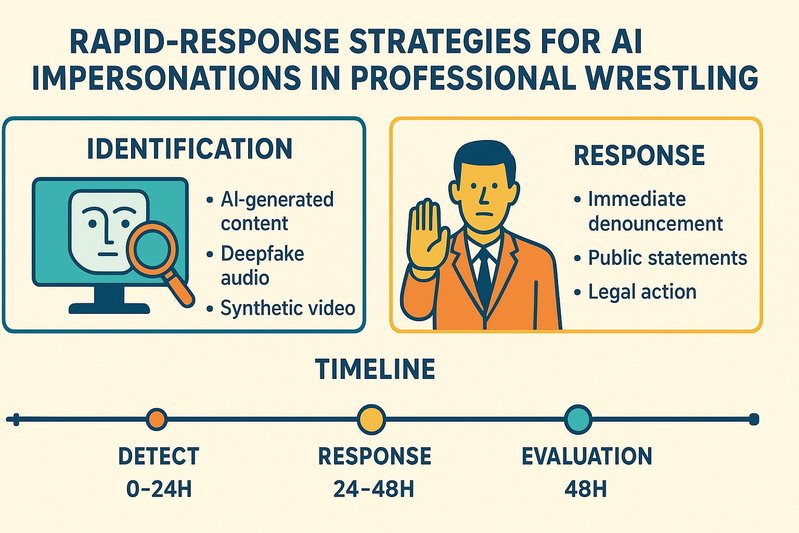
Rapid‑Response Playbook for AI Impersonations Targeting Pro Wrestlers
When a fake promo hits a platform at 2 a.m., damage can compound by sunrise: confused fans, sponsor jitters, and impersonators monetizing attention. Allegations of AI‑generated videos depicting WWE talent in early 2026—without a definitive, public record—highlight how fast impersonations can spin up and how critical it is to respond with precision. Wrestlers and promotions sit at the intersection of persona‑driven brands, centralized media IP control, and a fragmented legal and platform ecosystem. That makes the first 24–72 hours decisive.
This playbook lays out a step‑by‑step response strategy designed for U.S.‑based incidents: how to intake tips without tipping off adversaries, verify and preserve evidence, reconstruct timelines and distribution maps, classify content to the right legal levers, sequence notices across platforms, coordinate among promotion/talent/counsel, choose venues that maximize leverage, and communicate publicly without amplifying the hoax. It closes with a post‑mortem checklist, metrics, and a continuous‑improvement loop to harden defenses.
Intake, Verification, and Preservation (Without Tipping Off Adversaries)
Start with quiet rigor. The goal in hour zero is to capture and preserve everything—at the highest quality and with strong chain‑of‑custody—while avoiding mass engagement that could alert uploaders, trigger deletions, or drive algorithmic spread.
flowchart TD
 A[Start] --> B[Establish Incident Lead]
 B --> C[Secure Comms Channel]
 C --> D[Assign Incident Commander]
 C --> E[Create Triaging Team]
 E --> F["Secure Workspace & Logbook"]
 F --> G["Intake & Hush Protocols"]
 G --> H[Acknowledge Tips]
 G --> I[Route Media Inquiries]
 H --> J["Evidence Capture & Chain of Custody"]
 J --> K[Preserve Evidence]
Flowchart illustrating the process of intake, verification, and preservation of evidence in a manner that does not alert adversaries. Each step builds on the previous to ensure secure handling and documentation.
-
Establish a single incident lead and secure comms channel
-
Assign an incident commander (IC) and a cross‑functional triage team (legal, comms, platform ops, talent liaison).
-
Spin up a secure workspace and logbook with time‑stamped entries and access controls.
-
Intake and hush protocols
-
Acknowledge internal tips and talent alerts immediately; instruct staff and talent not to reply, quote‑tweet, or comment on suspect posts.
-
Route all public/media inquiries to comms holding lines.
-
Evidence capture and chain of custody
-
Record first‑seen timestamps, URLs, account handles, post IDs, and any revenue links (ads, affiliate codes, tips, channel memberships).
-
Download original media at the highest available quality; avoid screen recordings unless no other option exists.
-
Generate cryptographic hashes (e.g., SHA‑256) for each file and archive in read‑only storage.
-
Preserve full page captures and server response headers where possible.
-
If platforms expose provenance metadata (for example, C2PA Content Credentials on official content), screenshot and export those details.
-
Note any visible or suspected invisible watermarks. Treat watermarks (such as common invisible tags) as supportive, not dispositive—transformations can degrade or strip signals.
-
Quiet fact‑finding
-
Check for any official WWE/TKO outputs that could have been misused or edited.
-
Solicit confirmation from the affected talent about whether any legitimate session could be the source of the clip’s materials.
-
Keep options open
-
Avoid early evaluative language in internal logs (“defamatory,” “intimate,” “satire”) until legal has reviewed the clip.
-
Do not contact the uploader yet. Prepare notices first, then execute sequencing (below).
Mapping, Classification, and the Decision Tree
Once the initial cache is secured, reconstruct the incident and choose the right enforcement path. Two tasks run in parallel: timeline reconstruction and content classification.
Timeline reconstruction and distribution mapping
-
Build a timeline of “first appearance” by platform, including:
-
Upload time, handle, post ID, and geo metadata if available.
-
Cross‑posts and aggregations (e.g., YouTube to X to TikTok), influencer pickups, subreddit threads, Telegram forwards.
-
Indicators of coordinated or bot amplification.
-
Monetization vectors (YouTube ads, affiliate links, donation links).
-
Create a distribution map
-
Prioritize major video platforms (YouTube, Instagram/Facebook, TikTok), X, Reddit, and any smaller hosts that commonly reupload.
-
Track takedown IDs and outcomes per URL to monitor recidivism.
-
Identify the single “parent” file if multiple edits are circulating; preserve all variants.
-
Capture provenance differentials
-
For official WWE outputs, ensure C2PA Content Credentials are present and demonstrable; catalog those as authenticity benchmarks.
-
Record instances where alleged videos lack provenance or appear to have altered/stripped metadata, which may support claims concerning removed or falsified copyright information.
Decision tree: choose the right lane
Classify the content into one of four lanes. This determines the lead filer, legal theory, and platform channels you’ll use first.
- Footage‑based (uses WWE‑owned audio/video, logos, or graphics)
- Indicators: recognizable WWE broadcast footage, entrance themes, lower‑third graphics, PPV clips.
- Lead filer: Promotion (WWE/TKO).
- Primary lever: DMCA §512 notice‑and‑takedown; consider claims for removal or alteration of copyright management information when credits/watermarks are stripped.
- Platform channels: Copyright portals (YouTube, Meta, X, TikTok), Content ID where available.
- Synthetic persona (face/voice convincingly cloned; no WWE IP embedded)
- Indicators: fully generated or heavily manipulated video/audio; no underlying WWE footage.
- Lead filer: Talent (right of publicity and false endorsement), coordinated with WWE where marks or brand elements appear.
- Primary levers: State right‑of‑publicity statutes (e.g., California, New York), Lanham Act false endorsement when there’s implied sponsorship or commercial use.
- Platform channels: Manipulated/synthetic media policies; privacy complaints for simulated face/voice dedicated routes; trademark/brand impersonation if marks appear.
- Intimate or sexually explicit deepfake
- Indicators: nudity/sexual depiction; coercive or harassing context.
- Lead filer: Talent (civil remedies for unlawful dissemination of sexual deepfakes where applicable), with safety and support protocols.
- Primary levers: State civil remedies for sexual deepfakes (including dedicated New York statute), platform intimate‑image policies; potential criminal or civil nonconsensual image statutes depending on jurisdiction.
- Platform channels: Fast‑track intimate‑image removal portals; escalations through safety teams.
- Defamatory insinuation or false facts
- Indicators: claims of illegal conduct, cheating, criminality, or factual misstatements presented as real.
- Lead filer: Talent (defamation/false light); promotion may support if brand is implicated.
- Primary levers: Defamation and privacy torts; Lanham false endorsement if commercial pitch is tied to the misrepresentation.
- Platform channels: Manipulated media, deception, and safety policies; escalation citing reputational harm.
A compact matrix for action planning:
| Scenario | Lead Filer | Primary Legal Lever | Initial Platform Channel |
|---|---|---|---|
| Footage‑based | Promotion | DMCA §512; potential §1202 CMI | Copyright portals; Content ID |
| Synthetic persona | Talent (+Promotion if marks used) | Publicity; Lanham false endorsement | Synthetic/manipulated media; privacy face/voice |
| Intimate deepfake | Talent | State intimate‑image remedies | Intimate image/safety reporting |
| Defamatory | Talent | Defamation/false light (+Lanham if commercial) | Manipulated media; deception/safety |
Notice Sequencing, Channels, and Venue Strategy
The order of operations matters. Sequence notices to suppress reach quickly without foreclosing stronger claims.
flowchart TD;
 A["Wave 1: Triage and quick cuts"] --> B[File DMCA notices];
 B --> C[Include hashes and exact timecodes];
 A --> D[Submit platform impersonation complaints];
 D --> E[YouTube privacy complaints];
 D --> F["X, cite deceptive policy"];
 D --> G[TikTok synthetic media policy];
 D --> H[Meta manipulated media policy];
 I["Wave 2: Rights-based escalations"] --> J[Send right-of-publicity letters];
 J --> K[Preserve evidence];
 A --> I;
This flowchart outlines the notice sequencing strategy for managing content using WWE-owned assets, detailing steps from immediate DMCA filings to rights-based escalations.
Notice sequencing playbook
-
Wave 1: Triage and quick cuts
-
File DMCA notices immediately for any clip using WWE‑owned footage, audio, logos, or graphics. Include hashes and exact timecodes where feasible.
-
In parallel, submit platform impersonation/manipulated media complaints for synthetic persona clips; on YouTube, use the dedicated privacy complaint route for simulated face/voice. On X, cite the deceptive synthetic media policy; on TikTok, the synthetic media policy; on Meta, manipulated media and labeling commitments.
-
Wave 2: Rights‑based escalations
-
Send right‑of‑publicity and Lanham Act demand letters to uploaders where identity is known; preserve the option for platform‑targeted actions depending on venue leverage (see below).
-
Where marks appear, add trademark complaints via platform brand portals to strengthen takedown scope.
-
Wave 3: Intensify pressure
-
For intimate deepfakes, deploy state civil remedies, request expedited removal under platform intimate‑image policies, and coordinate safety resources for talent.
-
Consider §1202 claims if evidence indicates removal or alteration of copyright management information (e.g., stripped credits/watermarks) associated with infringing edits.
-
Wave 4: Litigation assessment
-
Evaluate a narrow, high‑leverage filing if content persists or recidivism is high. Weigh forum selection to maximize exposure for platforms or commercial exploiters, factoring Section 230 contours.
Platform‑specific channels checklist
-
YouTube
-
DMCA: standard copyright webform; Content ID where eligible.
-
Synthetic media: labeling requirements for realistic AI; privacy complaint route specifically for simulated face/voice content; nondisclosure can lead to penalties.
-
Escalation: partner managers and trusted‑flagger status accelerate action.
-
Meta (Facebook/Instagram)
-
Manipulated media policies and broader AI‑generated content labeling commitments can support removal or labeling.
-
Use trademark and privacy portals where persona and marks are co‑used.
-
X
-
Deceptive synthetic and manipulated media policy allows labels, reach limits, or removal.
-
Pair manipulated‑media reports with trademark notices if brand assets appear.
-
TikTok
-
Synthetic media policy mandates labeling; prohibits misleading depictions that cause harm and depictions of private individuals or minors.
-
Use IP portals for any WWE content and safety reporting for harmful impersonations.
Venue strategy and leverage in platform‑targeted actions
Choosing where to bring a platform‑targeted claim can reshape the risk calculus:
-
Section 230’s IP exception is pivotal
-
Platforms are broadly immune for user content, but the IP exception complicates the picture. Courts disagree whether state right‑of‑publicity claims fall within that exception.
-
In some jurisdictions, state publicity claims have been allowed to proceed against platforms; in others, courts construe the exception narrowly to federal IP only.
-
Leverage the circuit split
-
If contemplating platform liability for publicity‑based harms, forum shop toward circuits more receptive to state publicity claims against platforms. Conversely, expect stronger immunity arguments in circuits applying a narrow IP exception.
-
For federal IP hooks (copyright, trademark), the IP exception to Section 230 is clearer, boosting leverage.
-
Regulatory pressure as a complement
-
The FTC’s finalized rule on government/business impersonation and its proposed rule extending to individual impersonation signal regulatory scrutiny of deceptive AI‑enabled impersonation. Citing these developments in demand letters can amplify urgency.
-
At the federal legislative level, the NO FAKES Act’s momentum underscores the policy trajectory toward harmonized protection against unauthorized AI replicas—useful context in negotiations, even before adoption.
-
Cross‑border notes for global distribution
-
If the same clips reach EU/UK audiences, transparency duties for deepfakes under the EU AI regime, GDPR constraints on biometric data, UK passing off for false endorsements, and Online Safety Act duties can supplement U.S. measures. Incorporate labeling and consent expectations in takedown narratives when geo‑relevant.
Coordination, Communications, and Continuous Improvement
Strong process beats whack‑a‑mole. Assign roles, lock messaging, and build a feedback loop that lifts time‑to‑resolution and reduces recidivism.
Coordination between promotion, talent, and external counsel
-
Role clarity
-
Promotion leads on copyright and trademark claims; talent leads on right‑of‑publicity, intimate‑image, and defamation claims. Coordinate filings to avoid conflict and duplication.
-
Designate external counsel with experience in publicity, Lanham, and platform practice to vet notices and prep litigation options.
-
Contract hygiene
-
Update standard agreements to require explicit, informed consent for digital replicas and voice clones; bound by purpose, duration, territory, and compensation. Include kill‑switches and audit rights over AI vendors, with do‑not‑train covenants.
-
Bake in provenance requirements for official outputs using C2PA Content Credentials. This strengthens attribution and platform enforcement.
-
Platform partnerships
-
Pursue trusted‑flagger status and memoranda of understanding that align WWE’s roster registry and provenance signals with platform enforcement workflows. Joint incident metrics can bolster advertiser confidence.
Public communications and sponsor assurance
-
Holding lines and speed
-
Within the first hours, issue a brief holding statement acknowledging awareness, noting that evidence collection is underway, and warning fans about deceptive AI impersonations—without repeating the claims or linking to the content.
-
For intimate or high‑harm scenarios, add explicit safety language and assurances of support to the affected talent.
-
Authenticity anchors
-
Promote an authenticity page outlining how to verify official content (for example, visible labels and Content Credentials on official channels). Publish a roster registry of official handles and approved synthetic projects, if any.
-
Sponsor outreach
-
Provide private briefings to key partners summarizing steps taken, platform receipts (without sensitive details), and expected timelines for resolution.
-
Reiterate compliance with platform policies and emerging regulator expectations to reinforce brand safety.
-
Post‑removal messaging
-
After successful takedowns, post a concise update: the content was unauthorized, platforms have removed it, and official channels bear authenticity signals. Avoid amplifying the original narrative.
Post‑mortem, metrics, and continuous improvement
-
Metrics to track
-
Time‑to‑first‑notice (per platform and per legal lane).
-
Time‑to‑removal and rate of remonetization suppression.
-
Recidivism: reuploads per week and mean time between reuploads.
-
Ratio of copyright vs. synthetic‑persona takedowns.
-
Trusted‑flagger throughput and response variance.
-
Sponsor sentiment shifts (qualitative if specific metrics unavailable).
-
After‑action review
-
Convene within 72 hours of containment. What evidence gaps slowed notices? Which platform channels under‑performed? Did any notices misclassify the content type?
-
Update templates, escalate trusted‑flagger requests, and refine the decision tree accordingly.
-
Contract and vendor updates
-
Add learnings to AI vendor codes of conduct: mandatory provenance, watermarking where relevant, secure operations, and auditable logs.
-
Expand do‑not‑train lists and scan‑and‑block covenants with liquidated damages for breaches.
-
Training and drills
-
Run quarterly tabletop exercises simulating each decision‑tree lane (footage‑based, synthetic persona, intimate, defamatory).
-
Refresh comms playbooks and keep contact rosters for platform escalations current.
-
Program maturity goals
-
Within 3 months: amend talent agreements for AI consent and compensation; launch a performer registry linked to Content Credentials; negotiate trusted‑flagger statuses.
-
Within 12 months: pilot opt‑in group licensing for digital replicas with dashboard controls for performers; publish transparent fan‑content guidelines that preserve lawful commentary while curbing exploitative impersonation.
-
Ongoing: maintain incident dashboards, iterate rate cards for authorized synthetic projects with clear approval workflows, and stress‑test cross‑border compliance where distribution extends to the EU/UK.
Conclusion
AI impersonations hit pro wrestling where it’s most vulnerable: personas with global fanbases and rich media archives, circulating on platforms whose rules and tools don’t always align. Speed and sequencing determine outcomes. Capture first, classify smartly, fire the right notices in the right order, and pick venues that maximize leverage. Pair legal and platform tactics with provenance and trusted‑flagger relationships, then close the loop through contracts, vendor standards, and training. That’s how you bend time‑to‑removal down and recidivism toward zero.
Key takeaways:
- Preserve before you broadcast: collect originals, hashes, and provenance signals without engaging uploaders.
- Classify the content to the right lane; let that drive lead filer, legal theory, and platform channel.
- Sequence DMCA, publicity/Lanham, and manipulated‑media notices for rapid suppression.
- Use venue strategy to exploit the Section 230 IP‑exception landscape when targeting platforms.
- Lock coordination, comms, and contracts—provenance on official outputs, explicit AI consent, and trusted‑flagger status are force multipliers.
Immediate next steps:
- Stand up a cross‑functional incident team and quiet‑intake process.
- Build reusable notice templates for each decision‑tree lane and each platform.
- Enable Content Credentials on all official channels and publish an authenticity page.
- Begin trusted‑flagger and escalation negotiations with YouTube, Meta, X, and TikTok.
- Amend standard talent agreements to require explicit AI consent, compensation, kill‑switches, and audit rights.
The long game is a consent‑first, provenance‑backed enforcement architecture that protects performers and partners while respecting legitimate fan expression. Wrestlers and promotions that operationalize this playbook won’t just survive the next deepfake—they’ll set the industry’s bar for resilience. 🛡️