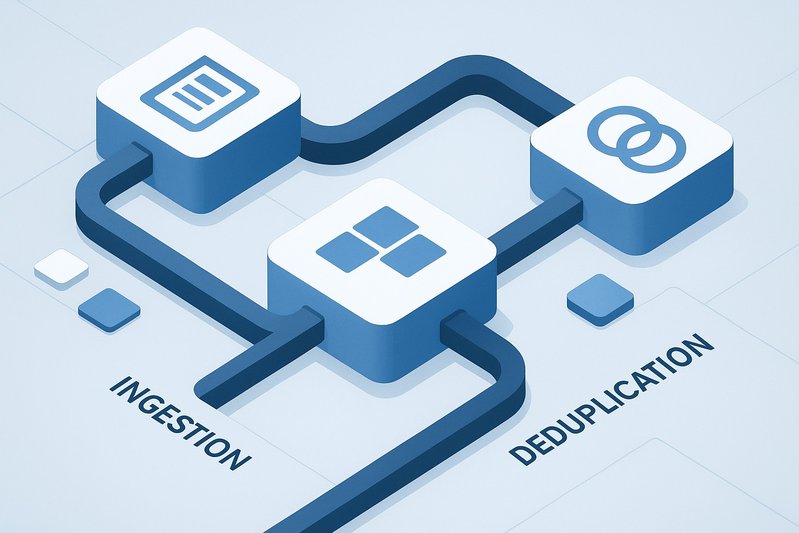
Provenance‑First Pipelines Rewire NVIDIA’s Multimodal Training Stack
Stock/editorial catalogs with contributor releases, license‑aware code corpora, and simulation‑grade synthetic engines are reshaping how multimodal models are trained. As Europe’s AI Act pushes for transparent training‑data summaries and Getty’s legal actions raise the stakes on unlicensed ingestion, NVIDIA has rebuilt key parts of its stack around provenance‑first data flows. The result is a training architecture that swaps brittle web scrapes for rights‑cleared libraries, metadata‑aware sampling, large‑scale deduplication, and principled real–synthetic mixing across vision, video, and code. This also aligns model delivery with enterprise governance demands, where traceability and repeatable policy enforcement are non‑negotiable.
This article maps the technical blueprint: how ingestion, curation, and license signals propagate through multimodal pipelines; how exact/perceptual hashing and MinHash families reduce memorization risks; how metadata‑aware sampling and synthetic data expand long‑tail coverage; how temporal handling in video tightens label quality; and how containerized microservices stabilize policy enforcement and traceability. Readers will see how these choices impact robustness, calibration, and enterprise readiness—and where metrics remain unavailable or implementation‑dependent.
Architecture/Implementation Details
From scrape‑first to provenance‑first
NVIDIA’s earlier pipelines looked like much of the industry: large web scrapes for text and images, augmented by academic datasets and growing synthetic sets. That model delivered scale but weak provenance, inconsistent demographic coverage, and higher toxicity/NSFW exposure. The re‑architecture centers on:
flowchart TD;
 A["Rights-Cleared Visual Corpora"] -->|integrates with| B["Enterprise Generative Endpoints"];
 A -->|involves| C["Contributor Consent Programs"];
 A -->|includes| D["Rich Metadata"];
 B --> E["Simulation Workflows (Omniverse)"];
 B --> F["Partnerships with Getty Images and Shutterstock"];
 G["License-Aware Code Foundation"] -->|uses| H["StarCoder2"];
 H --> I["Trained on The Stack v2"];
 A -->|synthetic scale-up with| J["Omniverse Replicator and Isaac Sim"];
This flowchart illustrates the transition from NVIDIA’s traditional scrape-first pipeline to a provenance-first architecture, emphasizing the integration of rights-cleared visual corpora with enterprise systems, consent programs, and license-aware code foundations.
- Rights‑cleared visual corpora integrated with enterprise generative endpoints (Picasso/Edify) and simulation workflows (Omniverse), primarily via partnerships with Getty Images and Shutterstock. These catalogs arrive with contributor consent programs, model/property releases, indemnification pathways, and rich metadata that flow through training and deployment.
- A license‑aware code foundation through StarCoder2 trained on The Stack v2, a curated corpus with de‑PII and malware filtering and documented license signals.
- Synthetic scale‑up with Omniverse Replicator and Isaac Sim for photorealistic vision/3D/video data with perfect labels and domain randomization, plus Nemotron to generate instruction and preference data that is policy‑constrained and traceable.
- Provenance‑aware delivery via NVIDIA NIM microservices and NeMo Guardrails, which encapsulate ingestion controls, safety filtering, logging, and policy enforcement for training and inference.
The upshot: provenance becomes a first‑class signal that shapes every downstream step—deduplication, sampling, evaluation, and compliance.
Multimodal ingestion by modality
- Vision/3D/Video: Licensed stock/editorial image and video libraries provide category breadth, releases for enterprise use, and metadata across geography, demographics, and scene composition. These assets condition and train diffusion and editing models in Picasso/Edify and feed simulation‑grade workflows in Omniverse. Synthetic data from Replicator and Isaac Sim expands long‑tail conditions (rare weather, hazards, robotics kinematics) with precise annotations, providing controllable knobs for distributional balancing.
- Text/Audio: Without exclusive publisher or audio deals, text and audio rely on open corpora augmented by Nemotron‑generated alignment data and customer‑provided domains. Diversity gains are steadier here, and multilingual depth depends on curated non‑English sources and the quality of alignment signals.
- Code: StarCoder2’s training on The Stack v2 introduces license awareness across languages and frameworks with de‑PII and malware filtering documented in the dataset card, improving compliance and downstream trust for code models deployed via NIM/NeMo.
Curation, PII/malware filtering, and license signal propagation
Curation pivots from after‑the‑fact heuristics to upstream quality guarantees:
- Visual: Rights‑cleared content arrives with explicit releases, captions, and editorial descriptors. These fields propagate into training records and RAG/conditioning stores, enabling group‑wise audits and takedown workflows. Safety filtering benefits from lower baseline toxicity/NSFW prevalence relative to open scrapes, with additional policy enforcement during both training and inference via NeMo Guardrails.
- Code: The Stack v2’s documented de‑PII and malware filtering reduce sensitive leakage and unsafe code exposure while keeping license signals intact for auditability and downstream distribution constraints.
- Text/Audio: Alignment data generated via Nemotron is traceable and policy‑constrained, allowing teams to gate and log the creation of synthetic instructions and preferences.
Across modalities, license fields and consent metadata are carried through data lineage so teams can answer “what went into this model” with actionable granularity.
Deduplication at scale: exact/perceptual hashing and MinHash families
Provenance‑first ingestion changes the dedup problem from “clean a noisy scrape” to “consolidate around a canonical, licensed copy.” Teams apply:
- Exact/perceptual hashing for images and video frames, combined with approximate nearest neighbor search to catch near‑duplicates across crops, resizes, and re‑encodings.
- MinHash/SimHash/n‑gram filtering for text and code to suppress near‑duplicated snippets, boilerplate, and reposted samples across corpora.
Empirical evidence in language models shows deduplication reduces memorization and improves generalization; similar benefits carry into multimodal pipelines when paired with metadata‑aware sampling. Practically, organizations should expect lower near‑duplicate rates after consolidation around licensed corpora, higher effective category entropy, and fewer toxic/NSFW leak‑throughs than open‑scrape baselines.
Metadata‑aware sampling and distributional balancing
Stock/editorial metadata provides subgroup and scene descriptors—releases, regions, shot types—that enable principled sampling beyond naïve uniform draws. Teams compute category entropy and inequality indices (e.g., Gini) pre/post integration and then rebalance minibatches to raise coverage of underrepresented categories and geographies. Synthetic generators fill gaps deliberately: Replicator creates rare scenes and object combinations with perfect labels; Nemotron populates instruction spaces under policy constraints. This shifts diversity where it matters (tail conditions and enterprise‑critical subgroups) rather than spiking uncontrolled noise.
Temporal coverage for video and label propagation
Stock/editorial video brings richer shot‑type coverage and scene diversity, with metadata that can be propagated to training records. Synthetic video from Replicator bolsters temporal edge cases—motion patterns, occlusions, hazards—while preserving exact ground truth (e.g., trajectories, segmentation, depth). Mixing real and synthetic improves temporal generalization for video diffusion and multimodal alignment, especially when validation remains strictly on held‑out real data. Specific temporal metrics are implementation‑dependent; teams should track per‑scenario recall, error calibration across durations, and failure modes under occlusion—specific metrics unavailable.
License‑aware code pipelines and benchmark alignment
Training code models on a curated, license‑aware corpus (The Stack v2) improves both compliance and domain coverage. StarCoder2 demonstrates competitive results on HumanEval/MBPP‑style tasks within open LLM cohorts while maintaining documented de‑PII and malware filtering. That posture matters for enterprise deployment: models inherit license constraints that can be surfaced in NIM documentation and enforced through policy, while benchmark alignment remains intact without relying on indiscriminate scrapes.
Microservice delivery for traceability and policy stability
NIM microservices package models and guardrails into repeatable endpoints for ingestion, training, and inference. This microservice layer centralizes:
- Safety filtering and policy enforcement (via NeMo Guardrails),
- Logging and audit trails to support enterprise governance,
- Stable rollout mechanisms that preserve data and model lineage.
C2PA participation complements this by enabling authenticity and provenance metadata in creative pipelines, ensuring downstream consumers retain context about model‑generated artifacts.
Comparison Tables
Scrape‑first vs. provenance‑first pipelines
| Dimension | Scrape‑first baseline | Provenance‑first redesign |
|---|---|---|
| Provenance traceability | Sparse, lossy | Rights‑cleared with releases and consent metadata |
| Metadata richness | Inconsistent captions/tags | Editorial/stock descriptors, demographics, regions |
| PII/NSFW exposure | Higher leak‑through risk | Lower baseline exposure; policy tooling applied |
| Dedup complexity | Heavy overlap with reposts | Consolidation around canonical licensed copies |
| License compliance | Often unclear | Documented licenses; takedown pathways |
| Sampling control | Limited subgroup signals | Metadata‑aware, subgroup balancing |
| Governance readiness | Ad hoc | Microservice logging, guardrails, C2PA alignment |
| Temporal/video coverage | Uneven shot/scene types | Richer shot types plus synthetic temporal edge cases |
Deduplication techniques and where to use them
| Technique | Best for | Strengths | Limitations |
|---|---|---|---|
| Exact hashing | Identical files (images/video frames) | Fast, precise | Misses resizes/crops/encodes |
| Perceptual hashing | Images/video near‑dupes | Catches mild transforms | Tunable thresholds; false positives on lookalikes |
| ANN near‑duplicate search | Embedding‑space neighbors | Scales to billions with indexing | Infrastructure complexity |
| MinHash/SimHash | Text/code near‑dupes | Efficient Jaccard/Hamming approximations | Sensitive to tokenization and shingling choices |
| n‑gram filters | Text/code boilerplate | Simple implementation | Coarse; can over‑filter without care |
Real–synthetic mixing by use case
| Domain | Real:synthetic tendency | Rationale |
|---|---|---|
| Creative vision (Picasso/Edify) | Real dominant; synthetic augmentation | Rights‑cleared aesthetics; synthetic covers rare styles/objects |
| Robotics/industrial vision (Omniverse/Isaac Sim) | Synthetic majority in fine‑tuning | Edge‑case coverage, perfect labels, deterministic regeneration |
| Text LLM alignment (Nemotron) | Rising synthetic share | Policy‑constrained instruction/preference data under tight provenance |
| Code (StarCoder2 + The Stack v2) | Real, license‑aware corpus | License compliance, de‑PII/malware filters, broad language coverage |
Best Practices 🔧
- Anchor ingestion in licensed catalogs and propagate license fields, contributor consent, releases, and region/demographic metadata through your data warehouse and feature stores. Maintain takedown hooks that can surgically purge training examples and associated embeddings.
- Run deduplication in stages: exact hashing first, then perceptual hashing and ANN search for near‑dupes; for text/code, layer MinHash/SimHash with n‑gram filters. Track overlap with existing corpora and with evaluation/test sets to cut memorization risk.
- Make metadata work: compute category entropy and inequality indices before and after provenance‑first consolidation. Use these signals to create sampling schedules that up‑weight underrepresented classes and geographies. Specific thresholds are workload‑dependent; expose them as configuration rather than constants.
- Treat synthetic as an instrument, not a crutch: use Replicator and Isaac Sim to fill tail conditions with perfect labels; validate on held‑out real sets to calibrate sim2real transfer. For text alignment, generate Nemotron data under explicit guardrails and keep generation logs for audit.
- Tighten video temporals: stratify sampling by shot type, motion profile, and occlusion regime. Leverage synthetic video to target failure modes (e.g., fast motion, low light). Label propagation should preserve release and scene metadata at the clip and segment levels.
- Harden delivery with NIM microservices: centralize safety filtering, policy enforcement, and logging. Pair with NeMo Guardrails for consistent behavior across training and inference, and participate in authenticity frameworks (e.g., C2PA) to carry provenance into outputs.
- Measure what matters: beyond FID/CLIP-style scores, track recall and error calibration in rare conditions, OCR performance in challenging layouts, and subgroup‑wise error rates. Where metrics are unavailable publicly, establish internal dashboards and ablation protocols.
Note on curriculum: staged mixing strategies and curriculum schedules can help ramp difficulty or adjust real–synthetic ratios over time, but specific prescriptions are implementation‑dependent; details unavailable.
Observed Performance Effects
- Robustness and long‑tail recall: Mixing rights‑cleared real data with domain‑targeted synthetic data consistently improves robustness when validated on held‑out real test sets in vision and robotics. Synthetic offers controlled diversity and perfect labels; licensed real data anchors realism and aesthetic fidelity. Teams report fewer brittle failures on rare weather, edge hazards, and complex kinematics; specific numeric metrics unavailable.
- Memorization and leakage: Deduplication reduces memorization in language models and applies similarly in multimodal pipelines. Consolidating around licensed copies lowers near‑duplicate density and toxic/NSFW leak‑through compared to open scrapes, easing downstream safety filters and reducing inadvertent content regurgitation.
- Calibration and fairness: Metadata‑aware sampling and subgroup evaluation supported by release and region labels enable better monitoring of calibration across demographics. Improvements are workload‑specific; organizations should track false positive/negative rates and calibration gaps per subgroup—specific metrics unavailable.
- “Stock/editorial bias” trade‑off: While curated visual catalogs improve labeling and governance, they can over‑represent staged or high‑visibility contexts. Synthetic augmentation and metadata‑aware sampling mitigate this by injecting everyday and rare scenarios to rebalance distributions.
- Code quality with compliance: StarCoder2 trained on The Stack v2 maintains competitive performance on HumanEval/MBPP‑style benchmarks within open LLM cohorts while preserving a clear licensing and safety posture. Enterprises gain auditability and reduced legal risk without sacrificing breadth across languages and frameworks.
- Text alignment outcomes: Nemotron‑generated instruction and preference data improve instruction following and reduce toxicity/refusal rates in controlled evaluations. Multilingual generalization still depends on seed data quality and careful augmentation—specific cross‑language metrics unavailable.
Conclusion
A provenance‑first redesign changes the physics of multimodal training. Rights‑cleared visual/video catalogs deliver rich metadata and governance; license‑aware code corpora improve compliance; Replicator and Isaac Sim expand tail coverage with perfect labels; Nemotron provides policy‑constrained alignment data; NIM and Guardrails wrap the stack in repeatable safety instrumentation. Deduplication and metadata‑aware sampling reduce memorization and calibrate distributions. The net effect is a stack better suited to enterprise requirements for auditability, stability, and fairness—without abandoning performance.
flowchart TD;
 A["Provenance-first redesign"] --> B["Rights-cleared visual/video catalogs"];
 A --> C["License-aware code corpora"];
 A --> D["Replicator and Isaac Sim"];
 A --> E["Nemotron"];
 A --> F["NIM and Guardrails"];
 B --> G["Deduplication and metadata-aware sampling"];
 F --> H["Stack features: auditability, stability, fairness"];
 G --> H;
This flowchart illustrates the processes involved in a provenance-first redesign that enhances multimodal training through various components and their contributions to compliance and governance.
Key takeaways:
- Replace scrape‑first ingestion with licensed, metadata‑rich catalogs and propagate license signals end‑to‑end.
- Combine exact/perceptual hashing and MinHash families to cut near‑duplicates and memorization risk at scale.
- Use synthetic generation surgically to fill tail scenarios; always validate on held‑out real data.
- Make subgroup and temporal metadata first‑class citizens in sampling and evaluation.
- Deliver models as microservices with integrated guardrails, logging, and provenance, and align with authenticity frameworks.
Actionable next steps:
- Inventory your training corpora by modality and compute category entropy and Gini indices before/after integrating licensed sources.
- Stand up a dedup pipeline across images/video/text/code with staged thresholds and overlap reports against test sets.
- Establish real:synthetic ablation studies for each workload, documenting performance under rare conditions and calibration across subgroups.
- Enable NIM microservices with NeMo Guardrails in both training and inference environments, and adopt C2PA for creative outputs.
Forward‑looking, provenance‑first pipelines will only gain importance as disclosure obligations tighten and multimodal models move deeper into safety‑critical domains. The teams that wire provenance, deduplication, and synthetic control into their foundations today will own the reliability and compliance curves tomorrow.