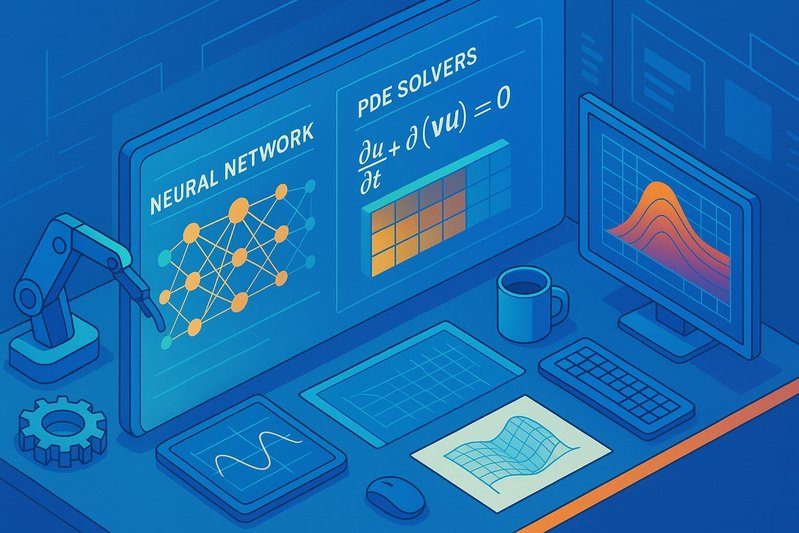
Pareto-Optimized PDE Solvers Reshape Engineering Workflows and Budgets
Neural surrogates for differential equation solvers are now fast enough and accurate enough to be seriously considered in production—but choosing them isn’t a binary bet. The industry has lacked a shared way to compare learned and classical solvers beyond anecdotes. That’s changing. A new benchmarking protocol reframes the decision as a portfolio allocation across accuracy–cost trade-offs, plotting Pareto frontiers instead of picking a single winner. It aligns with how product owners and technical leaders actually manage budgets and risk: by matching the solver family to the workload and service-level needs, not by forcing one tool to do it all.
This article shows how to use a Pareto lens—built on standardized, reproducible benchmarking—to decide when learned surrogates can overtake classical solvers on throughput, latency, and total cost of ownership. You’ll learn where amortization flips the economics, which regimes favor different solver classes, how procurement and infrastructure choices shift TCO, which KPIs and SLAs to track, and a practical adoption playbook to minimize regret while capturing real gains.
Executive lens: benchmarking that unlocks portfolio decisions
The hardest part of adopting learned PDE solvers has not been finding models; it’s been comparing them fairly to classical baselines. The DInf-Grid protocol provides the missing scaffolding: a suite spanning stiff and nonstiff ODEs and canonical PDEs (elliptic, parabolic, hyperbolic) across 1D/2D/3D, with consistent refinement ladders and empirical order-of-convergence (EOC) estimation in problem-appropriate norms. This enables executives to see error versus cost plotted in the same currency across solver families, so teams can invest where each class sits on the Pareto frontier.
Why it matters for decisions:
- Accuracy is measured in standardized L2/L∞ norms and in application-specific diagnostics (e.g., stability and invariant drift), giving a defensible basis for SLAs and risk reviews.
- Cost is decomposed into training GPU-hours, inference wall-clock, FLOPs per rollout, and peak memory, so procurement can compare amortized inference versus total (training+inference) cost directly.
- Classical stacks—DifferentialEquations.jl for ODEs, SUNDIALS for stiff problems, PETSc TS for PDE time integration, Clawpack for hyperbolic dynamics, FEniCS/deal.II for FEM, and Dedalus for spectral periodic cases—define trustworthy references and ground-truth convergence behaviors.
- Learned families—Neural ODEs, PINNs, neural operators (FNO/DeepONet/PINO), and learned numerical components—are evaluated under the same refinement discipline and with confidence intervals across seeds to quantify robustness.
The result isn’t a winner-takes-all verdict. It’s a Pareto map that shows, for each workload, which solver families dominate at specific error targets and cost budgets. That lets leaders allocate spend across a portfolio: classical solvers for one-off high-fidelity runs and validation; learned surrogates for many-query front-line throughput once error budgets are reliably met.
Where amortization wins: many-query workloads
Neural operators and physics-informed surrogates become compelling when inference happens orders of magnitude more often than training. In design-space exploration, digital twin monitoring, uncertainty propagation, and parameter sweeps, a one-time training cost can be amortized over thousands of queries, shifting the economics decisively in favor of learned inference—provided accuracy targets are satisfied and validated. Specific metrics unavailable, but the protocol explicitly measures training and inference wall-clock, FLOPs, and memory to support these comparisons.
- Neural operators (FNO/DeepONet/PINO) deliver strong resolution generalization and very low per-query latency on periodic, smooth problems, which makes them natural throughput engines when queries are abundant.
- Physics-informed approaches have low inference cost but higher training overhead; they are attractive for steady elliptic and diffusive parabolic regimes where residual minimization is effective.
- Classical solvers remain the workhorses for one-off high-fidelity runs, stiff kinetics, and for producing reference data to validate surrogates and bound risk.
Data standardization reduces time-to-value. PDEBench and JAX-CFD supply reproducible datasets and reference generation pipelines for periodic flows and parametric PDEs, shortening the path from pilot to production.
Segmented use cases: matching regimes to likely winners
Verticals rarely operate in a single dynamical regime. Mapping projects to archetypes helps predict ROI and risk before you invest:
- Smooth, periodic, and moderately chaotic flows (e.g., weather-like modeling on toroidal domains): Neural operators excel due to resolution generalization and minimal per-query latency; physics-informed operator variants further stabilize training.
- Parametric subsurface flow (e.g., Darcy with varying permeability fields): Surrogates trained on PDEBench-style splits can accelerate scenario analysis across asset portfolios, with FEM references used for validation.
- Stiff reaction networks and sharp internal layers: Classical implicit integrators (BDF/Radau/IMEX) provide reliability and predictable accuracy; neural ODEs require stiffness-aware backends to approach parity and often carry higher training overhead.
- Shock-capturing problems with discontinuities (e.g., Burgers/Euler): High-resolution finite-volume baselines (WENO + SSP Runge–Kutta) remain the safe default; generic surrogates can produce dispersion/Gibbs artifacts unless made conservative or hybridized, and require careful validation.
This segmentation reduces the temptation to chase a universal solver and instead funds the approach that dominates on the local Pareto frontier for each workload.
Procurement, infrastructure, and total cost of ownership
Adopting learned solvers is as much an MLOps call as it is a numerical one.
- Budgeting and profiling: Treat training budget (GPU-hours) and inference cost (latency, FLOPs, memory) as first-class KPIs. Standardized profilers like ptflops and fvcore help quantify compute and peak memory consistently across candidates.
- Tooling choices: Mature neural-operator repositories (FNO/DeepONet/PINO) and PINN frameworks (DeepXDE/NeuralPDE.jl) reduce implementation risk; classical stacks (SUNDIALS, PETSc, FEniCS/deal.II, Clawpack, Dedalus) anchor baselines and validation.
- Data pipelines: Standardized datasets and generation scripts (PDEBench, JAX-CFD) accelerate data acquisition and reproducibility, critical for procurement reviews and governance.
- Blended fleets: In practice, teams benefit from a mixed estate—modest GPU capacity for model training and inference benchmarks; CPU-centric nodes to run classical baselines and ongoing validations. Specific hardware ratios are application-dependent and not specified in the benchmark; organizations should log hardware and software details as part of repeatable evaluations.
Total cost of ownership improves when you consolidate around reproducible pipelines and standard logs: problem definitions, discretizations, solver settings, training hyperparameters, hardware, software versions, and random seeds—all prerequisites the protocol enforces out of the box.
KPIs, SLAs, and governance that move beyond anecdotes
Procurement and risk teams need more than demo plots. The protocol’s measurement discipline translates directly into governance artifacts:
- Accuracy targets: Expressed in application-aligned norms (e.g., relative L2 for fields, L∞ bounds where maxima matter) and matched to decision thresholds. EOC curves with confidence intervals reveal whether models converge under refinement or plateau due to approximation limits.
- Performance SLAs: Latency caps (average and tail), peak memory ceilings for deployment targets, and throughput commitments—measured consistently via synchronized timers and multiple repetitions—support capacity planning. Specific numeric targets are application-dependent; the protocol standardizes how you measure them.
- Stability budgets: For long-horizon rollouts, track invariant or energy drift per unit time and define acceptable bounds; compare learned solvers to structure-preserving classical references where relevant.
- Robustness and drift: Confidence intervals across multiple training seeds quantify statistical robustness; failure-rate tracking (e.g., blow-ups, unphysical artifacts) and retraining variability become audit-friendly metrics.
Together, these KPIs replace ad hoc claims with comparable, contract-grade evidence across solver classes.
Adoption playbook: de-risked rollout from evaluation to scale
While specific implementation details are not publicly available beyond the protocol, its reproducibility ethos suggests a pragmatic path to scale:
-
Side-by-side evaluation: Keep classical solvers as the source of truth while you benchmark candidate surrogates on production-like workloads. Use standardized EOC and accuracy–cost plots with confidence intervals to surface regimes where the surrogate underperforms.
-
Define safe zones: Restrict surrogate usage to parameter ranges, boundary types, and horizons where error budgets are comfortably met. Use PDEBench/JAX-CFD-style splits to assess generalization and sensitivity to boundary-condition changes.
-
Expand coverage with guardrails: Grow surrogate coverage as you accumulate evidence, and retain periodic revalidation runs on classical baselines. Track failure rates and long-horizon stability; schedule retraining or rollback when drift triggers are exceeded.
This approach turns adoption into a governed, evidence-based process rather than a leap of faith.
ROI scenarios and sensitivity analysis
The business case hinges on the ratio of training expense to avoided classical compute. Two patterns recur across the benchmark’s problem types:
- Design optimization: Replacing thousands of mid-resolution solves with millisecond-scale surrogate inference can compress iteration cycles from days to minutes—provided surrogates meet error budgets against FEM/finite-volume references. Specific metrics unavailable; however, the protocol’s amortized vs total cost Pareto panels quantify when the crossover occurs.
- Real-time operations: Latency-sensitive digital twins benefit from predictable per-query costs that fit within control loops; neural operators on periodic, smooth domains are strong candidates, with classical solvers reserved for periodic validation.
Sensitivity matters:
- Boundary conditions and data coverage: Resolution generalization weakens if deployment BCs differ from those embedded in training; evaluation across Dirichlet/Neumann/periodic cases and parameter shifts is essential.
- Stiffness and shocks: If stiffness indicators are high or discontinuities dominate, expect surrogates to struggle or demand hybrid, conservative components; budget accordingly for validation and potential fallback to classical integrators.
Decision matrix for solver selection
A simple rubric streamlines choices by mapping workloads to dominant solver families:
| Workload regime | Primary concern | Likely winner | Validation anchor |
|---|---|---|---|
| Periodic, smooth, many queries | Throughput and latency | Neural operators (FNO/DeepONet/PINO) | Dedalus/JAX-CFD periodic references |
| Parametric steady elliptic (e.g., Darcy) | Scenario analysis across assets | Neural operators/DeepONet; PINNs for residual control | FEM with multigrid (FEniCS/deal.II + HYPRE) |
| Stiff kinetics, internal layers | Reliability at target accuracy | Classical implicit (BDF/Radau/IMEX) | SUNDIALS/DifferentialEquations.jl |
| Shock-capturing hyperbolic | Conservation, TVD, stability | Classical WENO + SSP-RK; hybrid learned fluxes with caution | Clawpack, WENO literature |
| High-stakes, regulated | Auditability, stability | Classical or hybrid with tight guardrails | Structure-preserving baselines |
This portfolio approach minimizes regret while extracting value where learned models sit on the frontier.
Practical examples
The protocol’s worked examples illustrate how to apply a Pareto lens in practice, even when precise ROI numbers are application-specific:
-
Lorenz-63 (nonstiff ODE): Teams can train a Neural ODE and compare terminal-state and trajectory errors against high-order classical references across a tolerance ladder. If the learned vector field’s error plateaus before the integrator’s EOC, it likely won’t meet production SLAs; otherwise, adaptive integration can cut per-query cost at matched accuracy. This informs whether amortizing training over many control-loop queries makes sense.
-
1D Burgers (smooth vs shock-forming): With WENO+SSP-RK baselines as references, organizations can quantify how surrogates behave before and after shock formation. Smooth regimes may place operators near the Pareto frontier; shock regimes often push them off, signaling a need for conservative hybrids or classical fallbacks in safety-critical paths.
-
2D Navier–Stokes on a torus: Train at 64² and evaluate at 128², 256² to test resolution generalization and long-horizon stability. If energy spectra and enstrophy track JAX-CFD references within tolerance, neural operators can credibly replace many mid-resolution runs in design loops, with classical runs reserved for periodic validation. Specific metrics unavailable; the protocol prescribes the measurements to make the call.
-
2D Darcy with mixed BCs: Generate parametric permeability fields, train DeepONet/FNO on standardized splits, and validate against FEM. If the error plateaus below decision thresholds across parameter shifts, surrogates can power portfolio analysis; if not, stick with classical solves for accuracy-critical assets.
In each case, the benchmark’s EOC curves, Pareto plots (amortized vs total cost), and stability diagnostics provide the governance-grade evidence leaders need to greenlight or halt deployment.
Conclusion
The era of Pareto-optimized PDE solution is here—not because a single learned solver dethrones classical methods, but because a disciplined benchmarking protocol lets organizations allocate budgets where each solver family dominates. The DInf-Grid approach elevates choices from hunches to portfolio decisions, aligning accuracy targets, latency budgets, and TCO with the realities of specific workloads. Procurement gains clarity on training versus inference economics; engineering gains a reproducible path from evaluation to guarded rollout; and risk teams gain KPIs tied to physics and stability, not just visual fit.
Key takeaways:
- Treat solver selection as portfolio optimization, not a binary choice; use EOC and accuracy–cost Pareto plots to guide spend.
- Favor neural operators and physics-informed surrogates for many-query, smooth/periodic regimes; keep classical baselines for stiff, shock-dominated, or high-stakes workloads.
- Operationalize governance: define accuracy norms, latency and memory SLAs, and stability budgets; track robustness across seeds and failure rates over time.
- Build a blended fleet and standardized data/toolchains to speed time-to-value and reduce TCO.
Next steps: Stand up the benchmark on one or two representative problems from your portfolio, instrument costs rigorously, and run a side-by-side evaluation against classical baselines. Use the resulting Pareto map to pilot limited surrogate deployments in safe zones, with scheduled revalidation. From there, scale where the economics—and the evidence—clearly favor learned models. 📈