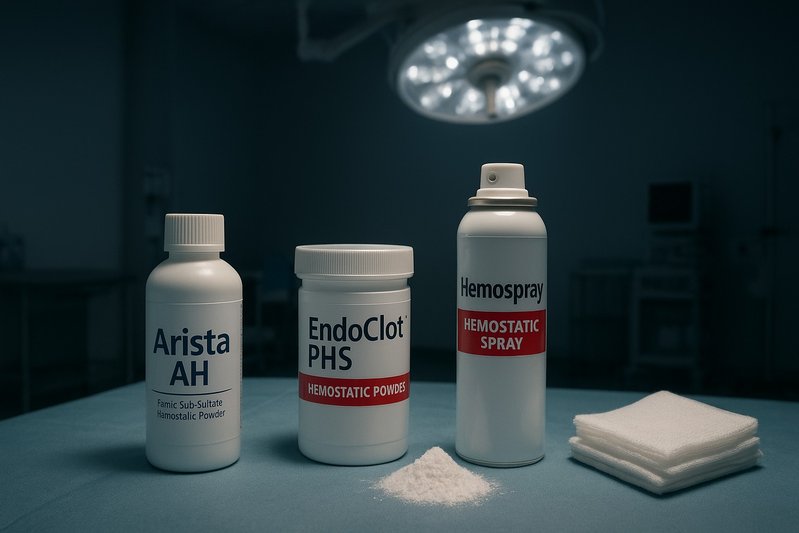
OR and Endoscopy Economics Rewritten by Hemostatic Powders: Arista AH, EndoClot PHS, and Hemospray in Focus
Subtitle: A market and adoption analysis across indications, workflow fit, cost drivers, regulatory pathways, and competitive positioning versus gauze
A few grams of hemostatic powder can flip the economics of a bleeding episode—shortening procedure time, averting transfusions, and unblocking OR and endoscopy throughput. In the surgical suite, absorbable microporous polysaccharide hemostats (MPH) like Arista AH are now routine adjuncts for diffuse oozing. In the GI lab, catheterized powders such as EndoClot PHS and Cook Medical’s mineral-based Hemospray are delivering immediate control for many non-variceal bleeds, reshaping workflows and escalation thresholds. Meanwhile, in the field, hemostatic gauze still rules. The divergence highlights that clinical setting and delivery modality—not just material science—drive adoption and ROI.
This article maps the business and adoption landscape for hemostatic powders across surgery and endoscopy. We examine indication segmentation and workflow fit, quantify cost drivers and offsets, compare competitive positioning versus hemostatic gauze, unpack regulatory pathways across geographies, and outline procurement, training, and human-factor realities. Readers will walk away with a decision framework to deploy powders where they create the most value—and avoid pitfalls where they don’t.
Market Analysis
Indication segmentation and workflow fit
- Surgery (OR): For capillary and venous oozing—especially over broad or irregular surfaces—absorbable MPH (e.g., Arista AH) integrate seamlessly as adjunctive hemostats under direct visualization. Surgeons can dose incrementally with bellows applicators and leave the material to be resorbed, removing only excess to avoid mass effect. This makes powders a natural complement to sutures, clips, and energy devices when pinpoint control is impractical.
- Endoscopy (GI): For non-variceal mucosal bleeding, catheterized, gas-assisted powders—EndoClot PHS (starch-based) and Hemospray (TC-325) (mineral-based)—offer immediate coverage of diffuse or multiple points via the endoscope’s working channel. They function as a bridge or adjunct to definitive therapy and can be deployed quickly when visualization is compromised by active bleeding.
- Prehospital and combat care: In deep tract and junctional hemorrhage, hemostatic gauze remains first-line for packing under TCCC guidelines, with kaolin- or chitosan-impregnated dressings recommended over loose powders due to safety, depth deposition, and removal considerations. This underscores a tactical gap where free powders are not the preferred tool.
Adoption drivers in the OR
Three factors explain why absorbable MPH have quietly become cross-specialty staples:
- Workflow fit under visualization: Surgeons see the oozing field, apply small aliquots, reassess, and move on. The ability to titrate dose saves time relative to assembling and applying thrombin or fibrin sprays in low-risk oozing scenarios.
- Resorbability and simplicity: Absorbable powders reduce later removal steps versus non-absorbable agents; single-use format and straightforward IFUs minimize friction.
- Cross-service standardization: One product line (sizes, applicators) can serve general, vascular, oncologic, spine, and OB/GYN teams, easing formulary decisions and training.
Endoscopy value proposition
In the GI lab, powders change two economics levers: speed to control and case flow.
- Immediate hemostasis: Both EndoClot PHS and Hemospray report high immediate hemostasis rates in non-variceal GI bleeding, offering rapid stabilization that improves visualization and often reduces the need for multiple devices in a single case.
- Catheterized, CO2-assisted delivery: Dedicated catheters and propellant cartridges enable broad, gentle coverage without clogging, which is crucial in the dynamic endoscopic environment where time-to-control dictates sedation time and downstream resource use.
Competitive matrix versus hemostatic gauze
Powders and gauzes each win in their native settings. The table below guides purchasing and protocol design across service lines.
| Attribute | Absorbable MPH (Arista AH) | Endoscopic Powders (EndoClot PHS / Hemospray) | Hemostatic Gauze (Kaolin) |
|---|---|---|---|
| Primary setting | OR, open/ MIS adjunct for oozing | GI endoscopy for non-variceal mucosal bleeds | Prehospital/combat and ED for packing |
| Mechanism-in-practice | Rapid dehydration/matrix barrier | Broad mucosal coverage via catheter and CO2 | Compression + FXII activation under packing |
| Speed of initial control | Fast under visualization | Immediate control commonly reported | Fast when packed and compressed |
| Depth/tract access | Limited without specialized tips | N/A (mucosal surface target) | Excellent for deep/narrow wounds |
| Removal/resorption | Absorbable; remove excess | Not absorbable; residue managed endoscopically | Removable with packing changes |
| Field guideline status | N/A | N/A | TCCC-recommended first line |
ROI & Cost Analysis
Cost structure: where dollars accrue
The per-case cost of powders reflects materials, manufacturing complexity, sterilization, packaging, and delivery hardware. These drivers help procurement teams evaluate list prices and negotiate value-based contracts.
| Cost driver | What matters | Business implication |
|---|---|---|
| Raw materials | Plant-derived starch (MPH) vs. mineral for endoscopic powder | Predictable supply, potential scale economies for MPH; mineral powders often paired with proprietary delivery |
| Particle engineering | Spray-drying, milling, flow agents to ensure uniform dosing | Tight specs increase COGS but reduce waste/clogging and training burden |
| Sterilization | EtO vs. gamma; effects on polymer properties and shelf life | Process control and validation affect reliability and cost; sterilization choices influence product stability and labeling |
| Packaging | Moisture barriers, desiccants; single-use | Shelf-life and wastage rates drive effective cost per use |
| Delivery hardware | Bellows applicators vs. CO2 cartridges and catheters | Endoscopic systems carry higher hardware costs but can yield time savings |
| Regulatory/biocompatibility | ISO 10993 test programs and post-market surveillance | Upfront and ongoing compliance costs; mitigates adverse event risks |
Offsets: where savings show up
- Shorter time to hemostasis: In the OR, incremental dosing under visualization can shrink time spent addressing diffuse oozing, protecting critical-path minutes in complex cases. In the GI lab, rapid mucosal coverage often stabilizes visualization and reduces device changes.
- Fewer transfusions: Faster local control may reduce intraoperative or intraprocedural blood loss, lowering RBC unit use in select cases.
- Avoided escalation: In GI bleeds, immediate control can avert unplanned second-line devices or emergent embolization, preserving schedule integrity.
A simple ROI lens
Procurement leaders can model breakeven with a few inputs:
- Incremental powder cost per case versus existing adjuncts
- Average minutes saved per qualifying case (OR or endoscopy)
- Value per minute of room time reclaimed (local cost model)
- Reduction in secondary device use or transfusion rates
Even conservative assumptions (e.g., modest 3–5 minutes saved in a subset of cases and a small decline in secondary device deployments) can justify premium SKUs when applied to high-volume services. The key is disciplined indication criteria and post-adoption measurement.
Regulatory Landscape and Procurement Implications
- Surgery (U.S.): Arista AH holds U.S. clearance as an adjunctive hemostat for surgical use with established IFUs and broad clinical adoption. This de-risks formulary inclusion for general surgery, oncology, and other teams.
- Endoscopy (U.S./EU): EndoClot PHS and Hemospray are cleared for non-variceal GI bleeding with dedicated delivery systems. Institutions can standardize around one or both depending on physician preference and inventory risk tolerance.
- Divergent pathways: PerClot, an MPH powder, previously obtained CE Mark but its U.S. PMA program was discontinued in 2021—an instructive signal that evidentiary thresholds and strategy matter by geography and indication. For procurement, that means aligning product claims with approved indications to avoid off-label exposure.
- Compliance and surveillance: Robust ISO 10993 programs underpin safety labeling; proactive review of FDA MAUDE reports can inform training updates and risk controls, especially regarding aerosol exposure and residue handling.
Procurement takeaway: Favor products with clear, current indications matching your use cases, invest in cross-service training, and embed post-market signal checks into quality governance.
Use Cases, Training, and Human Factors
Procurement and standardization
- Device standardization: In the OR, one absorbable MPH line (sizes/applicators) can cover multiple specialties; in endoscopy, stocking a single powder with catheters sized for common scopes streamlines inventory.
- Shelf-life logistics: Powders are hygroscopic; closed, moisture-barrier packaging and “first-to-expire” picking prevent waste. Single-use once opened is the norm.
- Training: Brief, visual training on dosing, visualization tips, and residue management speeds adoption and ensures IFU compliance—particularly critical for aerosolized endoscopic devices.
Barriers to wider adoption
- Removal and confined spaces: IFUs advise removing excess material where mass effect is a concern, which can slow workflow in tight anatomy; absorbable MPH mitigate but don’t eliminate the issue.
- Aerosol safety: Endoscopic powders require eye and airway protection protocols and coordination with anesthesia; teams should document gas pressures and plume management in procedures, and monitor MAUDE signals for any emerging issues.
- Radiolucency and documentation: Most powders are radiolucent, complicating postoperative imaging if residue persists; diligent charting of use/location supports downstream care. Institutions may consider adding policy language to procedural notes templates.
- Field guidelines: In trauma systems seeking to harmonize across hospital and EMS, remember that TCCC continues to favor hemostatic gauze for packing; powders complement but do not replace gauze in prehospital kits.
Practical Examples
- Surgical oncology service line (modeled): A 500-bed hospital standardizes on Arista AH for liver resections and complex pelvic surgery. Over a 6-month period, applying conservative assumptions—powders used in 40% of cases, saving an average of 4 minutes of hemostasis time in those cases, and preventing one RBC unit in 5% of those cases—the service estimates annualized savings that offset acquisition costs, while also freeing several OR days’ worth of minutes for higher-margin cases.
- GI bleeding pathway (mixed product strategy): A high-volume endoscopy unit protocols EndoClot PHS as first-line for diffuse, non-variceal mucosal oozing and keeps Hemospray available for refractory cases or operator preference. Early hemostasis improves visualization, limits device exchanges, and stabilizes patients for definitive therapy in the same session. Internal KPI tracking focuses on scope time in active bleeds, device count per case, and 7-day rebleed and readmission rates.
- Trauma network alignment: The hospital’s trauma team ensures ED/EMS kits maintain TCCC-recommended kaolin gauze for packing, while the OR and GI lab stock powders for controlled, visualized settings. Cross-training emphasizes when to pack versus spray, reducing misapplication risk and supply waste.
These examples illustrate the operational logic rather than prescriptive outcomes: adoption hinges on matching the device to the workflow, measuring what matters, and keeping teams aligned on indications.
Conclusion
Hemostatic powders have carved out clear, economically rational roles in surgery and endoscopy: absorbable MPH like Arista AH for broad oozing in visualized fields; catheterized powders like EndoClot PHS and Hemospray for rapid mucosal control in non-variceal GI bleeds. They are less compelling for deep, high-flow external hemorrhage where packing with hemostatic gauze remains standard. The winners are institutions that standardize thoughtfully, train across service lines, and measure the offsets in minutes, devices, and transfusions that powders can deliver. ⏱️
Key takeaways:
- Match the product to the setting: powders for visualized fields; gauze for deep tract packing.
- ROI stems from faster control and avoided escalation; track minutes, devices, and RBC units alongside costs.
- Regulatory pathways diverge by geography and indication; align procurement with labeled use and monitor safety databases.
- Standardization, shelf-life management, and brief competency training reduce waste and variation.
Next steps for leaders:
- Run a service-line pilot with clear indication criteria and KPIs; negotiate pricing tied to volume and training support.
- Update protocols to delineate when to pack vs. spray; add aerosol safety steps to endoscopy checklists.
- Establish quarterly reviews of MAUDE signals and internal incident reports to refine practice.
Forward look: Expect continued uptake in OR and GI as evidence accumulates and delivery hardware improves, while prehospital protocols will likely continue to prioritize gauze—preserving a pragmatic, setting-specific equilibrium that optimizes both outcomes and budgets.
Sources
- Baxter – Arista AH (Microporous Polysaccharide Hemostat): https://advancedsurgery.baxter.com/arista-ah — Absorbable MPH product profile and IFUs underpin workflow fit and resorbability claims in surgical use.
- EndoClot Plus – Polysaccharide Hemostatic System (PHS): https://endoclot.com/products/phs/ — Endoscopic powder description and delivery system support claims about catheterized, CO2-assisted value in GI bleeds.
- Cook Medical – Hemospray (TC‑325) Endoscopic Hemostatic Powder: https://www.cookmedical.com/products/hemospray/ — Validates non-variceal GI bleeding indication and immediate control positioning.
- EndoClot PHS Clinical Experience in Non‑Variceal GI Bleeding (PubMed): https://pubmed.ncbi.nlm.nih.gov/34224833/ — Peer-reviewed evidence of high immediate hemostasis rates in GI endoscopy informs adoption rationale.
- Deployed Medicine – Hemorrhage Control (TCCC): https://deployedmedicine.com/market/11/content/53 — Field guideline context explaining why gauze remains first-line in prehospital care.
- Joint Trauma System – CoTCCC: https://jts.health.mil/index.cfm/committees/cotccc — Confirms committee positions guiding EMS/military procurement and training.
- Teleflex QuikClot (Kaolin Hemostatic Gauze): https://www.teleflex.com/usa/en/product-areas/hemostasis/quikclot/index.html — Product archetype for the gauze comparator in trauma and ED settings.
- Artivion Press Release – Discontinues US PMA Program for PerClot (2021): https://investors.artivion.com/news-releases/news-release-details/artivion-discontinues-us-pma-program-perclot — Illustrates divergent regulatory pathways and the business impact of PMA discontinuation.
- FDA Guidance – ISO 10993‑1: https://www.fda.gov/regulatory-information/search-fda-guidance-documents/use-international-standard-iso-10993-1-biological-evaluation-medical-devices-part-1 — Frames biocompatibility requirements that influence lifecycle costs and labeling.
- FDA MAUDE Adverse Event Database: https://www.accessdata.fda.gov/scripts/cdrh/cfdocs/cfmaude/search.cfm — Supports the emphasis on post-market surveillance and aerosol safety protocols.
- Effects of Gamma Irradiation on Chitosan Molecular Weight/Properties: https://pubmed.ncbi.nlm.nih.gov/19021290/ — Example of sterilization’s impact on polymer properties, relevant to cost/quality trade-offs.