NASA FY2025–FY2026 Cuts Recast Japan–U.S. Missions: LiteBIRD Slips 3–9 Months, XRISM U.S. Science Down 20–40%, Gateway Interfaces Rephased
A scenario-based look at 2026 impacts across LiteBIRD, XRISM, MMX, and Gateway, the DSN bottleneck shaping operations, and the mitigation levers that preserve science return
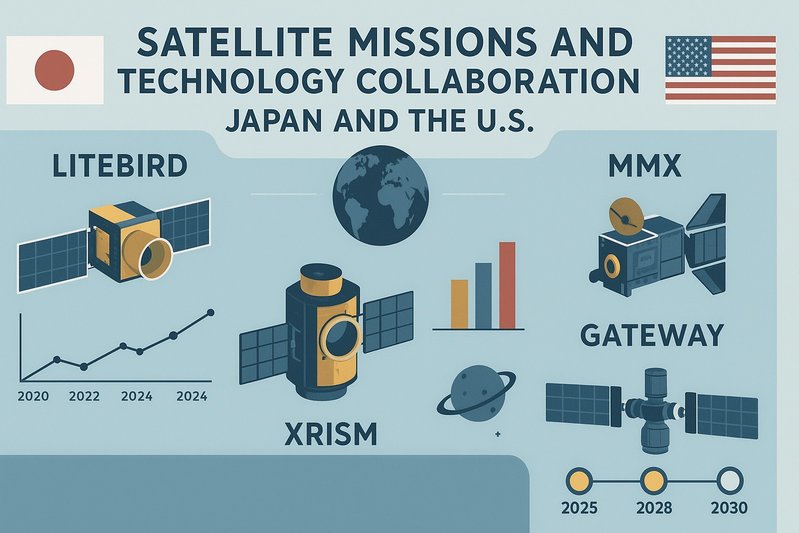
The next two budget cycles will not hit Japan–U.S. space collaboration evenly. The sharpest 2026 exposures sit in NASA’s Science Mission Directorate: a schedule-sensitive LiteBIRD hardware path that hinges on U.S. detectors and cryogenics; XRISM operations that remain stable in Japan but face thinner U.S. science enablement; and MMX, where communications coverage and early-ops readiness—not launch hardware—are the variables. Human exploration work on Gateway is more about the choreography of integration and partner interfaces than launch dates, with 2026 serving as a crucible for freezing specifications, validating subsystems, and planning logistics services that link ESA’s I‑Hab and JAXA contributions.
The through-line is capacity: funding levels shape the work that can be obligated when it matters, and in 2026 the bottleneck most likely to bend operations is NASA’s Deep Space Network. DSN time will flow to spacecraft safety and critical events first, with science passes trimmed at the margins. That math puts MMX’s early operations on the bubble unless partner networks backfill, nudges XRISM’s U.S. cadence toward longer latencies, and leaves Gateway unaffected operationally but exposed to knock-on planning shifts. The single most schedule-critical technology path is LiteBIRD’s U.S. detector/readout and sub‑Kelvin systems, where even modest delays in component CDRs and long‑lead procurements can force 2026 work into 2027.
What Matters Most in 2026—and How to Measure It
In this cycle, timing is as consequential as magnitude. Funding that arrives late in the year behaves like a cut for schedule-driven milestones, pushing contract options, slowing level-of-effort software and analysis tasks, and forcing triage on long-lead purchases. A practical way to read 2026:
- Mild scenario: approximately flat nominal funding translating into about 5% real erosion, with obligations sliding into the mid-year.
- Moderate scenario: roughly a 10% shortfall to science accounts and 5% to human exploration, paired with mid-year rephasing.
- Severe scenario: 15–20% reductions or rescissions that demand formal rebaselines and partner renegotiations.
Quantitative yardsticks that matter by mission:
- LiteBIRD: 2026 U.S. deliveries slip three to nine months under a moderate scenario; nine to eighteen months if severe. Descopes, if invoked, would reduce detector modules or performance margins—directly impacting sensitivity to primordial B‑modes.
- XRISM: U.S. guest observer support and data processing throttle back by about 20–40% under moderate pressure, extending latency from observation to higher-level products and shrinking the pool of funded investigators.
- MMX: Launch readiness in 2026 remains driven by JAXA and H3; U.S. exposure centers on DSN coverage and operations interfaces. Under moderate pressure, DSN or ops support reductions on the order of 10–20% can be mitigated if partner networks substitute; without mitigation, risk climbs during time-critical events.
- Gateway: No 2026 launch exposure; impacts present as six to twelve months of rephasing to partner interface freezes and logistics planning in the moderate case, with partner CDRs and long-lead procurements shifting accordingly.
The metrics to watch are simple and revealing: months of slip against 2026 subsystem CDRs and interface freezes; DSN hour allocations through critical MMX windows; GO selection/funding rates and archive latencies for XRISM; contract option exercises; and the fate of long-lead procurements on LiteBIRD’s detector and cryogenic lines.
LiteBIRD: U.S. Cryogenics and Detectors Are the Critical Path
LiteBIRD’s international design leans on U.S. hardware where schedule elasticity is thin: detector/readout chains and sub‑Kelvin cryogenics. These are not generic parts; they are specialized, long-lead technologies that define instrument capability and set the tempo for 2026 subsystem CDRs and verification campaigns. When obligations lag, the earliest technical casualties are CDRs and long-leads.
- Under a mild scenario, expect one to three months of drift on component reviews and purchase orders—absorbed if integration margins are healthy.
- Under a moderate scenario, expect three to nine months of delay to 2026 deliveries, pushing a nontrivial chunk of work into 2027 and forcing JAXA to rephase integration and cryo verification campaigns.
- In a severe case, the slip stretches to nine to eighteen months, with pressure to revise memoranda of understanding and consider targeted descopes.
The trade space for descoping is narrow and consequential:
- Fewer detector modules or relaxed cryogenic performance margins reduce sensitivity to B‑mode polarization. That is a direct science penalty, not a paperwork artifact.
- Deferring non-critical technology demonstrations is lower risk but yields limited savings and does not address bottlenecks if those demos aren’t on the critical path.
Cost dynamics complicate the picture. Rephasing supplier milestones increases overhead and risk premiums, and prolonged uncertainty creates idle time in Japanese integration facilities. Switching suppliers mid‑stream is technically possible in theory but rarely favored: new interfaces invite integration risk, and “savings” evaporate if rework is needed. The lowest-cost path to preserving capability is often targeted bridging that keeps the specialized U.S. cryogenic and detector lines intact through 2026.
Mitigation levers:
- Protect long-lead purchases and keep CDRs on a credible calendar, even if late in the fiscal year.
- Resequence verification to put more slack into cryogenic test campaigns.
- Explore limited partner workload reallocation only where interfaces and qualification pathways are already established.
XRISM: Operations Hold, U.S. Science Runs Thinner
XRISM is in steady-state science operations under JAXA. The spacecraft and its core operations are not at risk in 2026 from U.S. budget mechanics. Where U.S. reductions bite is in the enabling layer: guest observer support, calibration cross-checks, data processing throughput, and value-added archive services.
What changes under pressure:
- Moderate scenario: GO selection and funding rates drop by roughly 20–40%; processing at U.S. archive and analysis systems slows, widening the gap between observation and availability of higher-level products. Fewer pipeline enhancements make it into production.
- Severe scenario: Further thinning of analysis tools and user support; cadence of calibration updates stretches out.
What does not change:
- The spacecraft’s baseline operations funded by JAXA.
- Data rights and access policies; international access remains intact.
The net effect for U.S. researchers is timeliness and volume. Fewer funded projects, slower pipeline tuning, and delayed releases of high-level catalogs depress near-term science output without jeopardizing the mission itself.
Mitigations:
- Prioritize calibration and high-impact time-domain observations.
- Lean more on JAXA pipelines for baseline products while U.S. systems maintain essential archiving.
- For specialized operations segments that benefit from DSN, substitute JAXA or ESA ground assets where feasible to preserve critical communications schedules.
MMX: Launch Intact, DSN Coverage Is the Gating Risk
Mars Moon eXploration remains a JAXA-led campaign with 2026 dominated by launch, early cruise, and initial operations. NASA’s exposure is concentrated in three areas: DSN coverage, instrument operations interfaces (notably for the U.S.-provided MEGANE instrument), and funding for participating scientists who will work the earliest data.
- Launch readiness in 2026 is not expected to pivot on U.S. funding. The dominant drivers are JAXA spacecraft readiness and the H3 launcher.
- Under mild or moderate U.S. constraints, MMX proceeds if DSN requirements are prioritized. The risk profile rises if DSN triage trims communications during navigation or commissioning windows.
- Under severe constraints, DSN shortfalls increase operational risk unless partner networks step in.
This is a playbook problem, not a physics problem. Pre-negotiated cross-support through ESA’s Estrack and JAXA ground assets can maintain comm/TT&C margins and dilute exposure to DSN bottlenecks. If that backfill is in place, U.S. science return tracks more closely with analysis capacity than with spacecraft operations. Without it, timelines for orbit determination, commissioning, and instrument checkouts face avoidable pressure.
Mitigation levers:
- Lock in cross-support frameworks early, with explicit prioritization of navigation and commissioning tracks.
- Streamline early operations timelines to reduce coverage conflicts.
- Maintain minimal essential funding for U.S. participating scientists to avoid a post-launch lag in analysis.
Gateway and Artemis: Interfaces and Logistics Shift Right
Gateway’s 2026 calendar is about integration choreography—freezing partner interfaces, validating subsystems, and advancing logistics service planning that knits NASA’s PPE/HALO with international contributions, including ESA’s I‑Hab and JAXA subsystems and logistics derived from HTV‑X. The risk in 2026 is rephasing, not rockets.
What moves in a moderate scenario:
- Six to twelve months of rephasing to partner interface tests and logistics planning.
- Japanese subsystem CDRs and long-leads (ECLSS, batteries) synchronize to the new freezes and integration windows.
- Procurement pacing for an HTV‑X–derived logistics service slips to track a later initial logistics need date.
What does not move:
- Core partner roles; JAXA’s life-support and battery contributions remain mission-critical, and logistics services are preserved in scope even if cadence adjusts.
Contract and industrial effects are predictable:
- Integration contracts rephase; no‑cost extensions and resequenced milestones become the norm.
- Japanese contractors contend with deferred orders and lower monthly burn rates, raising holding costs and complicating workforce retention.
- Advance procurement to protect long-leads is the key tool to avoid stranded costs.
Mitigation levers:
- Re-baseline interface freezes to match a later I‑Hab delivery while continuing Japanese subsystem qualification in parallel.
- Leverage ESA integration capacity to absorb timing volatility.
- Phase long-leads for logistics services to maintain optionality while reducing near-term cash demand.
DSN and Data Pipelines: The Cross-Cutting Constraints
When budgets tighten, DSN scheduling resolves to a simple hierarchy: spacecraft safety and critical events first, everything else second. That forces nuanced trade-offs across missions:
- MMX: The largest DSN exposure in 2026 among the Japan–U.S. collaborations. Critical windows center on navigation and commissioning. Without partner backfill, risk increases for timeline compression and reduced margins.
- XRISM: DSN needs are episodic and modest relative to deep-space missions; they can be trimmed or substituted with JAXA assets for many use cases.
- Gateway: DSN does not drive 2026 milestones; the constraint manifests as planning elasticity and testbed scheduling rather than loss of operational coverage.
On the data side, pressures surface at archives and pipelines rather than spacecraft:
- XRISM’s U.S. archive and analysis services can stretch latency and pare back value-added tooling when funds are late or lean. The mission continues; the U.S. science tempo slows.
- LiteBIRD’s data pipeline implications sit beyond 2026 operations; the pertinent exposure now is delivery of the hardware that will define science performance later in the decade.
The realistic mitigation for DSN is diversification: pre-arranged cross-support with ESA and JAXA networks, and disciplined prioritization of critical events. For data pipelines, prioritize calibration and core products while deferring enhancements that do not impact scientific validity.
Japanese Industry and Cost-Sharing Dynamics
The most direct industrial exposure in Japan is tied to Gateway. If U.S. integration work slides, Japanese suppliers building life-support systems, batteries, and logistics capabilities must retime production. The typical financial signatures are lower monthly burn rates, higher holding costs, and pressure on workforce stability. Contractual tools—no‑cost schedule extensions, resequenced milestones, and targeted advance procurement to protect long-leads—can reduce stranded cost risk, but repeated resequencing invariably creates supply-chain inefficiencies.
For XRISM, industrial exposure in Japan is limited; U.S. funding trims primarily affect U.S. university groups and archive contracts. JAXA operations remain nominal with only minor cadence adjustments in data exchange. For MMX, cost shifts are operational—if DSN hours are constrained, adding ESA or other services moves a modest amount of communications spend outside DSN. Hardware production schedules in Japan are the primary cost drivers and remain stable across scenarios. For LiteBIRD, delays on U.S. detector/cryo deliveries create idle time risk for Japanese integration facilities; early transparency and protecting long-leads are the cheapest ways to avoid churn. Switching suppliers mid-stream is technically possible but often disfavored due to interface and qualification risks.
Decision Levers, Contingency Paths, and What to Watch Next
Three levers preserve the most science return for the least money:
- Protect schedule-critical long-leads and CDRs
- LiteBIRD: Keep detector and sub‑Kelvin cryogenic lines funded through 2026; the cost of slippage compounds at integration.
- Gateway: Advance-procure select long-leads for JAXA-related subsystems and HTV‑X derivatives to retain options even if broader integration slides.
- Pre-commit partner cross-support
- MMX: Lock ESA and JAXA ground support early for navigation and commissioning tracks to hedge DSN uncertainty.
- XRISM: Default to JAXA pipelines for baseline products when U.S. archive throughput tightens, preserving science validity and minimizing latency growth.
- Re-sequence without descoping core science
- Gateway: Shift interface freezes and logistics planning six to twelve months while continuing subsystem qualification in parallel.
- XRISM: Trim value-added pipeline features before cutting core archiving services; protect high-impact time-domain programs.
- LiteBIRD: Defer non-critical demonstrations; keep detector count and cryo performance intact where possible.
Indicators worth tracking over the next 12–18 months:
- NASA appropriations, operating plans, and reprogrammings that determine when obligations actually land.
- Oversight on acquisition and schedule credibility that can trigger rebaselines if cuts become severe.
- Mission-level schedule updates: PPE/HALO integration status, I‑Hab timing, and JAXA subsystem readiness for Gateway; U.S. CDR dates and long-lead procurements on LiteBIRD; GO cycles and archive performance metrics for XRISM; and DSN bookings and partner cross-support arrangements for MMX.
The Bottom Line
In 2026, SMD collaborations absorb the most immediate effects of reduced or late NASA funding. XRISM continues to operate but with thinner U.S. science enablement and slower pipelines. MMX’s launch remains on track with Japan, while U.S. exposure clusters in DSN coverage and early operations interfaces—risks that can be mitigated with partner networks. LiteBIRD is where timing matters most: three to nine months of delay to U.S. deliveries under a moderate scenario can push integration into 2027, and any descopes directly erode sensitivity to the very signals the mission is built to find.
Gateway’s impacts in 2026 are about choreography, not countdowns. Interfaces and logistics planning shift right, nudging Japanese subsystem schedules and procurement pacing without changing core roles. The unifying constraint is capacity: DSN hours and data pipeline throughput in science; integration bandwidth and long-lead funding in human exploration.
The cheapest way to keep science whole is also the simplest: protect schedule-critical long-leads, commit early to partner cross-support, and trim around the edges instead of the core. Do that, and 2026 becomes a year of controlled rephasing rather than lost momentum—one that preserves science return now and protects ambition later. 🚀