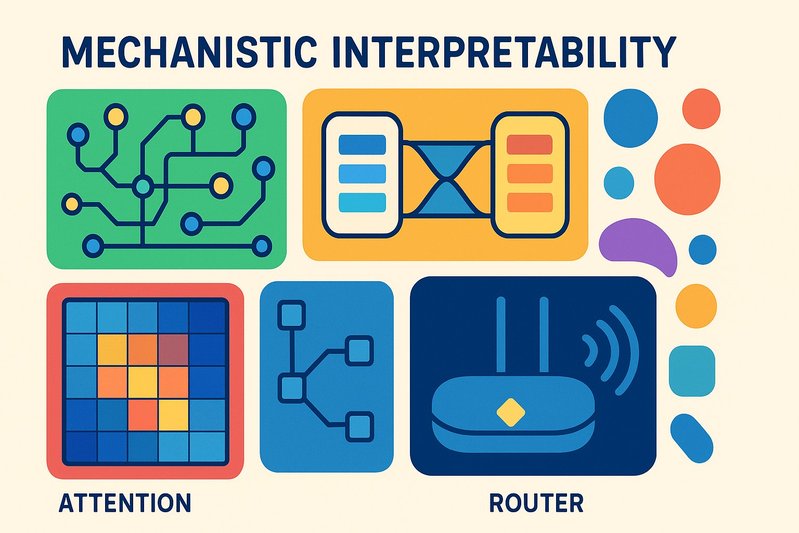
Mechanistic Interpretability Goes Mainstream: The 2026–2028 Roadmap
From sparse autoencoders and circuit discovery to router transparency and standardized retrieval/tool audits, research pivots from plausibility to causal faithfulness
Attention heatmaps once looked like the silver bullet for explaining how large language models reason. But the field spent years discovering a hard truth: the most compelling visualizations often fail the most basic tests of causality, completeness, and stability. Raw attention weights can change dramatically without altering predictions. Multi-step reasoning is driven by distributed features in residual pathways and MLP blocks rather than attention alone. And when models retrieve documents or call tools, the decisive choices live in routers, experts, and policies that self-attention simply doesn’t reveal.
Now a different paradigm is taking hold. Instead of reading off patterns from attention matrices, researchers are intervening, patching, editing, and auditing the actual causal pathways of computation—and backing up every claim with counterfactual tests. At the same time, feature-level approaches such as sparse autoencoders are turning opaque activations into interpretable, reusable building blocks that transfer better across tasks. Over the next two years, expect this pivot from plausibility to causal faithfulness to reshape methods, standards, and benchmarks—from how we localize circuits to how we verify routing decisions in MoE and retrieval-heavy systems.
This roadmap lays out where mechanistic interpretability is headed through 2028: automating causal discovery; scaling feature-level representations; reshaping training-time objectives; making MoE routers and experts auditable; standardizing retrieval/tool-use explanations; evolving benchmarks to prioritize stability, transfer, and process faithfulness; and confronting the risks that remain, including chain-of-thought unfaithfulness, superposition, evaluation leakage, and the hard problem of measuring completeness.
Research Breakthroughs
The decisive shift away from attention-as-explanation is backed by convergent evidence. Raw attention maps are non-unique with respect to outputs and can be manipulated without changing predictions. They often fail causal tests of necessity and sufficiency, and their patterns are brittle under paraphrases, adversarial perturbations, and decoding changes. This makes them useful for quick plausibility checks or provenance in retrieval cross-attention—where they show which documents were consulted—but not for end-to-end explanations of reasoning.
Causal interventions have set the new standard. Activation patching, head and path masking, attention editing, and causal mediation analysis allow researchers to ask “what if” questions about specific components—and to observe whether outputs change in line with those hypotheses. These methods repeatedly reveal that decisive computations for reasoning are distributed and frequently mediated by non-attention components, especially feed-forward layers that act as key–value memories. Knowledge editing methods that target non-attention parameters can reliably change outputs, strengthening the case that attention is mostly a routing mechanism rather than the locus of computation.
Representation-level analyses are maturing into a second pillar. Probing and sparse autoencoders recover sparse, interpretable features that recur across layers and models. While probes can reflect correlations and SAEs raise questions about coverage and purity, feature-level representations have proved more stable than attention patterns and serve as a better substrate for causal interventions and circuit discovery.
Gradient-based attribution offers a pragmatic complement. Techniques like Integrated Gradients and layer-wise relevance propagation satisfy useful axioms (notably, completeness for IG) and often align better with causal influence than raw attention when designed carefully. They still require validation via intervention, but they add a principled perspective on how much each token or pathway contributes.
Architecture-specific findings support this direction. In dense decoder-only Transformers, induction/copying heads are a repeatable exception where attention analyses, validated by interventions, work well. For Mixture-of-Experts models, however, the picture changes: routers select experts per token, and routing logits and expert computations often dominate the causal pathway. Attention maps miss these decisions. And in retrieval and tool-use settings, cross-attention aids provenance, but only leave-one-document-out tests, context ablations, and tool routing audits establish actual reliance and correct reasoning.
Taken together, these results point toward an ecosystem built on interventional methods, feature-level variables, and rigorous validation. Attention remains a helpful visibility layer for specific cases—especially provenance in retrieval—but is no longer the center of gravity for explaining reasoning in modern systems.
Roadmap & Future Directions
The next two years will be about turning these insights into scalable, standardized practice. Several priorities stand out.
-
Automating causal discovery
-
Scale activation patching and mediation analysis. Manual, layer-by-layer patching does not scale to larger models or complex behaviors. The clear direction is tooling that proposes candidate circuits, runs pre-registered ablation/patching experiments, and reports fidelity metrics by default. Specific frameworks and throughput metrics are unavailable, but the ingredients—activation patching, attention masking/editing, and counterfactual inputs—are established.
-
Build reusable circuit assets. Circuit-level explanations already exist in pockets (e.g., induction). Creating sharable, testable circuit artifacts aligned to precise hypotheses would accelerate transfer and replication. Concrete library formats are not specified; the need is implied by the success of circuit-level work and robust protocols.
-
Feature-level representations at scale
-
Push monosemantic SAEs. Sparse autoencoders have shown they can recover interpretable features that stabilize across layers and models. Expanding coverage, resolving feature purity, and mapping interactions with MLP/residual pathways will make SAEs a routine substrate for causal tracing and editing.
-
Disentanglement and transfer across tasks and languages. Feature-level variables appear more stable than attention patterns, and transfer improves at the feature level. Systematic audits under domain and language shift will quantify what transfers and where revalidation is required. Specific metrics are not provided beyond existing stability and transfer tests.
-
Training-time advances
-
Interventional supervision. Today, interventions and audits are mostly post hoc. The natural next step is incorporating signals from causal tests (e.g., whether a component is necessary/sufficient) into the training loop to encourage faithful computation paths. Specific recipes are not available, but the target is clear: discourage spurious shortcuts and adversarial attentions and reinforce process alignment.
-
Process-aligned objectives. Supervised chain-of-thought improves performance but is frequently unfaithful to internal computation. Objectives that reward process faithfulness—as measured by interventional metrics, not just output correctness—are a logical direction. Concrete implementations are not specified.
-
Adversarial robustness for explanations. Models should maintain explanatory stability under paraphrases, decoding changes, and counterfactual perturbations. Strengthening robustness at training time against these stressors complements post hoc audits.
-
MoE and router transparency
-
Expose and audit routing. In MoE LLMs, routing logits and per-expert computations often determine outcomes. Any credible explanation must show router distributions, expert selections per token, and the causal effect of swapping or ablating experts. Where possible, interventions should establish necessity and sufficiency for token-level decisions.
-
Expert introspection. Per-expert analyses—what features they encode, how they mediate residual computations—belong alongside router audits. Standardizing these audits will close a major blind spot in current explanations.
-
RAG and agent explainability standards
-
Leave-one-out retrieval and context ablations. Cross-attention to retrieved passages helps with provenance, but provenance isn’t reliance. Removing or altering retrieved content and observing output changes should be standard practice to demonstrate actual use of evidence.
-
Tool-use audits. For tool-augmented agents, surface attention to tool tokens says little about decision policies. Auditing function selection, routing decisions, and reliance on execution results via ablations and counterfactuals must become routine.
-
Provenance schemas. Provenance—what was consulted and when—should be captured alongside causal evidence of reliance. Specific schema details are not provided, but the requirement to separate “consulted” from “causally used” is explicit in current best practice.
Benchmark Evolution
Explanations that look plausible are no longer enough. Benchmarks and protocols are evolving to test whether explanations are faithful, stable, robust, and transferable—and to do so under the conditions where reasoning is hardest.
-
Fidelity and completeness
-
Causal faithfulness: Measure whether targeted perturbations to highlighted components change predictions in the predicted direction; test necessity and sufficiency via ablations and patching.
-
Completeness: Use attribution methods with formal completeness properties (e.g., Integrated Gradients) to test whether attributions account for output differences. Completeness beyond these axioms remains an open problem.
-
Calibration and stability
-
Calibration: Align confidence in an explanation with measured causal effect.
-
Stability: Stress explanatory assignments under paraphrases, adversarial/counterfactual perturbations, and different decoding hyperparameters. Long-context settings and diffusion of attention add extra pressure.
-
Robustness and transfer
-
Robustness: Test resilience to spurious correlations and adversarial attentions.
-
Transfer: Evaluate whether explanatory patterns (not just outputs) transfer across models, tasks, domains, and training setups. Domain/language shifts and model size often break naive transfer, highlighting the need for feature-level variables and revalidation.
-
Retrieval and tool-use audits
-
Retrieval: Standardize leave-one-document-out experiments and controlled context removal to confirm reliance on retrieved evidence rather than mere co-attention.
-
Tools: Record and audit policy decisions for tool selection and the model’s reliance on returned outputs via causal interventions.
-
Task coverage
-
Reasoning benchmarks: Multi-step and compositional tasks such as GSM8K, MATH, BIG-bench and BBH, MMLU, ARC, and DROP stress the capabilities where attention-only explanations falter and interventional, feature-level methods add the most value.
-
Interpretability method benchmarks: Frameworks like ROAR remain useful for sanity-checking whether feature importance estimates align with actual performance drops under removal.
Evaluation protocols that start with mechanistic hypotheses—then triangulate attention flow, gradients, candidate features, and circuits before running interventional tests—are already proving more robust. Expect them to become the default: pre-registered, counterfactual, and architecture-aware.
Risks and Open Questions
Even with stronger methods, several risks and gaps remain.
-
CoT unfaithfulness
-
Chain-of-thought often improves human comprehensibility and task performance but can diverge from the model’s internal computation. Without triangulation via interventional tests, rationales risk becoming post hoc justifications.
-
Superposition at scale
-
As models grow, features superpose more heavily, and head roles become less clean. This complicates interpretation and increases the odds that attention patterns are unstable. Scaling monosemantic features and disentanglement remains a central challenge.
-
Evaluation leakage and baselines
-
Attribution methods are sensitive to baselines and can pass superficial tests while failing causal audits. Sanity checks and counterfactual controls must be part of any serious evaluation.
-
Measuring completeness beyond IG
-
Attribution completeness axioms are useful but incomplete as a measure of whether an explanation “captures” a computation. Defining and measuring coverage for feature- and circuit-level explanations is an outstanding question.
-
Coverage and purity of SAEs and probes
-
Sparse autoencoders provide promising features but raise questions about how comprehensively and cleanly they capture the actual variables used in computation. Interventions remain the arbiter of faithfulness.
-
MoE routing behavior under shift
-
Routers and experts may behave unpredictably under domain or language shifts. Systematic audits across shifts—and interventional tests that verify token-level decisions—are essential for safe deployment in dynamic settings.
Impact & Applications
The practical impact is straightforward: explanations that survive causal audits will replace attention heatmaps as the default for serious reasoning evaluations. In dense models, this means interventional pipelines tethered to feature-level variables. In MoE systems, it means exposing router logits, recording per-token expert selections, and testing causal reliance on experts. In retrieval-heavy and tool-augmented setups, it means provenance plus leave-one-out/context ablations and tool routing audits, not just pretty cross-attention maps.
Methodologically, research will converge on a layered approach:
- Start with explicit mechanistic hypotheses.
- Generate multiple candidate explanations: attention flow, gradients/attributions, candidate features via SAEs.
- Confirm or reject hypotheses with interventions: head/path masking, activation patching, attention editing, counterfactual inputs, and, where applicable, knowledge editing.
- Report fidelity, completeness, calibration, stability, robustness, and transfer metrics alongside primary task accuracy.
As these practices normalize, expect less argument over what an attention head “means” and more emphasis on tested circuits and features that withstand counterfactual scrutiny. Retrieval and tool-use systems will move from showing what was looked at to proving what was actually used. And as model sizes and architectures continue to evolve, the focus will stay on verifiable causal pathways that generalize across tasks and domains.
Conclusion
Mechanistic interpretability is entering a new phase. The field has learned that attention is an invaluable routing lens and a useful provenance signal—but not a faithful, complete account of reasoning in modern language models. Causal interventions, feature-level representations, and rigorous validation are stepping in to fill that gap, with router and tool audits expanding the scope of what must be explained in MoE and retrieval/tool pipelines.
Key takeaways:
- Replace attention-only narratives with interventional tests of necessity and sufficiency.
- Use feature-level representations (e.g., SAEs) as stable substrates for causal tracing and editing.
- Expose and audit MoE routers and experts; include routing distributions in explanations.
- Standardize leave-one-out retrieval tests and tool-use audits to distinguish provenance from reliance.
- Evolve benchmarks to measure fidelity, completeness, stability, robustness, and transfer—not just plausibility.
Actionable next steps:
- Adopt pre-registered, counterfactual protocols for any explanatory claim about reasoning.
- Build pipelines that automatically propose and test circuit hypotheses with activation patching.
- Integrate attribution methods with formal properties (e.g., completeness) and validate them with interventions.
- Log and audit routers, experts, and tool/routing decisions as first-class explanatory objects.
The next two years will be defined by this pivot from what looks explanatory to what is causally true. Mechanistic interpretability will be judged not by the clarity of a heatmap, but by whether explanations survive surgical edits to the computation itself—and whether they transfer when the model, task, domain, or language changes. 🔬