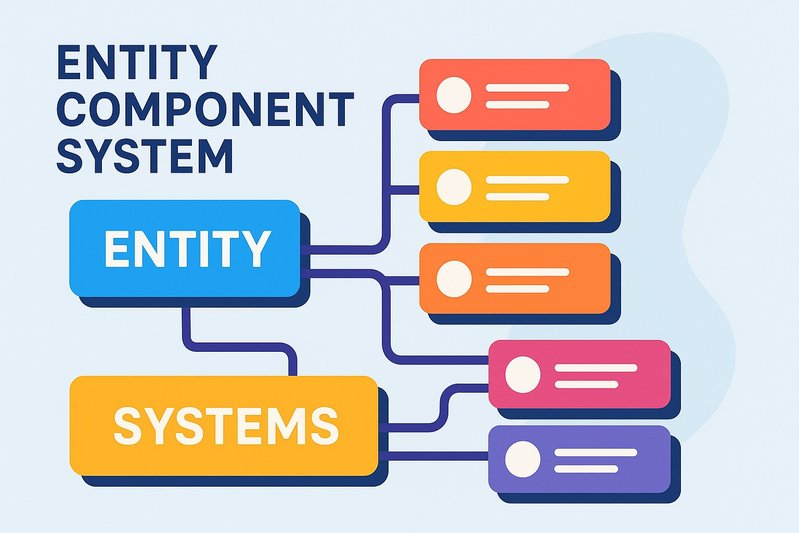
Mastering ECS Modeling in Bevy 0.18
Unlock Game Performance with Efficient Data-Oriented Design
As game development becomes more demanding, the technologies that underpin these virtual experiences must evolve to meet the complexity and scale of modern projects. One such technology is Bevy—a data-driven game engine built on an archetype-based Entity Component System (ECS). With its latest iteration, Bevy 0.18, developers can leverage highly efficient systems to enhance game performance. This article discusses key ECS modeling approaches and best practices using Bevy 0.18, concentrating on how these can unlock unprecedented performance gains.
Understanding Bevy’s ECS Model
Bevy’s ECS, or Entity Component System, is designed with a focus on high-throughput iteration by storing components in a cache-friendly manner. It embraces table storage for data that needs frequent access, while employing alternative sparse-set storage for components that are rarely used. This design provides extreme flexibility for game developers looking to optimize both performance and memory usage in their projects.
Optimizing with Archetype-Based Storage
In Bevy 0.18, the archetype storage system groups entities that share similar component compositions, allowing systems to iterate over components in a highly parallelized manner. This provides two significant benefits: reducing CPU overhead by minimizing cache misses, and increasing iteration speed by managing data locality. Developers should separate frequently-updated data from less-dynamic data into distinct components, which helps balance performance with system complexity.
Sparse-Set Storage for Flexibility
Components that are seldom present across entities, or are used as tags, benefit from Bevy’s sparse-set storage capabilities. This allows developers to avoid unnecessary memory overhead by only storing these components when needed—as opposed to allocating empty columns for them in most archetypes. Production projects often apply this pattern for flags or mode markers to streamline the performance footprint of less critical data.
Leveraging System Param Frameworks and Events
Bevy’s flexible system allows the declaration of precise data dependencies, through the SystemParam trait, among other tools. Using the Res/ResMut traits, developers can access global resources without saturating systems with unrelated data. Notably, Bevy allows small, focused systems that proclaim only the necessary data dependencies, ensuring each part of a game operates efficiently and with clear delineation.
Efficient Data Access and System Modularity
The SystemParam trait facilitates modular systems by specifying input dependencies only when required. Moreover, leveraging events in Bevy provides a uniquely discreet messaging channel for transient communications. This setup is ideal for handling interactions like spawn or despawn requests without the burden of tracking component changes across multiple systems, enhancing both speed and resource management.
State Management and Determinism
Typed States provide developers with coarse-grained control over game flow—transitioning smoothly between states like “Loading,” “Menu,” and “Gameplay.” This feature minimizes the risk of tangled logic and keeps systems organized. Bevy supports hooks for setup and teardown, ensuring that resources are managed appropriately as game states change.
Scheduling and Resource Management
Bevy’s scheduler is capable of executing systems concurrently wherever data access permissions are aligned. By delineating system sets and specifying before/after relationships, developers can orchestrate complex workflows that involve gameplay, physics, and AI. To achieve determinism in game simulations, the FixedUpdate loop allows consistent frame timing, crucial for smooth, jitter-free animations essential to maintaining coherent in-game physics and interactions.
Commands and Structural Changes
To apply changes like spawning or despawning efficiently, Bevy utilizes a command queue that performs actions at safe insertion points within the game loop. This approach maximizes parallelism while ensuring that conflicts or undesirable side effects, common with direct world mutations, are avoided.
Conclusion
ECS modeling in Bevy 0.18 represents a leap forward in making game engines not just more performant but also more developer-friendly through its data-oriented design. By combining table and sparse-set storage, leveraging efficient access and event systems, and maintaining robust state and scheduling controls, developers can seamlessly optimize their games to run efficiently and maintain a high-quality gaming experience. As teams continue to explore this architecture, they’ll find themselves not just meeting but exceeding the complex demands of modern game development.
References
Bevy’s focus on archetype-based ECS storage, system parallelization, and state control makes it a powerful choice for developers aiming to produce high-performance games. By adhering to best practices highlighted in Bevy 0.18, developers can unlock the full potential of data-oriented and resource-efficient design, paving the way for the future of game development.