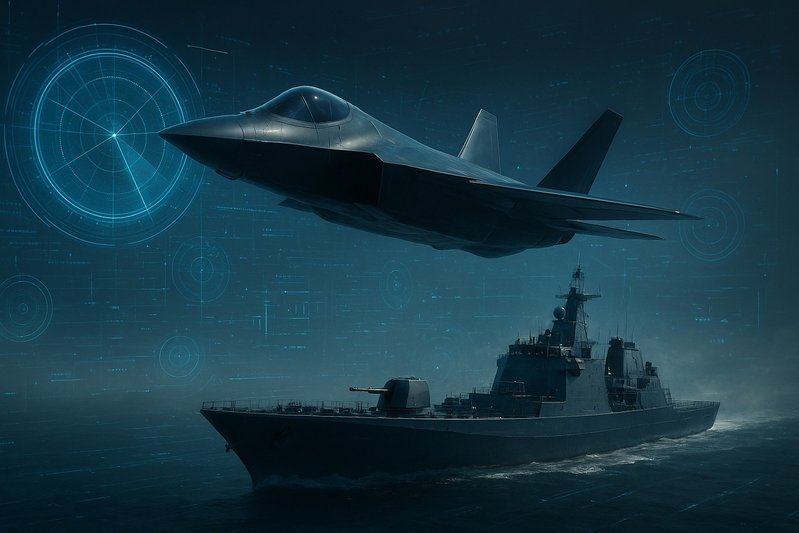
MADL, CEC, and E‑2D UHF Radar Enable Silent Kill Chains for Stealth Forces
A stealth fighter guiding a ship’s missile shot without ever turning on its own radar sounds like science fiction. It isn’t. Fleet trials have already validated cooperative fires in which an F‑35’s sensor picture fed a surface combatant through Cooperative Engagement Capability (CEC), enabling “silent” weapons employment while the stealth aircraft stayed emissions‑cold. At the same time, airborne UHF radar from E‑2D Advanced Hawkeyes, proliferated space sensors, and passive RF geolocation are extending custody on targets without forcing low‑observable (LO) platforms to radiate.
Under relentless surveillance by low‑frequency radars, IR search and track, and passive RF networks, emissions control has become the center of gravity for survivable operations. The winning pattern is consistent: bias sensing to passive onboard apertures; push active energy to offboard contributors; move data over directional low probability of intercept/detection (LPI/LPD) links; and close kill chains through cooperative engagement that decouples sensors from shooters.
This article maps the emissions‑aware architecture that makes those “silent kill chains” real. It explains how the sensing, transport, and fusion layers interact; how MADL, CEC, and E‑2D UHF radar underpin track quality without compromising stealth; what “good” looks like for latency, custody, and emissions budgets; and how to build resilience and validate performance without burning signatures. A brief air–sea case walk‑through shows the architecture in action, followed by technical pitfalls and mitigations practitioners should plan for.
Architecture/Implementation Details
Sensing layer: passive bias onboard, active energy offboard
- Onboard LO tradecraft prioritizes passive apertures—EO/IR and electronic support measures—to build local awareness while holding AESA radars in reserve. Fifth‑generation aircraft have demonstrated the ability to share those fused tracks within a formation while keeping their own emissions constrained.
- Offboard active sensing carries much of the detection burden. The E‑2D’s APY‑9 UHF radar adds critical reach and counter‑stealth utility, detecting low‑observable air targets at useful ranges and providing wide‑area tracks that LO assets can refine without radiating. Airborne UHF is particularly valuable for initial detection and persistent track stewardship.
- Space and commercial contributors extend custody without compromising LO aircraft. Proliferated LEO infrared sensors in the Space Development Agency’s Tracking Layer are fielded for missile warning and tracking with low latency; those data streams are increasingly relevant to air and maritime targeting ecosystems. Commercial RF geolocation constellations can passively locate emitters and map spectrum activity at scale, furnishing cues that LO nodes can exploit while remaining silent.
Transport layer: directional LPI/LPD links and waveform agility
- MADL (Multifunction Advanced Data Link) provides stealth‑preserving connectivity among F‑35s using narrow, directional beams and LPI/LPD techniques. The design goal is clear: exchange high‑value tracks without turning the formation into a beacon.
- CEC (Cooperative Engagement Capability) moves fire‑control‑quality data across platforms. Navy and Marine Corps events have already shown F‑35 sensor tracks contributing to Aegis engagements via CEC, validating remote kills that keep the most survivable nodes passive.
- Adaptive waveforms and electromagnetic maneuver complement these transports. Doctrine emphasizes agile spectrum operations and electronic protection to ride through jamming and sensing pressure. The principle: match link selection, power, and dwell to the threat and geometry, then automate spectrum management so operators don’t have to hand‑tune emissions in flight.
Fusion and track quality: turning weak cues into fire‑control data
- Weak cues become weapons‑quality through multi‑sensor fusion. A UHF detection from an E‑2D can seed correlation with passive bearing‑only cuts from LO aircraft and RF geolocation from space, tightening errors until a remote shooter can accept a solution. AI‑enabled fusion, while not detailed publicly, is central to accelerating that correlation and maintaining custody when any one sensor drops out.
- Cooperative engagement decouples roles. One platform detects and tracks; another shoots using shared fire‑control data. This breaks the classic “sensor‑emitter” tradeoff that would otherwise force LO assets to radiate to finish a kill chain.
Latency, custody, and emissions budgets: what “good” looks like
- Specific performance metrics are unavailable, but architectural goals are clear:
- Keep LO nodes passive as long as possible, radiating only when geometry and survivability allow.
- Maintain target custody by stitching together UHF airborne radar, space‑based tracks, and passive RF/EO cuts so shooters always have an acceptable solution.
- Use directional, short‑dwell transports for time‑critical exchanges; fall back to alternate paths when jammed or masked.
Resilience under jamming and loss
- The electromagnetic fight is assumed, not exceptional. Strategy places a premium on adaptive, resilient spectrum operations: agile waveforms, LPI/LPD links, electronic protection, and cross‑domain routing so kill chains don’t collapse if any single pathway is denied.
- On land, open, distributed air‑defense networks have demonstrated remote engagement and radar‑silent tactics, underscoring the broader pattern: separate sensors from shooters and keep the most targetable nodes quiet.
Validation and test without burning signatures
- Live trials pairing LO aircraft with CEC‑equipped ships provide the most credible validation, proving that offboard fire‑control can work while preserving aircraft EMCON. Beyond those events, public details on instrumentation and quantitative thresholds are limited; specific metrics are unavailable.
Architecture case walk‑through: a “silent” air–sea engagement 🔗
- An E‑2D on the edge of a contested littoral uses its UHF radar to detect low‑RCS air threats at range and begins track stewardship.
- A pair of F‑35s running emissions‑cold correlate that cue with passive apertures, exchanging tracks over MADL’s directional, LPI/LPD beams within their formation.
- The E‑2D promotes the track to fire‑control quality through CEC, fusing its UHF returns with additional contributors. A CEC‑equipped surface combatant accepts the solution.
- The ship launches weapons based on the shared engagement quality track. The F‑35s never radiate; their contribution remains passive and transport‑efficient. If the air picture shifts or jamming degrades one path, spectrum‑agile links and alternate contributors (including space‑based cues or commercial RF geolocation) keep custody until intercept.
Comparison Tables
Sensing contributors for stealth‑preserving kill chains
| Contributor | Emissions from LO platform | Primary band/phenomenology | Role in silent kill chains | Key strengths | Caveats |
|---|---|---|---|---|---|
| E‑2D APY‑9 (airborne UHF radar) | None (offboard) | UHF radar | Initial detection, wide‑area custody, counter‑stealth surveillance | Useful detection of LO targets; airborne geometry extends reach | Coarser track than fire‑control radars; requires fusion for weapon‑quality |
| SDA Tracking Layer (LEO IR) | None (offboard) | Infrared (space‑based) | Missile warning/tracking, cross‑domain cueing | Persistent, low‑latency custody from space | Primarily missile‑centric; integration latency/format varies |
| Space‑based RF geolocation | None (offboard) | Passive RF mapping | Geolocates emitters, maps spectrum activity | Scalable, global cues without emissions | Depends on adversary transmissions |
| LO aircraft onboard passive fusion | Minimal (passive) | EO/IR, ESM | Local awareness, correlation and refinement | Preserves stealth/EMCON; high‑quality context | May need offboard cues for long‑range detection |
Transport and fire‑control data movement
| Mechanism | Emission profile | Directionality | Primary function | Strengths | Caveats |
|---|---|---|---|---|---|
| MADL | LPI/LPD | Highly directional | Formation LO sharing (tracks/fusion) | Preserves stealth, reduces intercept risk | Platform‑specific ecosystem |
| CEC | Managed emissions via network doctrine | Sectorized | Fire‑control‑quality data sharing across platforms | Enables remote kills; decouples sensors/shooters | Requires compatible nodes and network planning |
| Spectrum‑agile tactical links | Adaptive | Varies | Resilient C2/SA under jamming | Flexibility under EMS pressure | Careful emissions scheduling required |
Pros and cons analysis:
- Pros: Offboard UHF radar and space sensors extend detection/custody without lighting LO assets; MADL and CEC move only what’s necessary, when necessary; cooperative engagement eliminates the “emit‑to‑shoot” constraint for stealth forces.
- Cons: Track quality must be carefully managed from coarse UHF cues to weapon‑quality; interoperability and timing standards are unforgiving; loss of a single high‑value sensor (e.g., an E‑2D) can stress custody unless alternative contributors are ready.
Best Practices
- Start passive, stay passive, radiate last
- Prioritize onboard passive fusion on LO aircraft. Hold active radar until geometry demands it.
- Define emissions budgets by phase. Short, directional bursts on LPI/LPD links for time‑critical updates; everything else rides more survivable transports or waits for offboard refreshes.
- Push active energy offboard and plan the geometry
- Make airborne UHF radar the “searchlight” and LO nodes the “refiners.” Keep the E‑2D where its horizon and sidelobe environment maximize detection while minimizing exposure of LO formations.
- Align shooters to accept remote fire‑control. Surface combatants and ground batteries should be postured to take CEC‑class solutions without spinning up additional emissions.
- Build fusion that respects track pedigree
- Maintain provenance across UHF radar, passive EO/ESM, and space‑based inputs so confidence can be computed and passed to shooters. When initial cues are coarse, automate the refinement path and thresholds needed to release weapons.
- Engineer for resilience and graceful degradation
- Assume jamming and network loss. Pre‑plan alternate transports and cross‑domain paths so custody persists: MADL within formations; CEC across air‑sea; spectrum‑agile links as backstops.
- On land, integrate open air‑defense networks that support remote engagements and radar‑silent modes to avoid presenting stable RF targets.
- Validate with live cooperative‑fires events—without over‑exposing signatures
- Conduct trials that pair LO aircraft with CEC‑equipped ships to verify end‑to‑end timing, track quality, and release authority while preserving EMCON. Instrument what you can; keep public signature details minimal. Specific quantitative metrics remain unavailable, but pass/fail criteria for custody and latency should be established internally.
- Decouple sensors, shooters, and weapons choices
- Pair remote shooters with low‑observable standoff weapons to keep the final approach survivable and reduce the need for late‑stage emissions. Air‑launched cruise missiles with LO shaping and advanced seekers fit this pattern when used with offboard cueing.
- Anticipate pitfalls—and mitigate upfront
- Geometry and ambiguity: UHF cues are often coarse. Plan for multistatic views and passive triangulation to tighten errors before weapon release.
- Identity management: IRST and passive RF networks complicate NCTR in EMCON. Use multi‑modal correlation and confidence thresholds; if in doubt, hold fire or seek an additional sensor look.
- Custody breaks: Space‑based cues or a second E‑2D orbit can bridge gaps if a primary airborne sensor is lost to weather, maintenance, or threat.
A note on the threat picture and counter‑countermeasures 📡
- Low‑frequency radars and IRST proliferation compress stealth’s window of invisibility into a window of delayed detection. The response is broadband signature reduction paired with emissions discipline and cooperative engagement.
- EMS maneuver tools—agile waveforms, LPI/LPD links, and automated spectrum management—help keep the network stitched together under jamming while limiting intercept risk.
Conclusion
Silent kill chains are no longer a theory exercise. Directional LPI/LPD transports such as MADL, fire‑control sharing via CEC, and offboard sensing anchored by E‑2D UHF radar, space‑based tracking, and passive RF mapping allow stealth forces to contribute decisively while remaining emissions‑disciplined. The technical center of gravity has shifted from individual platform stealth to emissions‑aware architecture: sense passively when possible, radiate offboard when necessary, move only the data you must, and let cooperative engagement close the loop.
Key takeaways:
- Emissions control is the decisive variable for survivability under modern sensing.
- Offboard UHF airborne radar and space/RF contributors sustain custody without compromising LO platforms.
- MADL and CEC enable stealth‑preserving sharing and remote fires.
- Track pedigree and timing matter as much as raw sensor range; fusion is the arbiter of weapons release.
- Resilience requires redundant transports, cross‑domain routing, and planned degradation modes.
Action steps:
- Audit mission profiles against explicit emissions budgets by phase and platform.
- Add or reposition E‑2D orbits and space/RF subscriptions to extend custody lines.
- Exercise cooperative fires routinely: LO aircraft + CEC shooters + spectrum‑agile backhaul.
- Instrument fusion pedigree and release thresholds; automate where feasible.
Looking ahead, proliferated space sensing, autonomous collaborators, and broadband LO materials will tighten the weave of these kill webs. The organizations that integrate them into disciplined, emissions‑aware architectures—rather than chasing single‑platform magic—will own the advantage in contested, data‑dense skies and seas.