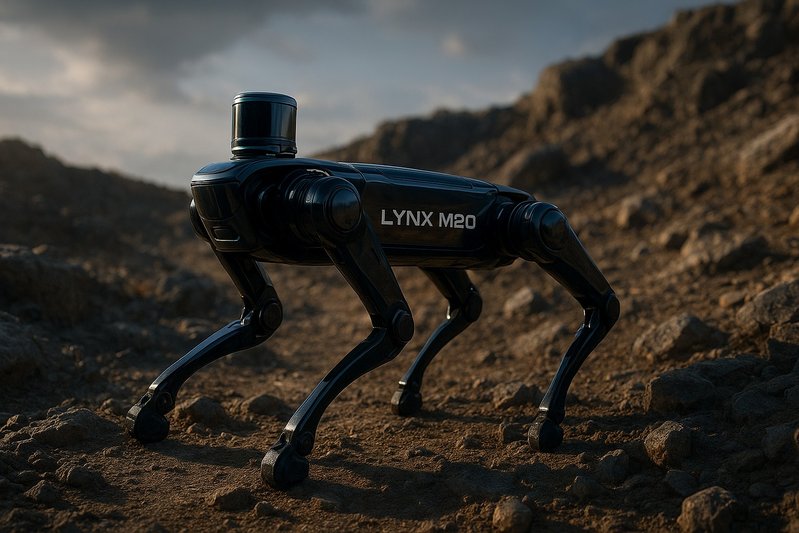
Lynx M20 Locomotion Architecture: Terrain‑Aware Control, LiDAR‑Vision Fusion, and a 1.0–1.6 kWh Energy Envelope
Multi‑hour autonomous inspection across rain‑slick stairs, loose gravel, compact snow, and high‑heat sites isn’t a single feature—it’s a cross‑stack behavior that emerges from sensing, estimation, control, planning, and thermal‑energy management working in concert. DEEP Robotics’ Lynx family targets exactly this domain, and the M20 variant is positioned for outdoor, all‑weather missions where ingress protection, perception redundancy, and battery resilience define success. While specific M20 figures remain limited, the architecture implied by Lynx‑class systems and peer benchmarks paints a clear picture of how inspection‑grade mobility is achieved—and where it needs onsite validation.
This deep dive maps the Lynx M20’s locomotion stack from sensor topology and time alignment to state estimation under precipitation and occlusions; from terrain semantics and contact‑aware control to online foothold re‑planning with friction and stability margins; and from thermal‑aware planning to the energy model that underwrites multi‑hour patrols. Readers will learn how LiDAR‑vision fusion stabilizes perception in weather, how impedance and reflexes preserve support on brittle or compliant terrain, how heat and altitude cap sustained speed and slope, and why the usable energy window for practical inspection lands around 1.0–1.6 kWh. The result is a grounded view of what to expect in the field—and what to measure before committing to mission‑critical deployments.
Architecture/Implementation Details
System framing: outdoor inspection constraints
Lynx‑class platforms are engineered for all‑weather industrial sites, which implies sealed electromechanics, redundant perception, and locomotion behaviors that tolerate slip, sinkage, and occlusion. Within this class, ingress protection often approaches IP66–IP67. The exact Lynx M20 IP code and operating/storage temperature ranges are not publicly posted; treat them as planning assumptions and verify with certificates and acceptance tests. Wading depth remains limited by venting and seal geometry even for IP67‑class systems, and high‑altitude operation (≥ 3,000 m) reduces convective cooling, cutting thermal headroom and sustained grade/speed.
Mobility envelopes typical of industrial quadrupeds—stairs, 30–35° dry ramps, and autonomous recovery behaviors—establish the operating backdrop. For the M20, specific metrics are unavailable and should be validated with the intended payload, terrain, and climate.
Sensor topology and data pathways
A Lynx‑class inspection stack centers on multi‑modal perception:
- 3D LiDAR (roof or mast) for mid‑range geometry, obstacle volumes, and stair profiling.
- A multi‑camera array for near‑field foothold perception, terrain appearance cues, and situational awareness in low light.
- GNSS/RTK for global localization outdoors, aiding loop closure and drift bounding.
- IMU and joint encoders for high‑rate base motion and legged‑inertial odometry.
Data flow follows a complementary structure. LiDAR geometry and intensity feed mapping and obstacle segmentation; cameras provide appearance and semantics that help distinguish stairs, puddles, reflective wet patches, or deformable substrates. GNSS/RTK stabilizes the global frame; when satellite signals degrade, legged‑inertial odometry bridges coverage using IMU and joint kinematics. The proprioceptive loop closes at high rate for foot contact, force estimation proxies, and impedance modulation.
Time synchronization and calibration are foundational. Cameras and LiDAR must be time‑aligned to avoid motion distortion in fusion, and extrinsic calibration between sensors and the base frame determines the fidelity of fused features. Specific M20 calibration and sync mechanisms are not disclosed; what matters operationally is maintaining tight timestamp alignment and verifying extrinsics after shocks or service. Environmental conditioning—heater elements or demist strategies for optics, lens hoods/wipers for rain, and LiDAR window defogging—keeps perception viable in cold and precipitation.
State estimation under precipitation and occlusions
Outdoor inspection guarantees periods when cameras saturate with glare or are occluded by droplets, and when LiDAR point clouds degrade in heavy rain or snow. Robust base state estimation fuses legged‑inertial odometry with exteroceptive SLAM (LiDAR and/or vision) and tolerates intermittent occlusions and contact slippage. As exteroception degrades, weight shifts toward IMU and joint signals, accepting higher drift until geometry stabilizes. Tuning must anticipate transient slip events—on wet metal, glare ice without studs, or loose sand—and expand outlier rejection windows for spurious features. Global fixes from GNSS/RTK help re‑anchor trajectories after long occlusions outdoors.
Terrain understanding, semantics, and traversability
Mobility hinges on distinguishing not just obstacles, but substrate properties. Stair recognition triggers specialized gaits with predictable footfall geometry and controlled body pitch. Wet‑surface detection and reflective puddle handling benefit from LiDAR intensity and camera filters; slippery patches demand speed caps and low‑brake profiles, especially on descents. In loose media (sand/gravel) and compact snow, traversability maps should reflect lower bearing capacity and foot sinkage, biasing footholds toward firmer patches and widening stance margins. In dust or fog, sensor redundancy keeps perception running; cleaning routines and heated optics maintain availability.
Contact detection, force estimation, and impedance control
Accurate foot contact detection and force estimation proxies (e.g., from motor currents and kinematics) let the controller adapt stiffness and damping to brittle or compliant ground. On fragile surfaces, lower contact stiffness and careful touchdown reduce crumbling; in compliant or suction‑prone mud, higher clearance swing trajectories and moderated stance timing minimize entrapment. Slip detection—via unexpected base motion relative to planned footholds or foot speed anomalies—feeds reflexes that unload, re‑place, or re‑time the step. Operators should expect to tune contact gains, slip thresholds, and swing heights to match site substrates.
Reflexes, disturbance rejection, and self‑righting
Industrial quadrupeds rely on reflex libraries and disturbance‑aware controllers to ride out perturbations—from sudden lateral pushes to a foot finding void where support was expected. Self‑righting restores function after a fall. For the M20, these behaviors are category‑typical but not yet published with quantified limits; field validation should measure tilt recovery, maximum perturbation impulse tolerated, and self‑righting success across surfaces (dry/wet).
Online foothold re‑planning and body motion planning with margins
Continuous foothold re‑planning selects collision‑free, supportable contact patches while maintaining body tracking within friction and stability margins. On slopes and stairs, planners manage the center‑of‑mass relative to the support polygon and adjust duty factors and step length to preserve traction. On glare ice, braking forces are minimized; on loose sand or compact snow, stance is widened and speed reduced to avoid recoil slip. These choices are tightly coupled to energy and thermal limits: longer stance times improve stability but can raise average power if heat rejection worsens.
Thermal‑aware planning in heat and at altitude
High ambient temperatures and solar load elevate drivetrain and pack temperatures; at altitude, thinner air reduces cooling. Thermal‑aware planning enforces speed caps on long grades, adds rest intervals, and schedules climbs for cooler periods. Expect 10–25% runtime loss from throttling and fan loads in hot conditions, with reduced sustained slope and speed. Continuous thermal logging—motor, drive, power electronics, and pack—underpins safe derates and post‑mission tuning. ⚡
Comparison Tables
Capabilities landscape and validation needs
The table below summarizes what’s expected in this class, what’s publicly visible for Lynx M20, and what to treat as a validation priority.
| Capability | Class‑typical implementation | Lynx M20 public status | Validation priority |
|---|---|---|---|
| Ingress/environment | IP66–IP67‑class sealing, rain/splash readiness | Specific IP rating not posted | High: obtain certificate, run rain/wading checks |
| Operating temp | ~–20 to +45 °C operation (storage wider) | Not posted | High: cold‑soak start, hot‑run throttling |
| Perception stack | 3D LiDAR + multi‑camera; GNSS/RTK | Implied by Lynx positioning | Medium: confirm sensor SKUs, heater options |
| Estimation | Legged‑inertial odometry + LiDAR/vision SLAM | Implied | Medium: tune for rain/snow occlusions |
| Terrain semantics | Stairs/slippery surface detection | Implied | Medium: verify on wet stairs, reflective puddles |
| Contact/impedance | Slip detection, adaptive stiffness | Category‑typical | Medium: expose/tune gains in field |
| Reflexes/self‑righting | Recovery behaviors, autonomous re‑orientation | Implied | High: measure recovery envelopes |
| Energy/runtime | Multi‑hour; 200–400 W inspection draw | Battery Wh not posted | High: confirm usable Wh, Wh/km |
| Charging | External CC/CV, 1–3 h typical; swap packs common | Not posted | High: charger wattage, hot‑swap, charge temp limits |
Peer context: environmental and endurance
| Attribute | Lynx M20 (public info) | ANYmal (reference) | Spot (reference) |
|---|---|---|---|
| IP rating | Not publicly posted; outdoor use | IP67 | IP54/55 (config‑dependent) |
| Operating temperature | Not posted | –20 to +45 °C | Temperate outdoor (not centrally stated) |
| Endurance | “Multi‑hour” class (not quantified) | ~2+ h | ~1.5 h per battery |
| Mobility (slope/steps) | Not posted | Class‑typical 30–35°; stairs, 20–30 cm steps | Class‑typical; stairs/obstacles |
Note: The Lynx M20 should be assessed side‑by‑side with certified specs and site‑representative trials before deployment.
Terrain stressors, physics, and mitigations
| Stressor | Dominant effects | Mobility/energy impacts | Control/sensor features | Field mitigations |
|---|---|---|---|---|
| ≤ –20 °C cold | Higher pack resistance; stiffer elastomers; icing | 20–40% runtime loss; slower gaits | Battery/camera heaters; conservative cold‑start profiles | Pre‑warm packs; warm‑up patrols; avoid charging below 0 °C without heat |
| High heat | Elevated component temps; less cooling | 10–25% runtime loss; derated speed/grade | Thermal watchdogs; adaptive duty factors | Shade ops; airflow; shorter continuous climbs |
| Compact snow | Foot sinkage; variable stiffness | Higher Wh/km; stance instability | Impedance control; wider stance; foot clearance | Wide/spiked feet; slower speed |
| Glare ice | Low friction; braking instability | 20–50% slip w/out studs | Slip detection; low‑impedance contact | Studded feet; avoid steep descents |
| Mud/slurry | Sinkage; suction; grit | Energy penalty; fouling risk | Contact quality sensing; high swing clearance | Aggressive treads; washdowns |
| Loose sand/gravel | Low bearing capacity; recoil slip | 30–100% energy penalty | Lower duty factor; longer stance | Larger feet; slope reduction |
Best Practices
Energy and thermal envelope: the 1.0–1.6 kWh window
Multi‑hour inspection requires roughly 200–400 W average draw at 0.3–1.0 m/s with modest payloads, translating to about 1.0–1.6 kWh usable pack energy for 3–4 hours in temperate conditions. Terrain penalties are significant: compact snow, loose sand, and mud raise energy per kilometer by 30–100% depending on sinkage and slip; wet stairs increase recovery costs and favor slower, more conservative gaits. In heat, extra fan loads and throttling erode runtime; at altitude, reduced cooling further constrains sustained grade and speed.
Illustrative planning runtimes (to be validated) show sensitivity to terrain and temperature for a 0.6 m/s inspection gait with a 5 kg payload:
| Condition | Estimated average power | Energy penalty vs. temperate flat | Runtime (1.2 kWh) | Runtime (1.6 kWh) |
|---|---|---|---|---|
| Temperate (20 °C), flat concrete | 250 W | 1.0× | ~4.8 h | ~6.4 h |
| Temperate, wet stairs/ramps | 300 W | 1.2× | ~4.0 h | ~5.3 h |
| Loose sand (moderate sinkage) | 375 W | 1.5× | ~3.2 h | ~4.3 h |
| Compact snow | 375–450 W | 1.5–1.8× | ~2.7–3.2 h | ~3.6–4.3 h |
| Glare ice (with studs), slow gait | 300–350 W | 1.2–1.4× | ~3.4–4.0 h | ~4.6–5.3 h |
| Cold –20 °C, flat (pre‑warmed pack) | 300–350 W + 10–30 W heaters | 1.2–1.4× + capacity loss | ~2.8–3.6 h | ~3.7–4.8 h |
| Hot +45 °C, flat (thermal overhead) | 300–325 W | 1.2–1.3× | ~3.7–4.0 h | ~4.9–5.3 h |
Treat 1.0–1.6 kWh as a practical planning window absent a published battery Wh figure. Verify Wh/km on representative routes and maintain thermal logs to bound derates.
Battery heaters, charge limits, and lifecycle care
- Do not charge Li‑ion below 0 °C without active heating; plan for onboard pack heaters and BMS‑enforced temperature thresholds.
- Expect reduced available capacity and higher internal resistance in cold, and accelerated degradation when storing at high temperature or high state of charge in heat.
- In hot weather, runtime loss stems from cooling overhead and throttling; schedule operations for cooler periods when possible and avoid long, continuous climbs.
- Confirm charger wattage, charge time (10–90% and 10–100%), charge temperature limits, and whether packs are field‑swappable or hot‑swappable.
Operator‑exposed parameters, telemetry, and field tuning 🔧
Inspection robots succeed when operators can tune behaviors to the site. Prioritize the following:
- Expose contact gains, slip thresholds, and swing heights by terrain profile (dry, wet, ice, sand, snow). Provide presets for stairs and ramps.
- Telemetry to log and visualize: pack temperature, heater duty cycle, voltage sag under load, Wh/km, motor/drive temperatures, base tracking error vs. plan, slip events per distance.
- Update pathways that allow safe field deployment of gait and perception profiles, with rollback if regressions appear.
- Feet as a first‑line tool: maintain sets of rubber, abrasive, and micro‑spiked feet; document traction deltas and swap criteria.
Acceptance tests that close the loop
Before mission‑critical use, run site‑representative acceptance tests with the intended payload and accessories:
- Cold‑soak at –25 °C for 8 hours; verify start‑up, warm‑up, defog/demist, and runtime at –20 °C across flat and compact‑snow surfaces.
- Heat runs at +45 °C and/or at ≥ 3,000 m effective altitude; measure sustained speed, slope derates, and throttling behavior.
- Controlled rain/splash aligned with the claimed IP rating; confirm wading depth and post‑test sealing.
- Mobility metrics on dry/wet surfaces: slope 0–35° (dry) and 0–20° (wet), step/obstacle clearance at 15–30 cm, and stairs with slip‑and‑recovery logging.
- Substrate trials on glare ice (with/without studs), compact snow, loose sand, and mud to quantify slip ratios and recovery behavior.
Conclusion
Inspection‑grade mobility in harsh outdoor environments is not a single spec; it’s an architectural property that emerges from how a robot sees, estimates, steps, plans, and manages heat and energy over hours. In Lynx family context, the M20 aligns with the category’s core ingredients: LiDAR‑vision redundancy, GNSS‑aided localization, legged‑inertial odometry, terrain semantics for stairs and slippery surfaces, contact‑aware impedance and reflexes, and planners that respect friction and stability margins. The energy side is equally decisive: for sustained inspection gaits at 0.3–1.0 m/s with modest payloads, a usable window around 1.0–1.6 kWh is the practical anchor, with substantial derating in cold, deep snow, loose sand, or heat/altitude. Specific M20 metrics for IP rating, temperature range, battery capacity, slope/step limits, charging, and hot‑swap are not publicly posted and must be verified.
Key takeaways:
- Expect LiDAR‑vision fusion, legged‑inertial odometry, and terrain semantics to carry perception and estimation through weather and occlusions.
- Contact detection, slip‑aware impedance, and reflexes preserve support on brittle or compliant ground; tune them per substrate.
- Thermal‑aware planning caps sustained speed/grade in heat and at altitude; log temperatures to inform derates.
- Runtime depends on terrain and temperature; plan around a 1.0–1.6 kWh usable energy window and validate Wh/km onsite.
- Treat environmental sealing, charging method, and hot‑swap capability as high‑priority validation items.
Next steps for teams evaluating Lynx M20: obtain the signed datasheet and certification package; instrument acceptance tests in cold, heat, and rain with the intended payload; procure feet matched to target substrates; and set up telemetry/field‑tuning workflows for contact and gait parameters. With these measures in place, inspection robots can be integrated confidently and iterated to the realities of the site, rather than the assumptions of the lab.