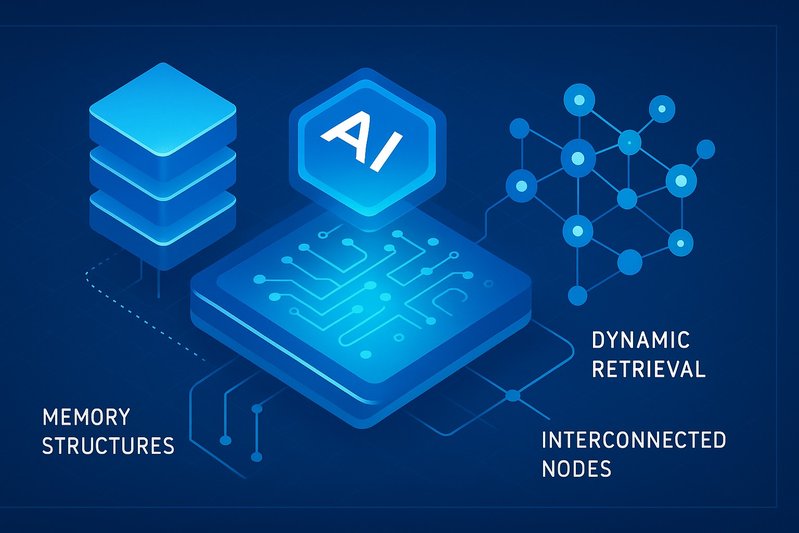
Hybrid RAG and Layered Memory Build High‑Fidelity LLM Agents at Scale
Grounded memory systems for LLM agents are converging on a layered design that blends long‑context working memory, episodic event logs, and structured semantic stores—then ties it all together with hybrid retrieval and salience‑aware controllers. The result is better factuality, less interference, and predictable latency—if you get the serving and governance right. While single‑stack, long‑context models help, the state of the art is hybrid RAG architectures that pair dense and sparse retrieval with tool‑mediated browsing and graph‑enhanced reasoning for verifiable grounding [1–3].
This article lays out a reference architecture and the concrete implementation patterns that matter in practice: how layers interact; how to represent, index, and retrieve knowledge; how to control reads/writes with salience, novelty, and age‑aware decay; how to compress and consolidate long histories; and how to serve high‑throughput workloads with KV‑cache extensions (vLLM), optimized attention (FlashAttention‑2), and streaming/ring attention [17–19,62]. You’ll learn which components to combine, what trade‑offs to expect, and how to instrument performance envelopes (p50/p95 stage latencies, throughput under concurrency, and cost drivers) without hallucinating promises the stack can’t keep.
Architecture/Implementation Details
Layer roles and interfaces
- Working memory: the live prompt and KV cache hold the current turn and short history. Long‑context models help, but efficient serving—PagedAttention for fragmentation‑free KV management, continuous/prefix batching, and streaming/ring attention—keeps latency in check as sequence lengths grow [17–19].
- Episodic memory: append‑only, time‑stamped event logs of preferences, errors, intermediate results, and decisions carry context across sessions. Cognitive‑inspired reflection can roll up atomic notes into higher‑value summaries for downstream use.
- Semantic memory: durable, auditable knowledge—facts, schemas, ontologies—materialized in a relational store or knowledge graph and complemented by vector search over unstructured content for flexible recall [1–3].
Interfaces:
- Read path: multi‑pool queries against (a) a recent episodic buffer, (b) personal/tenant semantic profiles, (c) global knowledge bases, and (d) tools (search/web/APIs). Orchestrate a hybrid pipeline—BM25 + dense retriever + cross‑encoder reranker—with explicit source URIs, timestamps, and hashes to enable per‑claim grounding [1,2,26,27,39].
- Write path: a controller scores candidate memories by importance, novelty, predicted utility, and user flags; it writes to episodic logs, schedules consolidation to semantic stores, and tags provenance (W3C PROV) to avoid laundering unverified claims [4,39].
Representations and indexing
- Dense vector stores: ANN search with HNSW/IVF/ScaNN gives scalable, semantically flexible recall; FAISS underpins high‑performance local indexing, while hosted vector DBs (Pinecone, Weaviate, Milvus, Chroma, Qdrant) supply hybrid search, metadata filters, and ACLs [1,20–24,22,58].
- Graphs and relational stores: knowledge graphs capture entities/relations for exact queries and validation; hybrid designs pair graph lookups with vector search over documents for breadth and precision [1–3,56].
- Chunking: align with semantic units (paragraphs/sections for prose; functions/classes for code; transaction/session windows for logs) to improve retriever recall and reduce context waste (specific chunk‑size metrics unavailable).
Hybrid retrieval orchestration and graph‑enhanced paths
- Sparse+dense with reranking: start broad (BM25 + dense), then cross‑encode to precision; tune on BEIR/KILT tasks to improve retrieval quality and end‑to‑end answer attribution [1,26,27].
- Tool‑mediated browsing and planning: interleave reasoning with search, page fetches, and database/API calls via ReAct; layer Self‑RAG‑style retrieve‑then‑critique to improve evidence coverage and reduce hallucinations [2,3].
- GraphRAG: construct a corpus‑derived knowledge graph; query entity‑centric paths for multi‑hop reasoning and disambiguation, yielding citation‑friendly outputs.
Read/write controllers and interference control
- Salience and diversity: score writes on importance, novelty (semantic distance to existing memories), predicted utility, and user signals; use MMR or submodular selection on reads to balance relevance and diversity; apply age‑based decay to prefer fresher context.
- Isolation: partition memories by tenant/user/project via namespaces; keep append‑only logs with soft‑deletes and shadow copies for edits; track embedding model versions in indexes to avoid distribution drift [20–24].
Compression and consolidation
- Hierarchical summaries: session → weekly/monthly rollups → semantic statements tied to profiles/ontologies; carry explicit provenance with URIs/timestamps.
- Prompt compression and hierarchical indexing: use instruction‑tuned compression like LLMLingua to shrink read‑time tokens; apply RAPTOR’s tree‑organized indexing to increase recall/precision over long/heterogeneous corpora [42,57].
Serving for throughput and latency
- KV‑cache and batching: vLLM’s PagedAttention enables high‑throughput, low‑fragmentation serving with continuous batching and prefix caching; combine with state‑flow stacks such as SGLang for tool‑heavy, multi‑turn agents [17,63].
- Attention kernels and decoding: FlashAttention‑2 speeds attention and lowers memory; streaming and ring attention stabilize throughput for long inputs; speculative decoding can further cut latency (exact gains vary; specific metrics unavailable) [18,19,62].
Storage and governance in the data plane
- Vector DB capabilities: hybrid sparse–dense search; metadata filters (tenant, time, modality, PII tags); row/field‑level access control; and horizontal sharding are table stakes for production [20–24,58].
- Shaping the footprint: PostgreSQL + pgvector or LanceDB are viable when you want a unified transactional + vector workload at moderate scale; at very large scale or on spinning disks, DiskANN‑style graph‑on‑disk indexes help bound latency/footprint [59–61].
- Provenance and audit: record raw turns, tool calls, retrieved contexts, and outputs with hashes/timestamps; represent derivations with W3C PROV; support deletion workflows compliant with GDPR Article 17 and PII redaction with tools like Microsoft Presidio [39,44,45].
Performance envelopes and observability
Instrument p50/p95 per stage (retrieval, reranking, tool calls, decoding), tokens/sec under concurrency, and cost per task (tokens, retriever queries, tool/API fees, and amortized storage/index maintenance). Use groundedness metrics like RAGAS and evaluation suites (LongBench/SCROLLS/RULER for long‑context; BEIR/KILT for retrieval attribution) to connect infra tuning to end‑to‑end outcomes [10–12,25–27]. Where numeric benchmarks are not provided in the report, treat improvement claims qualitatively and validate with your own runs (specific metrics unavailable).
Comparison Tables
ANN/indexing and retrieval options
| Option | What it brings | When to prefer | Notes/refs |
|---|---|---|---|
| HNSW | High‑recall graph ANN with good latency | General‑purpose semantic search in memory | Common in FAISS and vector DBs [1,22] |
| IVF (coarse quantization) | Faster search via partitions | Large collections with acceptable approximate recall | Widely supported; tune lists/probes [1,22] |
| ScaNN | Efficient ANN for dense vectors | High‑throughput dense retrieval | Cited as an ANN choice in hybrid RAG stacks |
| Flat (exact) | Exact recall | Small/hot partitions or evaluation baselines | Higher latency/cost; supported in FAISS |
| DiskANN | Graph‑on‑disk ANN | Very large scale or spinning disks | Bounds latency/footprint at scale |
| GraphRAG | Entity‑centric, multi‑hop retrieval | Disambiguation, procedural/relational domains | Yields citation‑friendly paths |
Serving optimizations for long‑context agents
| Component | Role | Latency/throughput effect | Notes/refs |
|---|---|---|---|
| vLLM PagedAttention | KV cache mgmt + continuous/prefix batching | Higher throughput, lower fragmentation | Production LLM serving |
| FlashAttention‑2 | Fast attention kernel | Lower attention time/memory | Combine with vLLM/speculative decoding |
| Streaming attention | Online decoding over long inputs | Stabilizes memory/latency | Suitable for streaming chats |
| Ring attention | Reduced memory for long sequences | Improves feasibility at extreme lengths | Complements streaming |
| SGLang | State‑flow/tool‑call throughput | Cuts orchestration overhead | Multi‑turn/tool‑heavy agents |
Best Practices
Orchestrate hybrid retrieval with critique and provenance
- Start with hybrid BM25 + dense retrieval; rerank with a cross‑encoder; train and validate on BEIR/KILT to couple retriever quality with downstream attribution [1,26,27].
- Interleave ReAct‑style planning with tool calls (search, web, DB/APIs) and adopt Self‑RAG’s retrieve‑then‑critique loop to reduce hallucinations and improve evidence coverage [2,3].
- Carry provenance end‑to‑end: include URI, timestamp, and content hash on every chunk; render inline citations near claims; encode derivations in W3C PROV for audits.
Design read/write controllers to curb growth and interference
- Write less, write better: score writes by importance, novelty, predicted utility, and user confirmation; defer speculative content and rely on retrieval on demand.
- Read for relevance and diversity: combine recency‑weighted pools (episodic buffer, personal semantic profile, global KB, tools) with MMR/submodular selection; apply age‑based decay to favor fresh context.
- Isolate aggressively: namespace per user/project; append‑only logs with soft‑deletes and shadow copies; track embedding version IDs in metadata to avoid mixing distributions across index updates [20–24].
Compress and consolidate with provenance retention
- Periodically summarize long threads to hierarchical rollups; use LLMLingua (prompt compression) to cut read‑time tokens while preserving key entities, dates, and decisions; adopt RAPTOR tree indexing for long/heterogeneous corpora [42,57].
- Promote consolidated statements into semantic stores only with verifiable sources; attach provenance so future edits and recrawls can re‑verify claims.
Serve efficiently for multi‑tenant, long‑context workloads
- Deploy with vLLM PagedAttention for KV‑efficient, continuously batched serving; enable prefix caching for repeated system prompts; layer FlashAttention‑2 for kernel speedups [17,62].
- For tool‑heavy agents, use state‑flow serving (e.g., SGLang) to reduce orchestration overhead; instrument per‑stage p50/p95 latencies and cost per task, not just tokens/sec.
- Favor tiered storage: hot caches for recent/high‑value items, warm vector indexes for active content, cold object storage for archives; schedule batch consolidation/re‑indexing off‑peak.
Govern the data plane
- Redact PII before embedding/persistence (Microsoft Presidio); enforce row/field‑level ACLs in vector DBs; provide deletion workflows that propagate tombstones across indexes and backups to satisfy GDPR Article 17 [20–24,44,45].
- Represent provenance with W3C PROV and keep audit‑friendly records: raw turns, tool calls, retrieved contexts, model outputs, and verification outcomes.
Practical Examples
While the report does not include code snippets or system‑specific benchmarks, it describes concrete architectural patterns that can be applied:
-
Hybrid pipeline for knowledge‑intensive QA: Combine BM25 with a dense retriever; feed the union into a cross‑encoder reranker; require each context chunk to carry a URI, timestamp, and hash. Evaluate with BEIR and KILT to tune retrieval and measure end‑to‑end correctness with attribution [1,26,27]. In practice, this reduces hallucinations and narrows context to the most relevant evidence (specific metric improvements are not provided).
-
Self‑RAG + ReAct for tool‑aware agents: For tasks needing fresh or multi‑step evidence, alternate reasoning steps with tool calls (search, web/API fetch), then apply a Self‑RAG critique stage that checks coverage and suggests further retrieval if gaps remain [2,3]. This loop tends to improve evidence coverage and reliability by design (quantitative gains not specified in the report).
-
Graph‑enhanced multi‑hop retrieval: Build a knowledge graph from a documentation corpus; at query time, retrieve both topically similar passages and graph neighbors of key entities. Use entity‑centric paths to disambiguate similar terms (e.g., procedures or components with overlapping names) and to present citation‑friendly, multi‑hop explanations.
-
Long‑history consolidation: For multi‑session assistants, roll up episodic logs into session and weekly summaries; use LLMLingua to compress summaries included at read time; index the corpus with RAPTOR’s tree to improve recall across sprawling threads [42,57]. Promote only high‑confidence, provenance‑backed facts into the semantic store.
-
Serving for low latency under concurrency: Host the agent with vLLM PagedAttention to minimize KV fragmentation; enable continuous batching and prefix caching; compile with FlashAttention‑2. Add streaming/ring attention when handling very long inputs to stabilize memory and latency (exact p50/p95 numbers are not supplied in the report) [17–19,62].
-
Governance and audit: Before persistence or embedding, run PII detection/redaction; restrict access by tenant/project filters in the vector DB; when a delete is requested, propagate soft‑deletes/tombstones to indexes and backups to satisfy GDPR Article 17. Record provenance as W3C PROV graphs for audits [20–24,39,44,45].
Conclusion
LLM agents achieve higher fidelity and scale when memory is layered, retrieval is hybrid and verifiable, and controllers treat write/read bandwidth as a scarce resource. In production, the winning stack pairs BM25 + dense retrieval + cross‑encoder reranking with planner‑verifier loops (ReAct, Self‑RAG), graph‑enhanced paths where multi‑hop reasoning matters, and disciplined consolidation with provenance. On the infra side, vLLM PagedAttention, FlashAttention‑2, and streaming/ring attention keep long‑context serving fast; vector databases with filters, ACLs, and sharding anchor the data plane; and audit‑ready provenance plus deletion workflows keep the system trustworthy and compliant.
Key takeaways:
- Use layered memory (working/episodic/semantic) and hybrid RAG with critique for reliability [1–3].
- Control writes with salience/novelty/predicted utility; balance read relevance/diversity with age‑aware decay.
- Prefer graph‑enhanced retrieval for multi‑hop reasoning and disambiguation.
- Serve with vLLM + FlashAttention‑2 and instrument stage‑level p50/p95; compress long histories with LLMLingua and RAPTOR [17,42,57,62].
- Enforce provenance (W3C PROV), ACLs, PII redaction, and deletion workflows in vector stores [20–24,39,44,45].
Next steps:
- Prototype the minimal stack: vLLM serving, hybrid BM25+dense retrieval with reranking, episodic write controller, and RAGAS for groundedness monitoring [17,20–25].
- Add planner‑retriever‑verifier loops and graph‑enhanced retrieval for complex domains [2,3,56].
- Establish evaluation harnesses for long‑context, attribution, and latency/cost tracking; iterate salience thresholds and decay policies.
With provenance‑first design, salience‑aware controllers, and production‑grade serving/storage, hybrid RAG and layered memory deliver grounded, auditable, and scalable LLM agents. 🚀
Sources
- A Survey on Retrieval‑Augmented Generation for Large Language Models — https://arxiv.org/abs/2312.10997 — Overview of hybrid RAG patterns, ANN choices, and retrieval pipelines.
- Self‑RAG: Learning to Retrieve, Generate, and Critique for Improving Language Models — https://arxiv.org/abs/2310.11511 — Retrieve‑then‑critique policy that improves evidence coverage and reliability.
- ReAct: Synergizing Reasoning and Acting in Language Models — https://arxiv.org/abs/2210.03629 — Tool‑mediated browsing/planning for interleaving reasoning with external queries.
- MemPrompt: Memory‑Augmented Prompting for LLMs — https://arxiv.org/abs/2306.14052 — Salience/novelty/predicted utility signals for memory write policies.
- Generative Agents: Interactive Simulacra of Human Behavior — https://arxiv.org/abs/2304.03442 — Cognitive‑inspired episodic memory and reflection/rollups.
- Transformer‑XL: Attentive Language Models Beyond a Fixed‑Length Context — https://arxiv.org/abs/1901.02860 — Recurrent mechanisms for long‑context modeling and windowing.
- LongBench — https://arxiv.org/abs/2308.14508 — Long‑context evaluation tasks.
- SCROLLS — https://arxiv.org/abs/2201.03533 — Benchmark for long sequences.
- RULER — https://arxiv.org/abs/2309.17453 — Long‑context evaluation.
- vLLM: PagedAttention — https://arxiv.org/abs/2309.06131 — High‑throughput KV‑cache serving with continuous/prefix batching.
- StreamingLLM — https://arxiv.org/abs/2306.02182 — Streaming attention for online decoding.
- Ring Attention — https://arxiv.org/abs/2310.01889 — Memory‑efficient attention for long contexts.
- Pinecone docs — https://docs.pinecone.io/ — Vector DB capabilities (filters, ACLs, sharding).
- Weaviate docs — https://weaviate.io/developers/weaviate — Vector DB hybrid search and governance features.
- FAISS — https://github.com/facebookresearch/faiss — ANN implementations (HNSW/IVF/flat) for local retrieval.
- Milvus docs — https://milvus.io/docs — Vector DB at scale with filtering/sharding.
- Chroma docs — https://docs.trychroma.com/ — Vector store features relevant to hybrid RAG.
- RAGAS — https://github.com/explodinggradients/ragas — Groundedness metrics.
- KILT — https://arxiv.org/abs/2010.11967 — Retrieval QA with attribution.
- BEIR — https://arxiv.org/abs/2104.08663 — Evaluation of retrievers across tasks.
- W3C PROV — https://www.w3.org/TR/prov-overview/ — Provenance representation for auditability.
- LLMLingua — https://arxiv.org/abs/2310.05736 — Prompt compression to reduce token budgets.
- Microsoft GraphRAG — https://github.com/microsoft/graphrag — Graph‑augmented retrieval for multi‑hop reasoning/disambiguation.
- RAPTOR — https://arxiv.org/abs/2306.17806 — Tree‑organized hierarchical indexing.
- Qdrant docs — https://qdrant.tech/documentation/ — Vector DB features incl. filters and sharding.
- pgvector — https://github.com/pgvector/pgvector — Vector search within PostgreSQL for unified workloads.
- LanceDB — https://lancedb.github.io/lancedb/ — Vector database for moderate‑scale, unified workloads.
- DiskANN — https://www.microsoft.com/en-us/research/publication/diskann/ — Graph‑on‑disk ANN for large scale/spinning disks.
- FlashAttention‑2 — https://arxiv.org/abs/2307.08691 — Faster attention kernels to cut latency and memory.
- SGLang — https://github.com/sgl-project/sglang — State‑flow serving for multi‑turn/tool‑heavy agents.