Home Mixer Blueprint Clarifies X’s Multi‑Stage Feed Architecture
A technical dissection of retrieval sources, Light/Heavy ranking, safety layers, and feed mixing as documented in twitter/the-algorithm
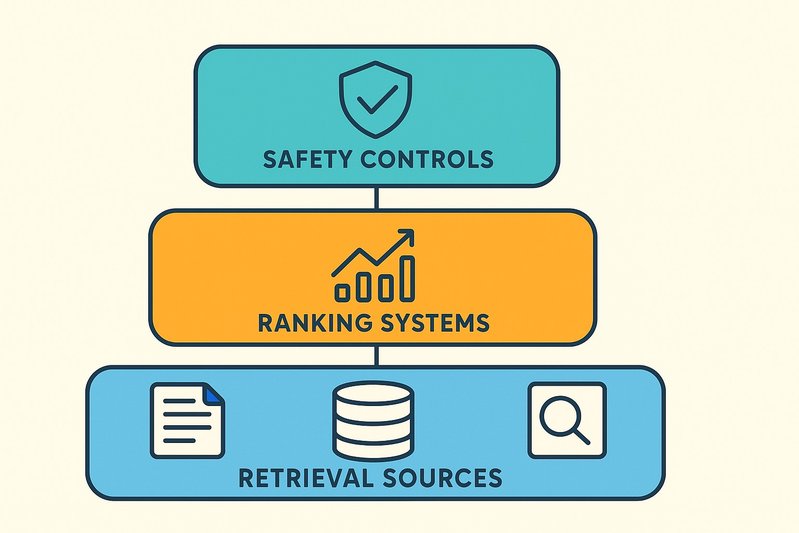
The Home timeline on X isn’t a single model; it’s a layered pipeline that fuses graph retrieval, community inference, multi-stage ranking, and policy-aware mixers into a real-time feed. The open-sourced Home Mixer blueprint lays out that structure clearly: a cascade begins with broad candidate recall from social and community sources, narrows quickly with a latency-tight Light Ranker, and then deepens quality with a richer Heavy Ranker before post-ranking controls and safety rules shape the final outcome. The result is a system designed for breadth, accuracy, and guardrails—without publishing per-change A/B deltas or early-2026 optimization metrics.
This article maps the end-to-end data flow and explains where each component sits, what it consumes, and how it influences the Home feed. It also outlines practical optimization “landing zones” at each stage—retrieval, ranking, re-ranking, and runtime—and clarifies cold-start handling as a direct consequence of the architecture. Readers will learn how the Home Mixer orchestrates candidate sources, what Light and Heavy rankers actually do, how diversity and safety enforcement govern the last mile, and where engineering constraints (latency, index queries, throughput) bound what’s possible. Specific numerical benchmarks remain unavailable publicly; the emphasis here is on structure, responsibilities, and optimization surfaces.
Architecture/Implementation Details
End-to-end data flow through Home Mixer
A Home request enters the Home Mixer—an orchestrator that coordinates candidate assembly, multi-stage ranking, and final blending into a scrollable timeline. The data flow follows a standard, large-scale recommender pattern:
- Candidate assembly: Retrieve a broad slate of tweet candidates from multiple sources: social-graph expansions (follows and engagement edges), community-structure neighbors, and other mixers that emphasize freshness and topical breadth.
- Pre-ranking mixing: Combine and deduplicate candidates from these sources, enforcing early caps by source and basic freshness/quality gates to constrain downstream load.
- Light Ranker pass: Apply a fast, feature-limited model to cull the pool quickly under tight latency budgets. This stage prioritizes recall of likely contenders while filtering obvious low-relevance items.
- Heavy Ranker pass: Score the surviving subset with richer features and more complex modeling to estimate propensities for multiple engagement actions. Calibration and objective alignment happen here.
- Post-ranking control stack: Impose diversity constraints, visibility rules, and safety/business policy enforcement. This stack steers exposure distribution, minimizes harmful outcomes, and aligns the final order with product constraints.
- Final blending and output: The Home Mixer composes the ranked list into the timeline, balancing follows and recommendations and ensuring a coherent user experience.
The blueprint emphasizes orchestration across multiple sources and layers, not a monolithic “one model to rule them all.”
Candidate retrieval from graph and community signals
Retrieval is grounded in two pillars:
- Social edges: The follow graph and engagement edges (e.g., interactions) produce candidates that reflect direct and near-neighbor affinity. This pathway capitalizes on strong ties and recent interactions to anchor the feed in familiar sources.
- Community structures: Clustering akin to SimClusters groups users and content by shared interests. Community-based retrieval adds topical breadth, long-tail discovery, and relevance when direct connections are sparse.
These sources plug into mixers that also consider:
- Freshness and real-time activity: Preference for recent, active content to maintain feed vitality.
- Deduplication controls: Early removal of duplicates or near-duplicates to save ranking budget and reduce repetitive impressions.
The blueprint explains the what and why of retrieval but does not enumerate specific recall metrics or per-source lifts; those details remain publicly unavailable.
Source mixing strategies before ranking
Before any model fires, the Home Mixer balances follows, recommendations, and community breadth to produce a candidate pool that’s neither too narrow nor too unfocused. Practical goals at this stage include:
- Ensuring follows and strong ties remain well represented.
- Introducing exploratory recommendations that widen topical coverage.
- Avoiding over-reliance on any single source without explicit bandit machinery.
Public materials do not disclose parameterized exploration policies, formal bandit algorithms, or their tuning. Mixing is present; detailed exploration policy specifics are not.
Light Ranker responsibilities
The Light Ranker is the first modeling gate across a large candidate set. Its defining traits:
- Feature subsets: A smaller, faster feature inventory prioritizes signals that are cheap to compute and generally predictive.
- Gating: Rapid elimination of low-relevance or low-quality candidates to shrink the set for deeper scoring.
- Latency constraints: Tight budgets force model simplicity, approximate features, and aggressive batching strategies.
- Quick filtering: Practical heuristics (e.g., minimal quality thresholds) often complement learned scores to maximize throughput.
Because this pass is bottlenecked by time and cost, its job is to maintain high recall of good items, not to perfectly rank the feed.
Heavy Ranker responsibilities
The Heavy Ranker applies richer features and more complex modeling to a narrowed set:
- Rich feature ingestion: Graph features, historical interactions, and content signals are fused to refine relevance.
- Multi-action propensity estimation: Predict propensities for engagement actions such as clicks, likes, retweets, and replies; downstream logic can aggregate or blend these signals to reflect session quality.
- Calibration alignment: Adjustments ensure predicted scores align with observed outcomes and combine coherently across actions.
This stage focuses on accuracy, nuance, and alignment with longer-term session metrics, within a looser—but still bounded—latency budget.
Post-ranking control stack: diversity, safety, and policy
After the Heavy Ranker, a control stack shapes exposure:
- Diversity constraints: Guard against repetitive sources or topics; promote varied creator and content exposure.
- Visibility rules and business logic: Enforce product-level caps, prominence rules, and other operational requirements.
- Safety and policy enforcement: Reduce exposure to harmful or policy-violating content via pre-filters and post-ranking checks. Safety-aware adjustments are part of the design.
These controls deliberately trade some raw engagement for a feed that meets safety and policy standards.
Embeddings and feature infrastructure
User and item representations provide the connective tissue:
- Graph-derived embeddings: Encapsulate social proximity and community membership.
- Content signals: Represent text, image, or video aspects of a tweet—though public materials do not enumerate cross-modal specifics.
- Historical interactions: Translate a user’s past behavior into personalized signals.
The system depends on robust feature pipelines and embedding infrastructure; memory footprint, refresh cadence, and training data freshness are mentioned as key operational considerations, without disclosing numeric budgets.
Runtime engineering boundaries
At production scale, quality is inseparable from performance:
- Latency distributions: p50/p95/p99 budgets must be respected end to end; exact values are not publicly published.
- ANN/query paths: Approximate nearest neighbor indices and graph traversals back retrieval under tight SLAs; parameter tuning affects recall, precision, and cost.
- Hardware/throughput: Batching, caching, and quantized inference help squeeze performance within compute envelopes; again, specific figures are not public.
- SLA adherence and cost: The system is described in terms of balancing speed, quality, and cost; quantitative trade-offs are not disclosed.
The architecture foregrounds these constraints without giving the underlying performance numbers.
Comparison Tables
Light vs Heavy Ranker responsibilities
| Dimension | Light Ranker | Heavy Ranker |
|---|---|---|
| Primary goal | Fast filtering with high recall | High-accuracy scoring and ordering |
| Feature scope | Subset; cheap to compute | Rich, diverse features |
| Modeling complexity | Simpler, latency-first | More complex, accuracy-first |
| Latency budget | Tight | Looser (still bounded) |
| Outputs | Shortlist of viable candidates | Multi-action propensities and calibrated scores |
| Failure mode to avoid | Over-pruning good items | Miscalibration or overfitting under latency limits |
Retrieval sources and mixers (pre-ranking)
| Source | Strengths | Risks/Costs | Early controls |
|---|---|---|---|
| Social edges (follows, engagements) | Strong affinity, high precision | Echo chamber risk | Caps by source; freshness gating |
| Community structures (clusters) | Topical breadth, long-tail discovery | Lower precision if poorly aligned | Deduplication; basic quality screens |
| Freshness-focused mixers | Real-time relevance | Potential volatility | Time-based windows; source balancing |
Pre-ranking mixing vs post-ranking control
| Layer | Purpose | Mechanisms | Notes |
|---|---|---|---|
| Pre-ranking mixing | Assemble broad, de-duplicated candidate pool | Source caps, freshness, lightweight filters | Avoids overload of rankers; sets diversity baseline |
| Post-ranking control | Shape exposure after scoring | Diversity constraints, visibility rules, safety/policy | Aligns outcomes with product and safety goals |
Best Practices
Optimization landing zones by stage
The blueprint makes it clear where improvements typically attach:
-
Retrieval augmentations:
-
Add or refine graph/community sources to raise recall of relevant candidates.
-
Tune ANN and traversal parameters to improve recall@K under latency and memory limits.
-
Strengthen freshness signals and pre-filters to reduce downstream waste.
-
Ranker model families:
-
Evolve Light Ranker architectures for better recall at fixed latency; distill heavier models only if budgets permit.
-
Expand Heavy Ranker objectives to multi-task setups that capture varied engagement actions, with careful calibration.
-
Re-ranking policies:
-
Adjust diversity and novelty rules to improve session quality without sacrificing safety.
-
Audit the interaction between business logic and safety filters to minimize unintended suppression of valuable content.
-
Feature and embedding improvements:
-
Enrich graph and community embeddings; refresh schedules and backfills matter for stability.
-
Integrate content signals where possible; evaluate cross-modal contributions with ablations.
Specific lifts or A/B results are not publicly available; the advice above follows from architectural roles rather than reported deltas.
Measurement and attribution that actually works
To distinguish real gains from noise and avoid stage overlap:
-
Offline retrieval metrics:
-
Track recall@K, hit-rate, and oracle-truncated NDCG@K after adding or tuning sources.
-
Measure coverage/diversity shifts and interactions with safety pre-filters.
-
Offline ranking metrics:
-
Report AUC, NDCG@K, MAP, and MRR per action type, plus calibration error.
-
Online outcomes:
-
Monitor CTR, dwell, session depth/length, and negative-feedback or toxicity rates with statistical confidence.
-
Use experiment-level confidence intervals and multiple-test correction across variants.
-
Cohort and locale breakdowns:
-
Evaluate new users vs heavy users, creators vs consumers, and locale/language segments for heterogeneity.
-
Treat modality differences (text/image/video) explicitly where applicable.
-
Trade-off accounting:
-
Log p50/p95/p99 latency end to end; track inference times, ANN query costs, and cost per 1,000 requests.
-
Document safety event rates and distributional effects (e.g., creator exposure) when re-ranking rules change.
Where numbers are not public, teams should still collect and report them internally to support decisions.
Cold-start handling as an architectural consequence
Cold-start and sparse-history cohorts lean on the pieces already in place:
- Priors from communities and graph: Community-based retrieval and graph embeddings provide immediate interest proxies when personal history is thin.
- Content-based signals: Text and media features help identify likely interests even before follow edges exist.
- Exploration budgets via mixing: Early exposure to diverse topics seeds useful feedback without explicit bandit details published.
To verify progress, track:
- Offline NDCG@K and MAP in zero- and few-interaction cohorts.
- Online time-to-first-engagement, first-session depth, and early retention curves.
- Any shifts in exploration exposure, safety screens, or latency for these cohorts.
Cold-start improvements are most credible when they do not degrade heavy-user performance or safety outcomes.
Operational guardrails to keep quality intact
Engineering constraints shape what is deployable:
- Respect SLA distributions: Design Light/Heavy splits and ANN parameters to hit p50/p95/p99 targets; specifics are not publicly disclosed, but enforcement is non-negotiable.
- Use approximations judiciously: Quantization, caching, and batching should include quality checks (AUC/NDCG deltas) to ensure speed gains don’t silently erode ranking.
- Monitor cost and availability: Throughput and cost per request determine practical scale; publish internal dashboards to keep optimization honest.
- Safety stays in the loop: Any retrieval or ranking change should be evaluated alongside safety/policy filters to avoid unintentional harmful exposure. 🛡️
Conclusion
The Home Mixer blueprint makes one point unmistakable: X’s Home timeline is a multi-stage system designed to balance scale, personalization, and safety through explicit architectural boundaries. Retrieval taps social and community signals for breadth; a Light Ranker filters quickly under tight latency; a Heavy Ranker adds depth with multi-action modeling and calibration; and post-ranking layers enforce diversity, visibility, and safety. Embeddings and feature pipelines knit the whole together, while runtime constraints and SLAs draw hard lines around what’s feasible in production.
Key takeaways:
- The Home feed is an orchestrated pipeline, not a single model; mixers and re-ranking rules are first-class citizens.
- Retrieval breadth plus Light/Heavy ranking depth is the backbone; diversity and safety rules steer the final output.
- Optimization “landing zones” exist at every stage—retrieval, rankers, re-ranking, and runtime—but specific public metrics are unavailable.
- Cold-start handling falls out of the architecture: community/graph priors, content signals, and early exploration.
- Performance, cost, and safety must be measured together; p50/p95/p99 latency and calibration belong in every release checklist.
Next steps for practitioners:
- Map your own pipeline to these stages and identify bottlenecks by stage.
- Instrument both offline (AUC, NDCG@K, MAP, MRR) and online (CTR, dwell, session, safety) metrics with cohort breakdowns.
- Prioritize retrieval recall and Light Ranker recall at fixed latency before expanding Heavy Ranker complexity.
- Strengthen safety and diversity policies in lockstep with recall and ranking changes.
The architecture offers a durable blueprint for high-scale feeds: broaden intelligently, rank in stages, and enforce guardrails that keep the experience healthy and coherent—even when specific optimization metrics remain behind the curtain.