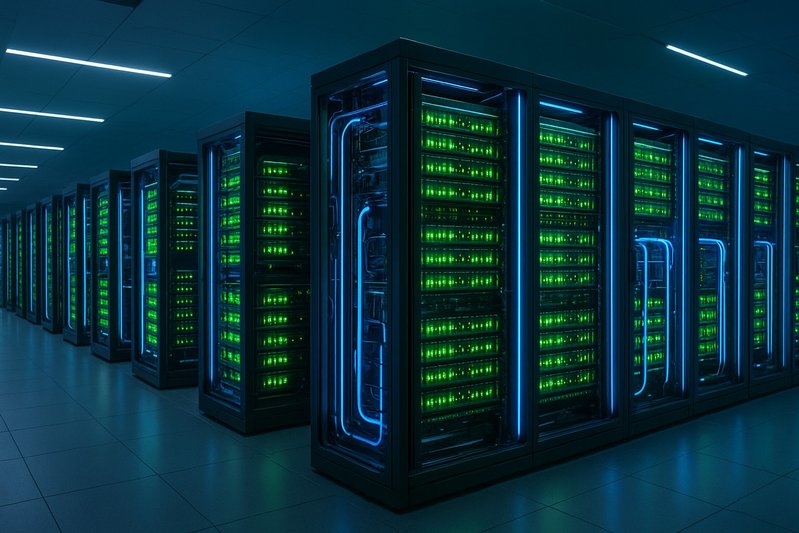
High-Power Density: Redefining Data Center Infrastructure
Achieving Safe and Efficient High-Density Power for AI Workloads
The tech landscape is undergoing a seismic shift with the meteoric rise of artificial intelligence (AI) workloads, forcing data centers around the globe to rethink infrastructure from the ground up. It’s a transformation driven by the sheer computational power demands of large-scale AI models, which necessitate densities that were unimaginable just a few years ago. How can data centers meet these rising demands safely and efficiently? This question is driving innovation across electrical, thermal, and mechanical domains in data center design.
The Challenge of AI-Driven Power Density
Modern AI and machine learning (ML) tasks require immense computational horsepower, congregating numerous GPU accelerators within a single rack. This concentration of hardware can push power densities in data centers from a conventional 30 kW per rack up to an intense 200 kW or more. As devices crank up in performance, they also generate a staggering amount of heat, pushing traditional air-cooling methods beyond their limits.
The current generation of AI accelerators, like NVIDIA’s H100 and AMD’s Instinct MI300X, each draw upwards of 700 watts. This necessitates a fundamental re-evaluation of cooling and power distribution solutions within data centers to accommodate these power and thermal intensities effectively.
Innovative Cooling Solutions
Liquid Cooling: The Forefront of Thermal Management
To handle the thermal output of high-density racks, many operators are turning to liquid cooling solutions. Direct-to-chip (DTC) cooling is becoming a popular option, which involves attaching liquid-cooled cold plates directly to resource-intensive components like CPUs and GPUs. This method effectively dissipates heat at the source, offering potential rack power densities of 60-120+ kW.
Immersion cooling is another increasingly attractive option, especially for extreme densities. It involves submerging entire server racks in dielectric fluids, significantly improving thermal management and potentially achieving pue values as low as 1.05. However, immersion cooling demands extensive changes in service processes and a thorough evaluation of fluid supply chains.
Enhanced Air and Rear-Door Heat Exchangers
While liquid cooling offers impressive thermal efficiency, many existing data centers must adapt without scrapping current infrastructures. Rear-door heat exchangers (RDHx) offer a middle-ground solution. These systems attach to rack exteriors and draw heat out before it infiltrates the entire data hall, supporting rack densities up to 90 kW. Enhanced air techniques, including sophisticated containment strategies, remain viable for retrofitting spaces under 30 kW per rack, though they provide limited room for growth.
Power Delivery: Rethinking Electrical Infrastructure
The need for efficient power distribution is critical as energy demands escalate. Emerging strategies favoring 415/240 V three-phase power and 48 V DC ecosystems are becoming the norm in high-density environments. These systems reduce transmission losses and accommodate higher currents through innovations like blind-mate power shelves and integrated liquid manifolds, thus optimizing both space and efficiency.
Embracing modularity with prefabricated components allows quick deployment and aligns with sustainable energy use. Prefabrication can trim construction timelines from traditional multi-year to mere months, helping meet swift deployment schedules requisite for rapidly growing AI needs.
Striking a Balance: Modularity and Sustainability
Prefabricated data center modules and containerized GPU pods represent an agile approach to expanding infrastructure capacity. This modularity enhances flexibility in terms of deployment and expands capacity on constrained sites without massive operational overhauls. Similarly, the adoption of open standards like Open Compute Project’s Open Rack V3 (ORV3) and Advanced Cooling Solutions (ACS) facilitates easier integration across multi-vendor environments.
Sustainability also occupies a central thread in these new designs. Liquid cooling paired with air economizers markedly slashes energy and water consumption, achieving PUE numbers conducive to modern efficiency targets. Notably, companies like Meta and Amazon have begun showcasing successful heat recovery endeavors, re-utilizing waste heat to power district heating systems, exemplifying a significant stride towards carbon-neutral goals.
Conclusion: A Path Forward
The trajectory of data center technology underscores a clear shift towards accommodating higher power densities through innovative thermal management and efficient power solutions. Direct-to-chip, immersion cooling, and modular prefabricated systems will play pivotal roles in this evolution, marrying high-performance demands with sustainability and efficiency imperatives. By aligning cooling selection with power distribution strategies and integrating open standards, data centers can maneuver the challenges of AI’s escalating requirements, ultimately achieving a balance of performance and sustainability requisite for the future.
Sources & References
