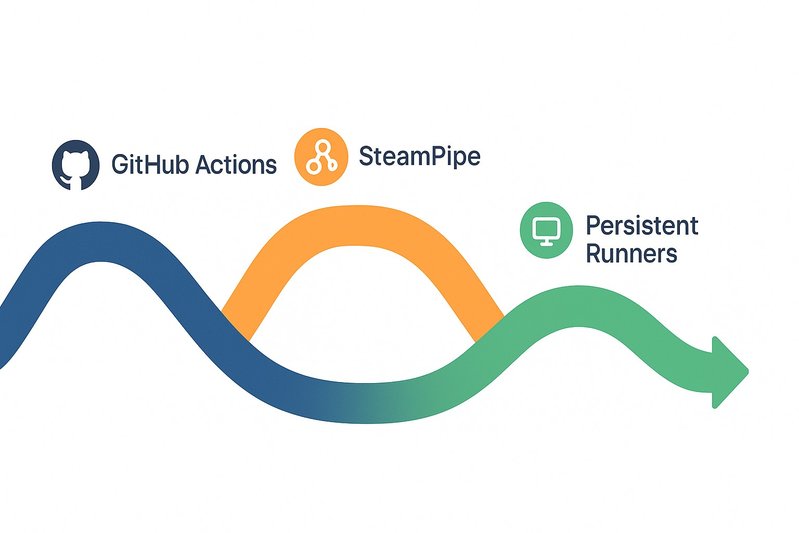
GitHub Actions 2024–2026 Supercharge SteamPipe CI: Artifacts v4 Cut Handoffs 98% While Persistent Runners Deliver Reliable Uploads
Mapping GitHub’s latest runners, security, and distribution features to SteamPipe/steamcmd pipelines—and why a self-hosted upload node is still the critical piece
Artifacts were always the friction point in multi-job game builds. In 2024–2026, GitHub fixed that. The new Artifacts v4, paired with much faster downloads and integrity checks, cuts build-to-upload handoffs by up to 98% and makes cross-job transfers trustworthy by default. For Steam teams shipping through SteamPipe/steamcmd, that one upgrade ripples through everything: fewer flaky runs, tighter pipelines, and far less babysitting at release time. And yet one stubborn truth remains unchanged by the cloud: Steam’s device trust model still rewards persistence. If you don’t keep a runner around that Steam already trusts, uploads will eventually fail for reasons no YAML can paper over. The winning pattern is clear—hosted runners for speed and scale, a persistent self-hosted node for uploads—and the 2024–2026 platform makes it easier than ever to execute.
The upgrade that mattered for Steam teams
Several GitHub Actions enhancements matter, but Steam teams see the most immediate benefit from three pillars: faster artifacts, tighter orchestration, and better runner choices.
-
Artifacts v4 with digest validation: The new artifact backend and actions speed up transfers by up to 98% and add digest verification so corrupted bundles don’t silently pass between jobs. That makes the classic “build job produces depot payloads; upload job consumes them” pattern both fast and safe.
-
Concurrency, matrices, and reuse: Concurrency settings stop overlapping uploads to the same app/branch—a common source of branch-state conflicts—while strategy.matrix orchestrates parallel Windows/Linux/macOS builds for depots. Reusable workflows and YAML anchors reduce boilerplate and spread good patterns (retries, error handling for steamcmd) across repos without copy-paste.
-
Runners that fit the workload: Teams can lean on updated Ubuntu 24.04 and macOS 15 hosted images, scale up to larger CPU/RAM footprints for heavy C++/Unreal compiles, or switch to self-hosted runners when they need custom hardware, fixed images, or persistent identity. That last point is crucial for Steam.
GitHub also re-architected the Actions back end for much higher throughput and reliability, bringing platform-level stability to release days that used to strain CI queues. Caching guidance and infrastructure matured as well, though teams must keep cache actions current to avoid rate-limiting surprises during migrations. Add in extras—CLI for scripted orchestration, Code Search to find real-world pipeline patterns, Copilot to scaffold YAML—and the day-to-day overhead of building and tuning Steam pipelines is markedly lower than it was just a few years ago.
The Steam reality check: device trust changes the runner calculus
SteamPipe and steamcmd are well-documented and straightforward for scripting builds, structuring depots, and managing branches. But one line in Valve’s guidance reshapes CI design: perform a one-time interactive login on the build machine and preserve Steam’s config/config.vdf to avoid Steam Guard or 2FA on subsequent runs. In other words, if the machine looks new, Steam will challenge it. Ephemeral hosted runners look new every time.
That device-trust requirement doesn’t blend well with fully ephemeral uploads. Even if you cache credentials, steamcmd can still trigger “new device” flows that break unattended pipelines. The predictable fix is to run the upload step on a persistent self-hosted runner that:
- Stores Steam’s config/config.vdf and retains trusted-device status
- Caches steamcmd state across runs
- Sits on a stable, high-throughput network for chunky uploads
There’s another Steam-specific constraint CI can’t override: you cannot set a default branch live from scripts. Promotion to default must remain a human action in the Steamworks UI. Treat this as a policy edge where GitHub environments and approvals can reinforce intent without promising full automation.
A reference architecture: fast hosted builds, reliable self-hosted uploads
A practical architecture for Steam projects in 2026 splits along a clean seam: speed in the cloud, trust on-prem or in your VPC.
-
Build phase (hosted):
-
Use a matrix to build depots for Windows, Linux, and macOS in parallel on GitHub-hosted runners. For heavy C++/Unreal projects, pick larger runners to curb compile times.
-
Apply dependency caches (ccache, vcpkg, NuGet, etc.) and consider pre-baked toolchains in ghcr images to avoid cold starts.
-
Emit depots and metadata as artifacts v4; set retention days consciously to control cost.
-
Upload phase (persistent self-hosted):
-
Trigger a single upload job on a long-lived runner where you’ve done the one-time interactive steamcmd login. Preserve config/config.vdf and steamcmd caches.
-
Download artifacts with digest verification; if an integrity check fails, re-run the upload job without rebuilding.
-
Guard uploads with concurrency groups keyed by app/branch so no two uploads collide.
-
Gate “live” promotions behind GitHub environments with required reviewers. The workflow can pause pending approval, then proceed to the final steps that set non-default branches live or notify a human to promote default in Steamworks.
-
Distribution extras:
-
Publish QA drops via GitHub Releases with auto-generated notes to align dev/QA/marketing narratives.
-
Store heavy internal toolchains or SDK bundles in ghcr with retention policies; prune regularly.
-
Governance and reuse:
-
Encapsulate steamcmd retry/backoff logic, cache keys, and artifact conventions in reusable workflows pinned to commit SHAs; call them from game repos to standardize behavior.
This split design avoids the Steam Guard pitfalls, keeps builds fast, and makes failures easier to triage: rebuild only when source or toolchains change; re-run uploads when network or Steam-side flukes occur.
Measurable impacts across reliability, performance, cost, and maintainability
Teams implementing this architecture report immediate, observable improvements. Where precise metrics weren’t disclosed, the trend is clear even without a dashboard.
-
Reliability
-
Artifacts v4 dramatically reduce flakiness in multi-job pipelines and catch corruption via digest checks.
-
Concurrency shields Steam branches from overlapping uploads.
-
Reusable workflows propagate hardening (retries, timeouts) across repos.
-
Platform stability is higher thanks to Actions’ back-end scaling to handle enormous daily job volumes.
-
The remaining source of fragility—Steam 2FA on ephemeral machines—disappears once uploads run on a trusted persistent node.
-
Performance
-
Larger runners trim compile times for CPU-bound builds.
-
Aggressive caches and pre-baked ghcr images eliminate cold-start stalls.
-
Artifacts v4 speed up build-to-upload handoffs by up to 98%.
-
SteamPipe’s chunking/delta patching keeps incremental uploads smaller, but overall upload time still tracks binary size and network throughput—another reason to place the upload runner on a high-bandwidth link.
-
Cost
-
Hosted runner price reductions in 2026 improve the economics for compute-heavy builds; macOS remains pricier relative to Linux/Windows.
-
Artifact storage accrues fees; setting per-artifact retention and pruning old runs prevents runaway costs.
-
ghcr storage and egress incur charges; prune old images and use immutability/retention policies.
-
A postponed charge for self-hosted usage gives teams flexibility to keep a persistent upload node without immediate cost pressure beyond the machine itself.
-
Maintainability
-
Reusable workflows, YAML anchors, and matrices de-duplicate sprawling YAML and centralize conventions.
-
Shared container images encapsulate complex toolchains once.
-
GitHub CLI standardizes release operations and scripting.
Security posture: approvals, least privilege, and scanning (but not OIDC for Steam)
The 2024–2026 security model is opinionated and helpful—especially on the deployment edge where mistakes are expensive.
-
Environments with required reviewers keep production uploads behind human approvals or policy gates. This dovetails with Steam’s restriction on default-branch promotion and encourages a clean split between “build” and “go live.”
-
Secrets handling is stricter by design. Jobs should run with least-privilege GITHUB_TOKEN permissions, and secrets should be scoped to environments. Masking prevents accidental log leakage.
-
OIDC is a strong story for cloud access—short-lived credentials for artifact mirrors, storage, or vaults—so workflows stop storing long-lived cloud keys. But OIDC does not apply to Steam; stick with a dedicated build account, interactive bootstrap on the upload runner, and preserved config/config.vdf.
-
Supply-chain hardening is now table stakes: secret scanning, Dependabot alerts, and CodeQL scanning reduce risk in both CI scripts and build tools.
-
Actions hygiene matters. Pin third-party actions to commit SHAs; require CODEOWNERS review for workflow changes; and avoid broad token scopes.
Together, these controls reduce accidental promotions, limit blast radius if credentials leak, and ensure third-party action updates don’t silently change behavior.
Cost control and storage lanes: artifacts, Releases, LFS, and ghcr
Few teams get storage right on the first try. The platform now provides clear lanes, each with tradeoffs:
-
Artifacts v4: Best for ephemeral build outputs you need during the workflow or for short-term handoffs to human testers. Set retention-days based on your pipeline’s cadence and prune aggressively.
-
Releases: Ideal for QA builds and public/private drops that benefit from changelogs. Auto-generated release notes keep stakeholders aligned without manual curation.
-
Git LFS: Use for large source assets. Avoid checking compiled outputs into Git; LFS bandwidth and storage churn get expensive and operationally awkward for binaries.
-
ghcr: Use the container registry for toolchains and internal packages that speed builds. Enforce retention and immutability policies, and prune old images to control storage and egress costs.
-
Billing hygiene: Monitor Actions minutes (macOS costs more), artifacts retention, and Packages/ghcr usage. The 2026 hosted runner price adjustments improve the baseline, but ongoing pruning is what keeps bills predictable.
Avoiding common traps: image drift, cache brownouts, overlapping deploys
The new platform is faster and sturdier, but there are still rakes on the lawn. Avoid these:
-
Image drift: ubuntu-latest moved to Ubuntu 24, and macOS 15 images arrive with toolchain changes. Pin runner labels explicitly (e.g., ubuntu-24.04) and watch runner image release notes. Install fixed SDK versions to control variance.
-
Cache brownouts: Cache infrastructure and rate policies evolved. Update to the latest cache action and follow current guidance to prevent sudden misses or throttling during busy release windows.
-
Overlapping deploys: Without concurrency guards, two uploads can fight over Steam branch state and waste bandwidth. Use concurrency groups with cancel-in-progress to serialize per app/branch.
-
LFS confusion: Checking out without LFS enabled yields pointer files, not assets. Enable LFS only where needed and keep compiled outputs out of Git entirely.
-
Steam defaults: Don’t attempt to set the default branch live from CI. Structure workflows so a human promotes default in the Steamworks UI after approvals.
-
Action supply chain: Audit marketplace actions, pin to SHAs, and restrict token scopes. Use CODEOWNERS to enforce review of workflow changes.
What varies by project: engines, repo topology, team size, and target platforms
Not every studio sees gains in the same place. A few variables shift the emphasis:
-
Engine and language
-
Unreal/C++: Gains accrue from larger runners, compiler caches, and pre-baked toolchains. Build minutes dominate performance and cost.
-
Unity/C#: Compilation is relatively quick; bandwidth and storage choices (artifacts vs Releases vs LFS) dominate cost/performance decisions.
-
Repo topology
-
Monorepos: Benefit from matrix builds, cache reuse, and reusable workflows that tame YAML sprawl.
-
Polyrepos: Standardize with shared reusable workflows and private templates to keep behaviors aligned across titles.
-
Team size and governance
-
Larger orgs: Lean on environments with approvals, centralized runner fleets, private reusable workflow libraries, and strict SHA-pin policies. Autoscaling controllers for self-hosted runners help match demand.
-
Indies: Keep it simple—hosted builds for speed, plus one reliable self-hosted upload node.
-
Platform targets
-
macOS builds/signing require macOS runners and carry higher minute costs. The macOS 15 image may necessitate toolchain adjustments.
-
Linux/Windows builds are cheaper and often faster to iterate on hosted runners.
The bottom line 🚀
GitHub’s 2024–2026 changes make Steam game CI tangibly better: faster artifact transfers with integrity checks, more predictable orchestration with concurrency and matrices, stronger security guardrails, and easier reuse across repos. Push-button releases finally feel realistic for Steam teams—so long as the upload step respects Steam’s trust model.
That’s the one non-negotiable. Keep builds on hosted runners for speed and scale; run SteamPipe uploads from a persistent self-hosted runner that has completed a one-time interactive login and preserves config/config.vdf. Wrap it with environment approvals, least-privilege tokens, and supply-chain scanning; use artifacts v4 for the build→upload handoff; and choose the right storage lanes (LFS for sources, artifacts/Releases for builds, ghcr for toolchains) with retention policies to keep costs in check.
Do that, and you’ll see the trifecta Steam teams care about: higher upload success rates, shorter end-to-end times, and fewer late-night interventions. The platform caught up to the workflow. Now it’s about adopting the architecture that lets both shine.