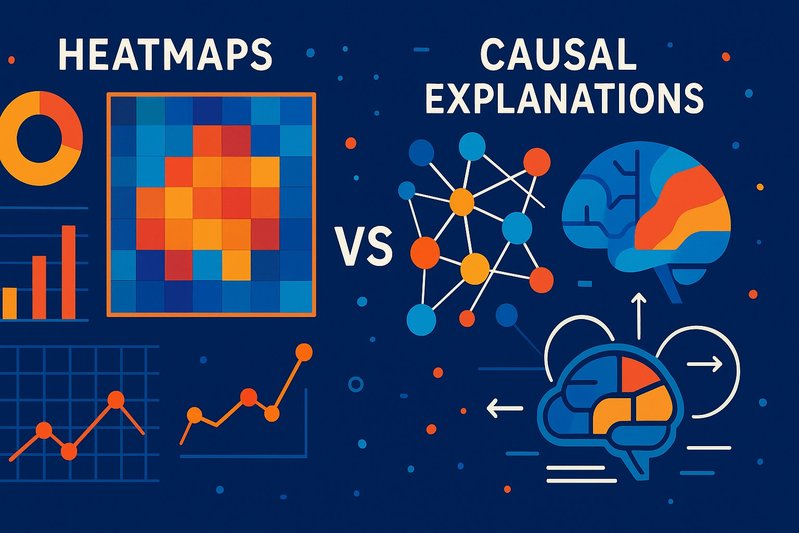
Enterprise AI Governance Demands Causal Explanations, Not Heatmaps
The mesmerizing glow of attention heatmaps has become the default “explanation” for large language models. But for enterprise AI, that visual comfort is a liability. Attention patterns are often plausible while failing basic tests of faithfulness, stability, and completeness. They routinely shift under paraphrase, decoding changes, and adversarial nudges, and in many cases they miss where the decisive computation actually happens. The stakes are higher now because modern deployments increasingly rely on dense transformers, Mixture-of-Experts (MoE) LLMs, and retrieval/tool-augmented systems—settings where attention provides, at best, partial provenance and, at worst, a misleading story about why the model did what it did.
This article makes the case for a governance shift: replace attention-based narratives with auditable, causal interpretability in production LLMs. Leaders will learn why heatmaps don’t meet audit standards for reasoning claims; how to weigh the ROI of causal audits versus the cost of false explanations; what architecture-aware governance looks like across dense, MoE, and RAG/tool systems; where attention is acceptable and where it is unsafe; a due diligence checklist for 2026 procurements; the operational KPIs that matter; and the organizational processes that institutionalize causal interpretability.
Why attention heatmaps don’t pass audits for reasoning claims
Attention visualizations are not reliable evidence of how a model reached an answer—especially on multi-step reasoning. Key problems include:
- Low causal faithfulness: Raw attention weights are non-unique with respect to outputs and can be manipulated without changing predictions. When an “explanation” doesn’t change outcomes under targeted interventions, it’s not explaining the causal path.
- Incompleteness: Aggregated attention paths (e.g., rollout/flow) can increase plausibility for long-range influence but frequently miss MLP/residual computations that dominate decisive reasoning steps.
- Lack of stability: Attention patterns shift under paraphrasing, decoding strategies, domain changes, and adversarial/counterfactual perturbations—undermining claims that they generalize as a reasoning account.
- Distributed computation: Modern LLMs often encode factual and compositional knowledge in feed-forward/residual pathways. Attention primarily routes information; it typically doesn’t implement the computation that determines final answers.
- Misleading comfort: Chain-of-thought text improves task performance and human comprehensibility, but the step-by-step rationale is often post hoc—plausible yet divergent from the internal causal pathway.
In retrieval contexts, attention to a source can accurately show which passages were consulted (provenance). But that is not evidence the content was used correctly in reasoning. Leave-one-document-out tests and causal context ablations are stronger indicators of reliance. For tool-augmented agents, attention over tool tokens provides weak evidence about policy decisions; faithful accounts require tracing routing choices and execution results through causal audits and ablations.
Bottom line for governance: attention heatmaps remain useful for quick plausibility checks and for narrow, pre-registered hypotheses about specific attention-mediated circuits (e.g., induction/copying heads). They are not sufficient for attesting to reasoning in production.
ROI calculus: the cost of false explanations versus investing in causal audits
Attention-only narratives are cheap to produce, but they create hidden liabilities:
- Decision risk: If the highlighted components are not causally necessary or sufficient, teams may “fix” the wrong thing, or over-trust brittle behavior that collapses under paraphrase or decoding changes.
- Portability risk: Explanations that fail to transfer across tasks, domains, or models force repeated rework and weaken governance claims.
- Compliance risk (qualitative): Claims about how a model reasons need to be supported by evidence that holds under intervention and stability tests. When explanations are unfaithful, documentation cannot withstand scrutiny.
Causal and feature-level audits cost more upfront—requiring compute, experimental design, and cross-architecture visibility—but they pay back by delivering:
- Higher fidelity and stability: Interventions such as activation/attention patching, causal mediation, and targeted editing provide the strongest evidence of necessity and sufficiency for specific circuits or features.
- Better transfer: Circuit- and feature-level findings tend to be more transferable than head-weight patterns, reducing revalidation burden when models or tasks shift.
- More complete coverage: Gradient-based methods with completeness guarantees (e.g., Integrated Gradients) and representation-level analyses (e.g., sparse autoencoders) complement interventions to create a defensible evidence stack.
Specific dollar metrics are unavailable, but the calculus is clear: low-cost, high-plausibility visuals create outsized downstream costs when they fail audits or break under distribution shifts; higher-cost causal audits reduce rework, improve reliability, and create documentation that survives due diligence.
Architecture-aware governance: dense, MoE, and RAG/tool deployments
Different architectures surface different causal bottlenecks. Governance programs must adapt evidence requirements accordingly.
Dense transformer LLMs
- Governance reality: Many decisive computations—including factual associations and compositional reasoning—reside in MLP/residual pathways, not attention.
- Evidence to require: Interventional studies (activation patching, causal mediation) across layers; gradient-based attributions that satisfy completeness (with careful baseline selection); representation features identified via probing or sparse autoencoders; controls for decoding parameters and paraphrase stability.
- What attention can do: Identify specific, attention-mediated circuits such as induction/copying heads—when tested via ablations and patching.
MoE transformers
- Governance reality: Routers select experts per token, often determining outputs more than self-attention. Attention maps omit critical routing decisions and per-expert computations.
- Evidence to require: Router logit distributions and routing audits; per-expert intervention results; end-to-end tests that isolate the effect of routing changes on outputs; stability checks across tasks and domains.
- What attention can do: Show token-to-token context movement—but not the expert-level computation that drives decisions.
RAG, RETRO, and tool-augmented systems
- Governance reality: Cross-attention to retrieved passages is useful provenance; it does not prove correct use of content or justify final reasoning steps. Tool tokens reflect surface usage, not policy rationale.
- Evidence to require: Leave-one-document-out retrieval tests; controlled context ablations; causal tracing from retrieved content to outputs; audits of tool selection and execution reliance via interventional tests; controls for retrieval set composition and decoding hyperparameters.
- What attention can do: Provide document/source traceability, which is necessary but insufficient for reasoning claims.
Governance map by architecture
| Setting | What attention reveals | What it misses | Evidence to demand |
|---|---|---|---|
| Dense transformers | Localized attention circuits (e.g., induction/copying) | MLP/residual computations; distributed features | Activation patching, mediation analysis, gradient attributions with completeness, feature-level analyses |
| MoE LLMs | Token-to-token routing context | Router decisions; expert computations | Router log audits; per-expert interventions; necessity/sufficiency tests |
| RAG/RETRO | Which passages were consulted (provenance) | Whether content drove the answer; reasoning over retrieved text | Leave-one-out retrieval; context ablations; causal tracing |
| Tool-augmented agents | Surface attention to tool tokens | Tool-selection policy; reliance on outputs | Causal audits of tool routing and execution results |
Where attention is acceptable—and where it is unsafe
Policy guidance for production teams:
-
Acceptable use
-
Document provenance in retrieval cross-attention, paired with stronger reliance tests when the claim is more than “we looked at this source.”
-
Mechanistically specified, attention-mediated circuits (e.g., induction/copying) with pre-registered hypotheses and interventional validation.
-
Early layers or smaller models where features are less superposed, when combined with confirmatory tests.
-
Unsafe use
-
End-to-end reasoning attribution for complex tasks (e.g., multi-step math or logic) without interventions.
-
Claims about decision policies in MoE routers, expert selection, or tool choice based solely on attention maps.
-
Stability claims that don’t control for paraphrase, decoding, or domain shifts.
In all cases, pair any attention-based narrative with interventional evidence and, where applicable, completeness-aware attributions and feature-level analyses.
Procurement and vendor due diligence checklist for 2026
Enterprises should demand artifacts that withstand interventional scrutiny. The following items are tailored to dense, MoE, and RAG/tool-augmented deployments:
-
Mandatory disclosures
-
Model architecture details: dense vs. MoE; presence of retrieval or tool routing components.
-
Routing visibility for MoE: router logits, expert selection distributions, and logging practices.
-
Retrieval provenance: cross-attention signals to retrieved passages and the composition of the retrieval corpus.
-
Decoding controls: supported strategies and their documented impact on explanation stability.
-
Interventional evidence
-
Activation/attention patching results that quantify necessity and sufficiency for claimed circuits or features.
-
Causal mediation analyses for reasoning tasks, with pre-registered hypotheses and controls.
-
Leave-one-document-out and context ablation tests for RAG; tool-use audits showing reliance on execution outputs.
-
Evaluation commitments
-
Faithfulness under intervention on reasoning benchmarks (e.g., GSM8K, MATH, BBH, MMLU, ARC, DROP), not just raw accuracy. Specific target metrics unavailable; vendors should propose measurable thresholds.
-
Stability under paraphrase and decoding changes, with documented protocols and results.
-
Completeness evidence where applicable (e.g., Integrated Gradients), including baseline selection rationale.
-
Transfer checks across tasks and domains, with clear revalidation procedures.
-
Documentation and auditability
-
Versioned experiment reports capturing configurations, controls, and outcomes.
-
Clear separation between human-friendly rationales (e.g., chain-of-thought) and causally validated explanations.
-
Structured change logs for model updates that could affect interpretability claims.
Operational KPIs for explainability programs
Governance leaders need KPIs that measure the strength and durability of explanations—not just their visual appeal.
-
Fidelity under intervention
-
Definition: Degree to which targeted manipulations (e.g., head/path masking, activation patching) change outputs as predicted by the explanation.
-
How to use: Track across tasks to quantify necessity/sufficiency of identified circuits or features. Improvements indicate explanations that correspond to real causal pathways.
-
Completeness
-
Definition: Extent to which an attribution method accounts for the difference between outputs (e.g., completeness property in Integrated Gradients).
-
How to use: Require completeness-oriented attributions for token-/layer-level explanations, paired with interventions.
-
Stability under paraphrase and decoding
-
Definition: Consistency of explanations under paraphrases, adversarial/counterfactual perturbations, and changes to decoding strategies.
-
How to use: Report variance across controlled perturbations; flag fragile explanations that drift meaningfully without output changes.
-
Cross-domain and cross-model transfer
-
Definition: Persistence of identified circuits/features when moved across tasks, domains, or model variants.
-
How to use: Track revalidation effort and degradation in fidelity; explanations with better transfer reduce maintenance overhead.
-
Calibration of explanatory confidence
-
Definition: Alignment between confidence scores assigned to explanations and their measured causal effect under intervention.
-
How to use: Penalize overconfident yet low-effect explanations; prefer explanations whose confidence aligns with observed impact.
Org design and processes to institutionalize causal interpretability
Enterprises can embed causal interpretability into day-to-day model operations with lightweight, auditable processes:
-
Pre-register hypotheses
-
Before running attribution methods, document explicit, mechanistic hypotheses (e.g., which circuits or features should mediate a given behavior). This reduces cherry-picking and supports audit trails.
-
Run multi-method explainability, then validate causally
-
Generate candidate explanations via attention, attention flow, gradients, and feature discovery. Treat these as hypotheses to be tested—not as final evidence. Prioritize activation patching, mediation, and targeted editing to confirm causal roles.
-
Control the confounders
-
Standardize decoding settings; include paraphrase/adversarial variants; log MoE routing decisions; record retrieval corpus composition. Interpretability claims degrade without these controls.
-
Separate provenance from reasoning
-
Maintain clear documentation when cross-attention shows source consultation but causal tests do not confirm reliance. Avoid conflating “we retrieved it” with “we used it correctly.”
-
Version and benchmark explanations
-
For key reasoning tasks (e.g., GSM8K, MATH, BBH, MMLU, ARC, DROP), keep versioned explanation artifacts alongside accuracy metrics. Require revalidation of explanations after model updates.
-
Codify acceptance criteria
-
Ship a model only when explanations meet internal thresholds for fidelity, stability, completeness (where applicable), and transfer. Specific numeric thresholds are organization-dependent; annotate them in governance policies.
These practices align day-to-day development with the kind of evidence that stands up to audits and reduces the risk of over-trusting brittle or post hoc narratives.
Conclusion
Enterprises cannot afford to equate eye-catching attention maps with evidence of reasoning. As models scale and architectures diversify—dense transformers, MoE with routers and experts, retrieval and tool-augmented systems—the gap widens between what attention makes visible and what actually determines an answer. Governance programs must pivot to causal interpretability: interventional evidence, completeness-aware attributions, feature-level analyses, and architecture-aware audit trails.
Key takeaways:
- Attention is useful for provenance and for narrow, validated circuits—but it is not a general explanation of reasoning.
- Causal audits cost more upfront but deliver stability, transfer, and audit-ready documentation that attention maps cannot.
- Dense, MoE, and RAG/tool systems require distinct evidence: router logs and per-expert interventions for MoE; leave-one-out and context ablations for RAG; causal tracing across all.
- Treat chain-of-thought as a user-facing rationale, not an explanation, unless triangulated via interventions.
- Operationalize explainability with KPIs for fidelity, completeness, stability, transfer, and calibration, and with processes that control confounders and pre-register hypotheses.
Next steps for leaders:
- Update procurement to require routing logs, interventional evidence, and benchmarked faithfulness—not just accuracy.
- Stand up a causal audit pipeline that includes activation patching, mediation analysis, and completeness-aware attributions.
- Make stability under paraphrase/decoding a release criterion, not a nice-to-have.
- Separate provenance claims from reasoning claims in all documentation.
- Institutionalize pre-registered hypotheses and versioned explanation artifacts across the model lifecycle.
The era of heatmap-driven storytelling is over. Causal explanations are the currency of enterprise AI trust—and the only defensible foundation for risk, compliance, and ROI in 2026 and beyond. 🚦