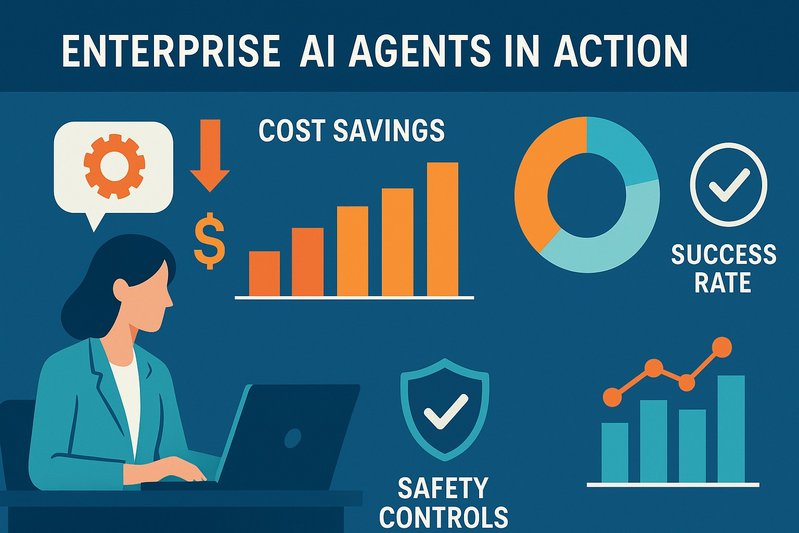
Enterprise AI Agents Earn Their Keep: Tool-Oriented Evaluation Cuts $/Success and De-Risks Adoption
Enterprises didn’t unlock real value from tool-using AI agents when the next frontier model arrived. They unlocked it when they could measure something CFOs and risk teams already trust: cost per success, incident rates, and reproducibility. Consider a simple budgeting example drawn from evaluation practice: if a browsing agent closes 62% of tasks at $0.47 per success using a plan-first controller versus 58% at $0.69 with an interleaved baseline, the savings are immediate at fixed volume. That math—coupled with incident ceilings and repeatable runs—turns “AI agents” from demo material into production systems with predictable ROI.
This article lays out a business playbook for deploying tool-using language agents—think MatchTIR-class systems—using a tool-oriented evaluation approach. The core idea is to treat agents like systems, not models. When enterprises normalize tool schemas, anchor on contract-ready KPIs, and stress-test safety, they can negotiate SLAs, manage costs, and switch vendors without reengineering. You’ll learn where agents pay for themselves, how to instrument $/success and incident metrics across domains such as browsing, RAG analytics, and software maintenance, which orchestration choices offer predictable cost control, and how to stage adoption with human-in-the-loop oversight.
From Demos to P&L: Make $/Success, Incidents, and Reproducibility First-Class
The shift from accuracy screenshots to production economics starts with standardized, reproducible measurement. Success must be defined by official benchmark-style metrics that business stakeholders can audit:
- Browsing and web workflows use WebArena/BrowserGym success and reward metrics.
- Software maintenance and support map to SWE-bench pass rates with tests passing.
- Retrieval-augmented QA and analytics track answer correctness alongside faithfulness via BEIR and RAGAS, so responses are grounded in evidence.
- Text-to-SQL pipelines should report exact match and execution accuracy on Spider and BIRD, against versioned databases.
Efficiency reporting must present end-to-end latency, tokenized cost, and tool-call counts so leaders can see the Pareto trade-off between accuracy and expense. Safety cannot be hand-waved: incidents should be categorized using the OWASP Top 10 for LLM applications—prompt injection, data leakage, insecure tool use—and tallied against thresholds appropriate for preproduction gates and go/no-go criteria.
Reproducibility is non-negotiable for procurement, risk, and engineering. Runs should be repeatable across seeds and environments, with HELM-style transparent reporting of configuration, traces, and confidence intervals to verify claims and support apples-to-apples comparisons. Normalizing tool interfaces with standard function-calling schemas across model providers (e.g., OpenAI and Anthropic conventions) prevents schema-induced bias and makes results portable.
Bottom line: anchor decisions on $/success under a latency SLO and an incident ceiling, and insist on reproducibility that any buyer can verify.
Where Agents Earn Their Keep: Three Families of Use Cases
Not every workflow benefits equally from tool-using agents. Three families repeatedly clear the business bar when evaluated with contract-ready KPIs.
-
Software maintenance and support. Agents that can reproduce bugs, run tests, and propose patches inside a controlled developer stack map cleanly to SWE-bench outcomes (tests pass) and are readily benchmarked against open software-agent stacks like OpenDevin and OpenHands. The literature emphasizes that orchestration and environment fidelity often dominate raw model quality in these settings—a governance-friendly message because it shifts attention to controllable system design. Specific enterprise MTTR reductions are context-dependent and not reported here (specific metrics unavailable).
-
Retrieval-augmented analytics. RAG turns sprawling knowledge bases and databases into grounded answers and executable SQL. Beyond answer accuracy, BEIR and RAGAS provide standardized diagnostics for retrieval quality and answer faithfulness that correlate with user trust and lower hallucinations. For text-to-SQL, Spider and BIRD’s execution accuracy and exact match—on versioned databases—offer pass/fail metrics that procurement and data leaders understand.
-
Operational workflows on the open web and internal apps. Browsing agents for navigation, form processing, and API-backed tasks benefit from deterministic tool interfaces and explicit success definitions in WebArena and BrowserGym. These environments also support adversarial testing that mirrors real-world failure modes (more below).
In each case, the KPI that matters is $/success within a latency SLO and under an incident ceiling. That framing lets teams compare controllers, models, and budget tiers on equal footing.
Contract-Ready KPIs with a Reproducible Harness
A reproducible harness translates use cases into auditable KPIs:
- Define success via official metrics per domain (e.g., tests pass; queries execute; tasks complete).
- Report efficiency: end-to-end latency, token and tool-call budgets, monetary cost, and success-per-dollar.
- Tally safety incidents per OWASP categories and track containment, fallback, and recovery.
- Publish multi-seed results with confidence intervals and HELM-style configuration disclosures.
Because the harness is repeatable and portable across models and clouds, buyers can demand confidence intervals, verify vendor claims, and enforce SLAs that map to business outcomes.
Predictable Cost Control Comes from Orchestration, Not Model Maximalism
Enterprises often default to model swaps for cost control. The evaluation literature suggests a better lever: orchestration choice.
- Plan-first controllers reduce unnecessary tool invocations and observations, trimming token use and external API spend while preserving accuracy. ReWOO’s decoupling of reasoning from observation is a canonical baseline demonstrating this dynamic.
- Interleaved reasoning and acting (ReAct) remains a strong default in interactive environments but can drive higher tool-call counts and cost—useful when success is paramount and budgets allow.
- Program-aided reasoning via code execution (PAL) reliably lifts correctness in math and coding, especially where wrong answers are expensive; expect higher latency and tokens as the trade-off.
- Deliberate multi-branch reasoning (Tree-of-Thought) can raise accuracy but carries notable cost/latency overhead; best reserved for high-stakes verticals.
- Self-reflection (Reflexion) adds modest overhead but improves long-horizon success, reducing human escalations in multi-turn tasks.
Together, these strategies move points along the cost–accuracy frontier in predictable ways. Because the harness reports $/success, token use, and p90/p99 latency, leaders can choose the controller that best fits their cost structure rather than chasing generic benchmarks.
Vendor Portability Is Governance
Vendor portability is more than negotiating leverage; it’s a governance feature. Normalized tool schemas with strict argument types, validation, and provenance logging prevent supplier-specific quirks from inflating success rates. OpenAI’s function-calling guide and Anthropic’s tool-use APIs describe compatible JSON-schema conventions that enterprises can standardize on across providers.
This portability matters when deployments must swing between cloud APIs and on-prem open weights for privacy or cost. Rank-order stability and cross-model deltas—computed under identical schemas and budgets—inform switches without reengineering. Testing across families such as Llama 3.1 and DeepSeek, as well as closed models, ensures orchestration gains transfer and highlights where improvements are largest on mid-capability open models.
Risk Management, Staged Budgets, and HITL that Pays for Itself
Risk management hinges on adversarial tests that mirror real-world failure modes:
- Browsing agents should face prompt injection pages and malicious forms in preproduction; incident classes like prompt injection, data leakage, and insecure tool use should be tracked per OWASP.
- SQL agents must be evaluated against stale schemas and noisy execution errors; measurements should center on execution accuracy and exact match with versioned databases.
- RAG pipelines need to prove answer faithfulness against held-out ground truth using BEIR/RAGAS-style diagnostics.
Adoption should be staged against budget tiers. Start with constrained token and tool-call budgets to validate that controllers operate within cost bounds; escalate budgets only when marginal accuracy gains justify expense. Present Pareto curves—$ per success against success rate—at each tier to stakeholders. Expect decoupled planning to deliver a low-cost win, while deliberate multi-branch reasoning earns its keep in high-stakes domains like finance or healthcare (specific vertical metrics unavailable).
Human-in-the-loop (HITL) remains a strategic multiplier. Insert review/approve gates for high-risk actions and measure uplift versus cost. Many organizations see strong ROI where agents prepare changes—SQL, patches, form submissions—and humans approve with one-click context; the harness should quantify how often HITL prevents incidents and how it shifts latency distributions (specific metrics unavailable). Such telemetry informs staffing and shift planning without guesswork.
ROI Math that Finance Trusts—and a Market Trend Toward Discipline
For CFOs, cost control is arithmetic, not alchemy. If a plan-first browsing controller closes 62% of tasks at $0.47 per success versus 58% at $0.69 with an interleaved baseline, annualized savings accrue under fixed task volumes. If program-aided reasoning lifts code-fix success by several points at a 20% latency hit (specific deltas vary by stack), the value depends on the relative costs of engineer time, service-level penalties, and user churn. The harness instruments each lever—$ per success, p90/p99 latency, incident ceilings—so finance and ops can tune to their own cost structures rather than generic leaderboards.
Procurement, meanwhile, can demand standardized disclosures: tool schemas, controller graphs, decoding settings, budget caps, and full traces for representative tasks. Contracts can specify pass/fail thresholds per domain, p90/p99 latency, incident ceilings per OWASP category, and reproducibility requirements like seeds and configuration hashes. This shifts negotiations away from brand-name models toward system-level commitments that track to business value.
The broader market trend is clear: disciplined orchestration beats model maximalism. As tool menus grow and workflows diversify, the systems that reach and stay in production are those with schema-accurate calls, explicit controller graphs, rigorous telemetry, and adversarial safety tests. ReAct, ReWOO, PAL, ToT, and Reflexion provide a menu of proven strategies whose cost–accuracy profiles are well understood from the literature; enterprises that demand normalized interfaces and reproducible metrics can mix and match these to fit their P&L.
Practical Examples
While company-specific production metrics are not disclosed here, the evaluation literature and benchmarks support several practical, contract-ready patterns that enterprises can adopt today.
- KPI mapping by domain (procurement-ready):
| Domain | Primary success metric for contracts | Supporting sources |
|---|---|---|
| Web browsing/operations | WebArena/BrowserGym task success and cumulative reward | |
| Software maintenance/support | SWE-bench pass rates (tests pass) | |
| RAG analytics (QA) | EM/F1 plus answer faithfulness (RAGAS/BEIR diagnostics) | |
| Text-to-SQL | Exact match and execution accuracy on Spider/BIRD |
- Orchestration choices and their business levers:
| Strategy | Expected impact on $/success | Expected impact on latency | Notes |
|---|---|---|---|
| ReWOO (plan-first) | Lower cost by reducing unnecessary tool calls | Neutral to lower | Good first-line controller for budget tiers |
| ReAct (interleaved) | Higher success in interactive tasks; potentially higher cost | Neutral to higher | Use when success rate is paramount |
| PAL (program-aided) | Higher correctness in math/coding; better $/success when wrong answers are costly | Higher | Switch on for code/math-heavy tasks |
| Tree-of-Thought | Potential accuracy lift | Higher | Reserve for high-stakes scenarios |
| Reflexion | Better long-horizon success; fewer escalations | Slightly higher | Useful in multi-turn agent workflows |
-
Vendor portability checklist:
-
Normalize tool schemas with JSON-style function calling across providers; enforce typed arguments and strict validation.
-
Run cross-model evaluations that include Llama 3.1 and DeepSeek alongside closed models to assess rank-order stability and portability.
-
Publish HELM-style configuration disclosures and multi-seed confidence intervals to support third-party verification.
-
CFO calculation template (illustrative):
-
Compute $/success for candidate controllers under a fixed task distribution and latency SLO.
-
Attribute cost drivers: token budget, external API calls, and human review overhead.
-
Use incident ceilings (OWASP categories) as gating constraints, not afterthoughts.
These examples show how to translate research-backed levers into contract-ready operations without bespoke tooling.
Conclusion
Enterprises can stop gambling on hype by treating tool-using language agents like systems with contract-ready KPIs—not like models that come and go with leaderboard cycles. A tool-oriented evaluation approach centered on $/success, incident ceilings, and reproducibility lets leaders predict ROI, negotiate SLAs, and make vendor-portable deployment decisions. Benchmarks such as WebArena, SWE-bench, Spider/BIRD, and BEIR/RAGAS supply auditable success definitions; orchestration strategies like ReWOO, ReAct, PAL, ToT, and Reflexion provide predictable cost–accuracy trade-offs; and OWASP-anchored safety testing keeps risk measurable and governed.
Key takeaways:
- Anchor on $/success under latency SLOs and OWASP-aligned incident ceilings; insist on HELM-style reproducibility.
- Pick controllers for their cost–accuracy profiles; don’t default to model swaps.
- Standardize tool schemas and traces across vendors to enable portability and negotiation.
- Stage adoption by budget tier and measure HITL uplift versus cost (specific metrics unavailable).
- Use domain benchmarks (WebArena, SWE-bench, Spider/BIRD, BEIR/RAGAS) to make procurement KPIs contract-ready.
Next steps: instrument a reproducible harness, normalize tool schemas, run cross-controller baselines at multiple budget tiers, and publish confidence intervals with full traces. With disciplined orchestration and adversarial safety tests in place, agent projects graduate from prototype purgatory to accountable production—and begin compounding operational value instead of compounding risk. ✅