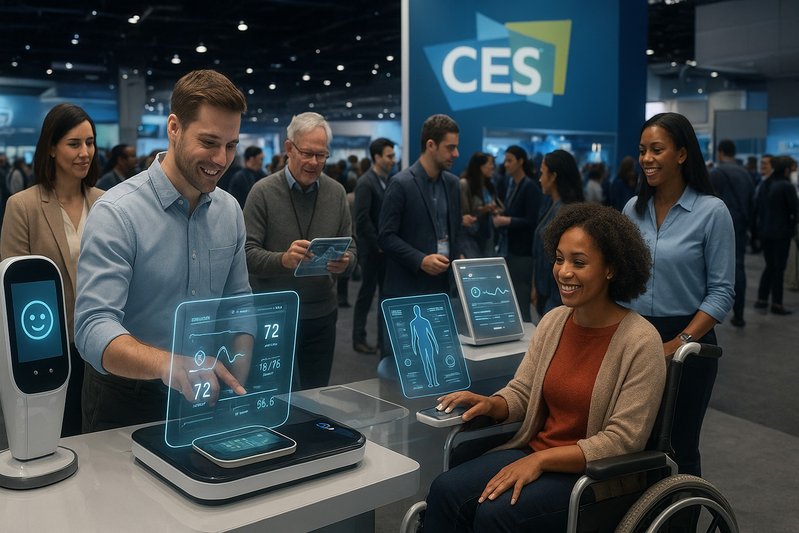
Empowering Health and Accessibility: Technological Innovations at CES 2026
See how the latest advancements in healthcare and accessibility tech are setting new standards at CES.
Transformative AI Becomes Mainstream
CES 2026 has redefined the landscape for technological innovation, notably in health and accessibility. This year’s show pivoted significantly, embedding AI not merely as a feature but as a default layer across devices, ranging from PCs to TVs, and from smart home devices to enterprise solutions. This deep integration was evident in the on-site demonstrations and the slew of CES Innovation Awards, where digital health and accessibility stood out as particularly competitive categories.
A New Horizon in Healthcare Technology
A highlight of CES 2026 was the shift in health tech from purely tracking to delivering validated, clinically significant outcomes. French company Withings made headlines with the Body Scan 2, which has transformed the concept of the smart scale into a comprehensive “longevity station.” With pending FDA clearance, this device offers insights into more than 60 biomarkers, including hypertension risks, at a $600 price point expected to hit retail in Q2 2026.
Meanwhile, the pediatric-focused device Earflo showcased significant clinical outcomes, with studies indicating an 86% fluid drainage within four weeks and a 90% reduction in ear tube surgeries. This demonstrates a move towards actionable health insights rather than just data collection. Earflo’s price is anticipated between $250 and $300, pending FDA 510(k) approval, expected shortly after CES.
Accessibility Takes a Bold Step Forward
Accessibility technologies took center stage with groundbreaking innovations. Naqi Logix’s Neural Earbuds received the Best of Innovation Award in Accessibility & Longevity. These earbuds allow users to control devices with subtle facial gestures and brain waves, bypassing the need for traditional voice or touch controls, thus significantly enhancing accessibility for users with mobility limitations.
The deployment of Bluetooth’s Auracast broadcast audio technology further emphasizes accessibility strides, offering seamless public listening experiences for both individuals with hearing loss and those without. Anchoring the CES Accessibility Stage, the Bluetooth SIG reported that 2025 had already seen Auracast integrated into public venues, making multi-listener scenarios as easy as scanning or tapping to access shared audio streams.
Driving Solid Health and Accessibility Outcomes with AI
The marked emphasis on AI at CES 2026 was underscored by Samsung’s “Your Companion to AI Living” campaign. The company’s Vision AI Companion now spans almost all their 2026 TV lines, demonstrating how AI can enhance interactivity and accessibility in daily life. Samsung’s integration of AI in home appliances-like their Bespoke AI refrigerator-enhances both usability for all and offers personalized experiences through the integration of Google Gemini’s vision-based assistance.
From a connectivity standpoint, Samsung promises long-term support, including seven years of Tizen OS updates, ensuring sustained innovation and trust in their AI-driven ecosystem.
The Automotive Sector Steers Towards Inclusion
Even within the automotive sector, the CES 2026 spotlight was on accessibility and AI integration. NXP’s S32N7 SDV compute series, developed with Bosch, focuses on enhancing safety and accessibility in vehicles. This processor series supports critical vehicle functions while allowing centralized software upgrades, leading to more efficient, safe, and inclusive transit options.
Enhancing Everyday Life with Intelligent Systems
Innovations in the smart home sector were not merely about gadgetry but prioritized orchestration, energy efficiency, and safety. This year’s showcase included Samsung’s AI-powered home appliances capable of recognizing items and planning based on vision analysis, alongside a partnership for smart home data-driven insurance savings, highlighting a move from convenience to meaningful impact.
Conclusion: Toward an Inclusive Future
CES 2026 has demonstrated that the convergence of AI, health, and accessibility technology is more than theoretical—it is now a tangible reality set to redefine user interaction. With breakthroughs in devices such as neural interface earbuds and inclusive audio technology, the barriers between technology and accessibility continue to dissolve, empowering a broader spectrum of users. The readiness of these technologies for market release, backed by clinical validations and regulatory measures, signifies a profound shift towards an inclusive tech ecosystem.
As we look forward to further advancements and real-world applications, the key takeaway from CES 2026 is clear: embedding accessibility and health insights into core technology offerings is no longer optional but an integral component of future innovations. This year’s CES has not only set a new standard for what is possible, but also for what is necessary in our ever-evolving tech landscape.