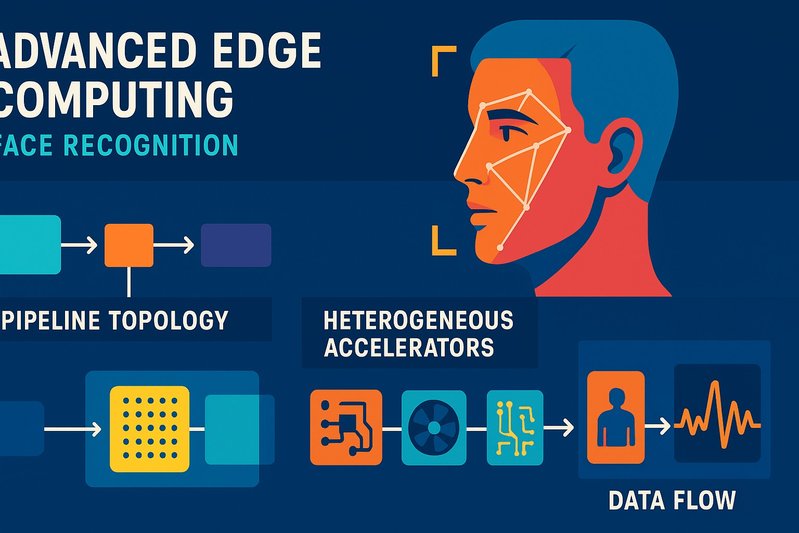
Edge Face Pipelines Deliver 15–40 ms Decisions and 30–120 FPS in 2026
A new generation of edge-first face identification pipelines is clocking in at 15–40 ms per decision while sustaining 30–120 FPS per camera stream, reshaping what “real time” means at the capture site. The shift is driven by a tight engineering loop: refined pipeline topology from decode to decision, deliberate mapping of workloads onto heterogeneous accelerators, compression strategies that retain accuracy in FP16/INT8, and approximate nearest neighbor (ANN) search tuned for cache and memory locality. At the same time, hybrid designs that keep embeddings at the edge and shard vector search in the cloud now hold tight latency envelopes within a single WAN round trip.
This piece walks through how those systems are built and tuned. You’ll see the pipeline broken down by stage and architecture; the detector and recognizer choices that work on edge hardware; how quantization, pruning, and distillation cut latency without hollowing out accuracy; where to run what across GPU/NPU/TPU/DSP; how HNSW, IVF‑PQ, and ScaNN stack up; and how to hit throughput targets while controlling energy budget. We’ll also cover index memory design, cold-start pitfalls, and the tactics teams use to keep decisions snappy.
Architecture/Implementation Details
Pipeline topology: from capture to decision
Edge pipelines converge on a common topology optimized for low latency and steady throughput:
- Capture and decode: hardware decode via ISP/encoder blocks keeps CPU overhead low and feeds frames into the pipeline with minimal buffering.
- Detection and alignment: modern detectors such as RetinaFace and face-tuned YOLO variants provide robust detection across pose and occlusion, followed by alignment to stabilize downstream embeddings.
- Embedding inference: margin-based recognizers—ArcFace, MagFace, CosFace—generate 112×112 embeddings with high discriminative power; MagFace’s quality-aware embeddings enable dynamic thresholding and score normalization for open-set performance under variable capture quality.
- ANN search and decisioning: local or cloud-hosted vector search returns top-k candidates; decisioning applies thresholds tuned for desired FAR/FRR, with optional quality gating and presentation attack detection (PAD) where needed.
flowchart TD
 A[Capture and Decode] --> B[Detection and Alignment]
 B --> C[Embedding Inference]
 C --> D[ANN Search and Decisioning]
Pipeline topology illustrating the flow from frame capture to decision-making, highlighting key processes and optimizations for low latency and steady throughput.
Warm-state, edge-optimized detection plus embedding commonly execute in 10–25 ms on capable NPUs/GPUs, with local ANN search adding roughly 0.5–5 ms for galleries of 100k or less when tuned with HNSW or IVF‑PQ. That yields capture-to-decision ranges of ~15–40 ms for single-face 720p/1080p frames, excluding liveness if not enabled.
Latency budgets by architecture
- On-device and near-edge: Keeping the entire loop local avoids WAN entirely. Near-edge adds roughly 1–2 ms over LAN. In warm state, 15–40 ms is typical per decision at single-face load.
- Hybrid: Edge performs detection/embedding, the cloud handles vector search. Add one WAN round trip—often 10–80 ms in commercial Wi‑Fi/5G eMBB environments—plus cloud ANN search (often 2–15 ms on GPU-backed FAISS), and lightweight broker overhead. End-to-end lands around 30–120 ms, dependent on RTT and cache locality.
- Cloud-only: Full pipeline runs remotely; uplink and orchestration introduce 50–150+ ms in typical geographies with tails under congestion or cross-region hops.
Cold-start costs matter. Model load on edge often adds 100–500 ms; mapping multi‑hundred‑MB indexes from disk can add seconds. Persisting services, memory-mapped indexes, and prewarming reduce first-decision delays.
Detector and recognizer choices tuned for edge
- Detectors: RetinaFace remains strong under occlusion and pose extremes; lightweight YOLO variants tailored for faces deliver high throughput after task-specific tuning. The choice is a precision/compute trade: larger backbones improve recall/precision but amplify latency; edge deployments lean on fused operators and quantized backbones to stay within budget.
- Recognizers: ArcFace and CosFace are stalwarts for 1:N identification. MagFace’s quality-aware embeddings help calibrate open-set thresholds and score normalization, mitigating false accepts under poor capture. FP16 optimization is effectively lossless; well-calibrated INT8 generally stays within ~0–1% of FP32 recognition accuracy, preserving NIST-grade performance envelopes when thresholds are tuned on target data.
Quantization, pruning, and distillation
- Quantization: FP16 is the default on GPU-class edge; INT8, when calibrated with representative data and per-tensor scales, slashes latency and energy while keeping accuracy intact in most pipelines.
- Pruning and distillation: Applied judiciously, these compress models and reduce memory bandwidth. Over‑aggressive pruning or domain mismatch can inflate FRR—recalibrate thresholds post-optimization and validate on domain data to avoid regressions.
- Runtime support: TensorRT, ONNX Runtime, Core ML, and NNAPI fuse ops, schedule kernels, and map layers to accelerators, reducing launch overhead and improving cache locality.
Accelerator utilization and CPU coordination
- What to run where:
- GPU/NPU/TPU/DSP: convolutional backbones, attention blocks, and large matrix ops for detection and recognition.
- CPU: video decode handoff, tracking/association, light preprocessing, and search if using CPU-oriented HNSW. Also orchestrates pipeline stages and handles I/O.
- Scheduling and fusion: Vendor runtimes consolidate kernels and minimize DRAM traffic; on mobile SoCs (Snapdragon, Apple ANE), NNAPI/Core ML schedulers target dedicated accelerators to keep power envelopes low while sustaining 30–60 FPS real-time pipelines.
- Multi-accelerator coordination: On Jetson Orin/Xavier-class hardware, CUDA GPUs and DLAs split workloads; TensorRT manages layer placement and precision. On Coral Edge TPU, INT8-only graphs paired with CPU-side HNSW deliver responsive end-to-end pipelines at modest galleries.
Memory and index design
- Embedding dimensionality and precision: A 512‑D embedding consumes roughly 2 KB in FP32, ~1 KB in FP16, ~512 B in INT8. For 100k identities, memory ranges from ~50–200 MB depending on precision and index metadata.
- Index choices: IVF‑PQ compresses vectors into compact product-quantized codes for memory efficiency and cache-friendly probing at scale; HNSW provides high recall with sub‑millisecond CPU latency and incremental inserts; ScaNN is optimized for high-recall query times on CPUs/TPUs.
- Edge constraints and caches: Higher-end gateways practically host ~100k to a few hundred thousand vectors in memory without heavy compression; beyond that, hybrid search with sharded cloud indexes and edge caches for hot identities avoids RAM pressure and long cold-start loads.
Throughput engineering and multi-stream scaling
Sustained throughput depends on detector size, batching, and gating:
- Per-device profiles:
- Jetson Orin class with TensorRT: 30–120 FPS per 1080p stream, scaling to hundreds of FPS across multiple streams with batching.
- Snapdragon NPUs and Apple ANE: real-time 30–60 FPS pipelines at mobile power envelopes, with headroom for tracking/PAD when operators are fused and scheduled on dedicated accelerators.
- Coral Edge TPU: 20–60 FPS per stream on quantized MobileNet-class detectors plus MobileFaceNet-class recognizers, paired with CPU HNSW for modest galleries.
- Intel Myriad X VPUs: tens of FPS per stick; gateways often aggregate several for site-level capacity.
- Gating and parallelism: Per-stream trackers reduce redundant detection; batch detectors across streams for GPU efficiency; pipeline parallelism overlaps decode, detection, embedding, and search; isolate CPU-bound search threads if HNSW is used to prevent head-of-line blocking.
Energy per inference and perf/W
- Coral Edge TPU: ~2 W operation; INT8 inference with per-inference energy in the few millijoule range for MobileNet-class models.
- Jetson Orin NX: configurable ~10–25 W modes; sub‑100 mJ per 112×112 embedding inference in real workloads at 10–20 W, while sustaining tens to hundreds of FPS depending on model sizes.
- Mobile SoCs (Snapdragon NPU, Apple ANE): 30–60 FPS pipelines at a few watts with dynamic power management; platform schedulers minimize energy per inference by leveraging dedicated accelerators.
- Cloud-only: shifts energy offsite, while edge savings grow by avoiding continuous encode/uplink.
Cold-start behavior and mitigations
- Costs: model load 100–500 ms; index mmap seconds for larger galleries.
- Mitigations: persistent always-on services; prewarming at boot; memory-mapped indexes; hierarchical PQ codes; staged cache warming for hot IDs; enrollment inserts in microbatches.
- Enrollment: single-identity embedding generation in <5–20 ms on capable accelerators; end-to-end adds (including index insertion) often land in ~10–50 ms, improved further with batching.
Comparison Tables
ANN strategies at a glance
| Strategy | Typical placement | Strengths | Trade-offs | Incremental updates | Memory footprint |
|---|---|---|---|---|---|
| HNSW | Edge CPU/Gateway CPU | High recall at low CPU latency; simple deployment | CPU-bound; memory grows with links | Yes, fast inserts | Higher per-vector overhead vs PQ-compressed schemes |
| IVF‑PQ (FAISS) | Edge GPU/CPU; Cloud GPU/CPU | Memory-efficient codes; cache-friendly; GPU acceleration; billion-scale with sharding | Quantization introduces small recall loss; tuning nlist/nprobe required | Yes | Very compact with PQ; index metadata adds overhead |
| ScaNN | Edge CPU; Cloud CPU/TPU | High-recall query times on CPUs/TPUs | Ecosystem narrower than FAISS in some stacks | Yes | Efficient; specifics vary by configuration |
Architecture latency and bandwidth profiles
| Architecture | Detection + Embedding | ANN search | Network transit | End-to-end (warm) | Uplink payload |
|---|---|---|---|---|---|
| On-device | ~10–25 ms | ~0.5–5 ms (≤100k) | None | ~15–40 ms | Alerts/metadata only |
| Near-edge | ~10–25 ms | ~0.5–5 ms (≤100k) | LAN +1–2 ms | ~17–45 ms | Alerts/metadata only |
| Edge–cloud hybrid | ~10–25 ms (edge) | ~2–15 ms (cloud) | WAN + serialization ~10–80+ ms | ~30–120 ms | Embeddings (KB/query) |
| Cloud-only | N/A (remote) | Cloud-side | WAN + orchestration | ~50–150+ ms | Frames or face crops |
Accelerator mapping and roles
| Workload | GPU/NPU/TPU/DSP | CPU | Notes |
|---|---|---|---|
| Decode/encode | ISP/encoder blocks | Orchestrates | Hardware units minimize CPU load |
| Detection | Yes | Fallback | RetinaFace/YOLO variants benefit from fused ops and FP16/INT8 |
| Alignment | Yes (fused) | Yes (light) | Often fused/pre-processing kernels |
| Embedding | Yes | Fallback | ArcFace/MagFace/CosFace in FP16/INT8 with calibrated scales |
| ANN search | GPU (FAISS), TPU (ScaNN), CPU (HNSW) | Yes | Choice driven by gallery size and recall/latency targets |
| Tracking/PAD | Yes (where supported) | Yes | Keep PAD co-located if latency permits |
Best Practices
Pipeline topology and gating
- Gate detection with per-stream trackers to cut redundant compute; promote stable face tracks and aggregate temporally for robust identification in non-cooperative scenarios.
- Normalize faces via alignment; reject low-quality crops with MagFace-style quality scores to stabilize open-set thresholds.
Model optimization and accuracy preservation
- Treat FP16 as the default on GPU-class edge; calibrate INT8 using target-domain data and per-tensor scales to hold recognition accuracy within ~0–1% of FP32.
- Apply pruning and distillation carefully; re-tune operating points (FAR/FRR) after each compression step and validate on domain-specific datasets to avoid drift.
- Fuse operators via TensorRT/ONNX Runtime/Core ML/NNAPI to reduce kernel launch overhead and DRAM traffic.
Accelerator placement and scheduling
- Map convolutional backbones and heavy linear ops to GPU/NPU/TPU/DSP; keep CPU for orchestration, tracking, and HNSW if selected.
- On multi-accelerator SoCs (Jetson Orin/Xavier), exploit DLAs for offloading and keep CUDA SMs fed with batched detector workloads.
- On mobile SoCs, rely on NNAPI/Core ML to place ops on dedicated accelerators and maintain real-time throughput at a few watts.
ANN index design and memory hygiene
- For ≤100k galleries, HNSW on CPU often meets latency with high recall and simple incremental updates.
- For larger galleries or tighter memory budgets, IVF‑PQ in FAISS compresses embeddings into PQ codes and keeps probe data cache-resident; tune nlist/nprobe for your recall/latency goals.
- In hybrid deployments, keep an edge cache of hot identities; shard and replicate cloud indexes; memory-map PQ indexes to minimize cold-start stalls.
Throughput engineering and multi-stream scaling
- Batch frames across streams for detector efficiency on GPUs; stagger per-stream pipelines to maintain steady device occupancy.
- Isolate CPU threads for HNSW search to prevent contention with decode/tracking; use lock-free queues between stages where possible.
- On Coral Edge TPU and Myriad X, choose INT8-friendly architectures (MobileNet-SSD, MobileFaceNet-class) and verify operator compatibility to avoid silent CPU fallbacks.
Energy and power modes
- On Jetson Orin NX, select power modes around 10–25 W to balance throughput with thermal envelope; aim for sub‑100 mJ per embedding in sustained operation.
- On mobile SoCs, let platform schedulers keep the NPU/ANE hot and CPUs cool; avoid unnecessary memory copies that inflate energy per inference.
- At the edge, avoid continuous video uplink; hybrid’s embedding-only uplink amortizes energy across decisions rather than frames.
Cold-start and enrollment
- Prewarm models at boot; memory-map large indexes; schedule periodic soft touches to prevent page eviction.
- Keep enrollment lightweight: generate embeddings in <5–20 ms on supported accelerators; batch inserts to HNSW or IVF‑PQ for 10–50 ms end-to-end enrollment per identity.
- For gateways, stage index loads and prioritize hot-shard warming; expose health metrics that reflect index readiness to avoid cold-path decisions.
Decisioning and thresholds
- Set operating points explicitly for desired FAR/FRR; use quality-aware embeddings to modulate thresholds under poor capture conditions.
- In hybrid setups, include lightweight broker logic for cache hits before cloud probes; bound retries under WAN jitter to keep SLAs intact. ⚙️
Conclusion
Edge-first face identification is now engineered, not hoped for: with FP16/INT8-optimized detectors and recognizers, tuned ANN search, and disciplined accelerator mapping, decisions land in 15–40 ms on-device and near-edge, with real-time throughput of 30–120 FPS per stream. Hybrid designs extend those gains to million-scale galleries, trading a single WAN round trip for elastic search capacity while keeping uplink payloads to a few kilobytes. The remaining pitfalls—cold starts, memory pressure, and energy spikes—are increasingly solved problems when teams prewarm models, memory-map indexes, and gate pipelines with trackers and quality scoring.
Key takeaways:
- Keep detection and embedding at the capture site; reserve cloud capacity for sharded search and analytics when galleries exceed edge RAM.
- Treat FP16 as default and INT8 as a first-class target with calibration; re-tune thresholds after any compression step.
- Choose ANN by scale: HNSW for modest edge galleries; IVF‑PQ for compressed scale and GPU acceleration; ScaNN for high-recall CPU/TPU paths.
- Engineer throughput, don’t assume it: batch detectors, parallelize pipelines, and pin CPU-bound search threads.
- Prewarm aggressively and memory-map indexes to neutralize cold-start tail latency.
Next steps: profile your current pipeline stage by stage; calibrate INT8 on domain data; A/B HNSW versus IVF‑PQ with your embeddings and recall targets; and implement tracker gating and batch scheduling on your accelerator of choice. By approaching edge identification as a whole-pipeline performance problem, you’ll meet sub‑50 ms SLAs consistently—and sustain them as galleries and camera counts grow. 🚀