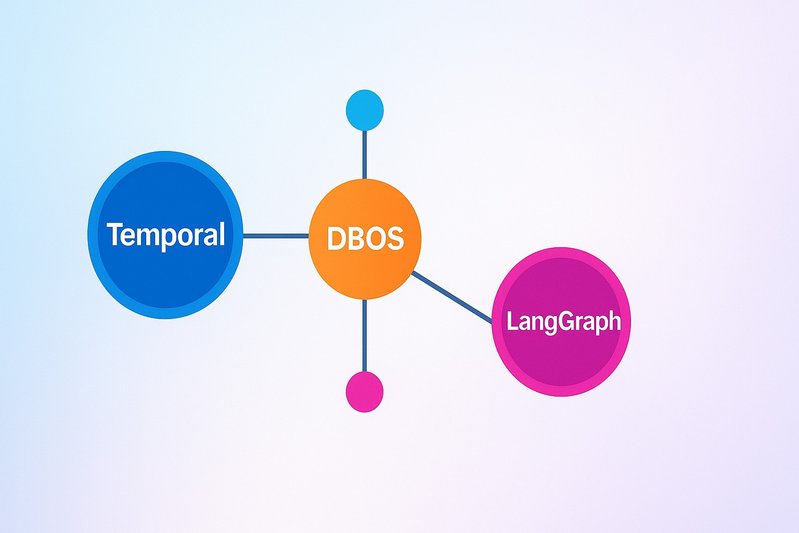
Developer Experience and Ecosystems: Building with Temporal, DBOS, and LangGraph
Unlocking the Developer Potential with Advanced Agentic Systems
As software ecosystems continue to evolve, developers increasingly rely on sophisticated agentic systems to manage reliable, scalable, and auditable workflows. This shift is powered by platforms like Temporal, DBOS, and LangGraph, each uniquely contributing to robust developer experiences and ecosystem support.
Navigating Agentic Workflows
Agentic systems integrate large language model (LLM) reasoning, tool usage, human-in-the-loop processes, and long-running orchestration into workflows that are essential for modern applications. By 2026, platforms such as Temporal, DBOS, and LangGraph have carved out specific niches in this domain, offering varying strengths across durability, scalability, and auditability.
Temporal: The Durable Workhorse
Temporal is renowned for its durable execution platform that emphasizes deterministic replay, ensuring consistent and recoverable workflows. Its comprehensive feature set includes robust timers, signals for external inputs, and a cloud offering with strict SLAs, making it suitable for mission-critical and regulatory-compliant scenarios (Temporal documentation, Temporal Cloud documentation). Temporal’s mechanisms for versioning and human-in-the-loop workflows are pivotal for developers managing complex, multi-week processes that demand high reliability (Temporal workflows docs).
DBOS: The Database-Centric Approach
DBOS leverages databases, typically PostgreSQL, as the runtime environment, which is ideal for teams focused on SQL-centric workflows. Its SQL-first auditability and transactional consistency provide a strong foundation for applications requiring stringent audit trails. While its ecosystem is less mature than Temporal’s, DBOS is appealing to TypeScript and database-oriented teams aiming for a tight integration with their existing data platforms (DBOS docs).
LangGraph: The Agentic Composer
LangGraph stands out as a library for building stateful agent graphs, providing rich tracing and evaluation features via LangSmith. While not inherently a durable, distributed workflow engine, it excels in agent logic composition and integrates seamlessly with durable orchestrators like Temporal and DBOS or as part of LangGraph Cloud to achieve production-grade operations (LangGraph docs, Announcing LangGraph Cloud).
Balancing Fault Tolerance and Audibility
Each platform provides unique semantics for fault tolerance and auditability—a major concern for developers. Temporal achieves this through exactly-once workflow progression with deterministic replay of immutable event histories, allowing developers to maintain audit trails and reproducibility (Temporal documentation). Meanwhile, DBOS capitalizes on exactly-once guarantees within database transactions and leverages sagas for handling side effect compensations, making it a robust choice for audit-focused applications (DBOS docs).
LangGraph, although reliant on the durability of its embedding environment, offers checkpoints and LangSmith’s run-level tracing to maintain reproducibility and facilitate detailed evaluations of agent interactions (LangSmith docs).
Developer Experience and Ecosystem Support
In the realm of developer experience, Temporal offers a wide range of SDKs, sophisticated testing capabilities, and a rich observability suite. Its strong typing and deterministic constraints ensure that developers can produce highly reliable workflows (Temporal documentation).
DBOS provides a TypeScript-first approach with a SQL-native development model, making it intuitive for those already familiar with database operations. Its integration with existing database systems facilitates straightforward local development and deployment (DBOS docs).
LangGraph’s focus on agent composition is particularly appealing to those developing multi-agent applications. Its Python and TypeScript libraries, coupled with LangSmith for robust tracing, offer unmatched insight and control over agent behavior (LangGraph docs).
Deployability and Operational Considerations
Temporal remains a flexible choice with both self-hosted and managed cloud options, providing extensive enterprise-level features like role-based access control and disaster recovery patterns (Temporal Cloud documentation).
Similarly, DBOS offers both open-source and managed cloud solutions, integrating seamlessly with existing database environments and offering performance scaling aligned with database capabilities (DBOS docs).
LangGraph is platform-agnostic as a library and can be run via LangGraph Cloud, which offers a managed environment for deploying and managing agent graphs (Announcing LangGraph Cloud).
Conclusion: Embracing Hybrid Models
For comprehensive agentic systems that require both high reliability and flexibility, a hybrid approach often yields the best results. By combining LangGraph’s agent-building capabilities with the durable orchestration of Temporal or DBOS, developers can create robust, scalable, and auditable workflows suited for the most demanding applications.
With each platform occupying specific strengths, development teams must evaluate their unique requirements—be it reliability, auditability, speed of deployment, or ease of use—to select the right combination of technologies. As we move forward, these ecosystems promise to revolutionize how developers design and manage advanced workflows.