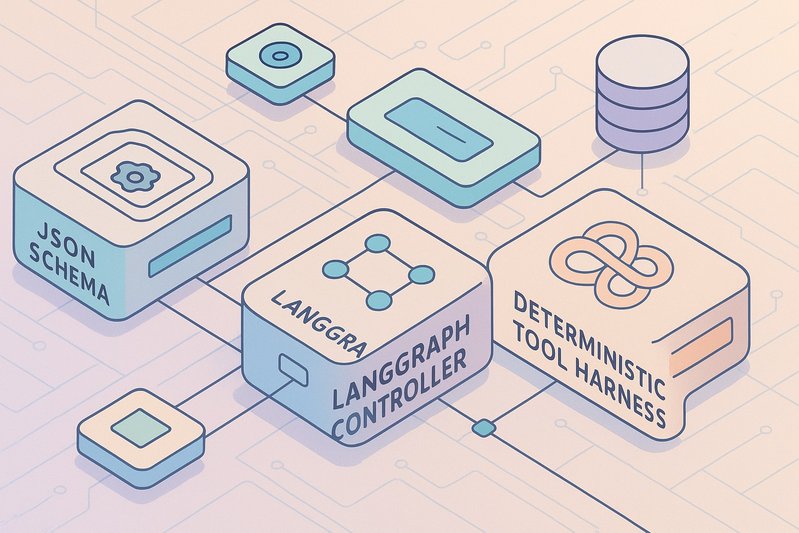
Deterministic Tool Harness for MatchTIR: JSON Schemas, LangGraph Controllers, and Reproducible Telemetry
When tool-using AI systems stumble, the culprit is often not the model’s reasoning but the plumbing around it—tool routing, orchestration, and prompts. For MatchTIR, attributing wins and losses to the right component requires a harness that normalizes interfaces, isolates controllers, and measures everything that matters. This article lays out a concrete, deterministic evaluation stack that exposes the true performance profile of MatchTIR without confounds. You’ll learn how JSON Schema-based tool interfaces align with mainstream function-calling APIs; how swappable LangGraph controllers separate orchestration from model capability; how pinned environments, replay cassettes, and provenance make runs repeatable; and how exhaustive telemetry enables statistical rigor and actionable error analysis.
Architecture/Implementation Details
Interface normalization via JSON Schemas
Interface normalization sits at the core of the harness. All tools—calculators, Python execution, retrievers, browsers, SQL engines, and external APIs—are exposed through JSON Schema function signatures aligned to OpenAI function calling and Anthropic tool-use conventions. This standardization minimizes schema-induced bias, enables strict argument validation, and makes per-tool precision and recall measurable against supervised function-calling baselines like ToolBench and Gorilla OpenFunctions.
The tool-call log captures both syntactic and semantic outcomes for every action: which tool the model selected, whether the arguments matched the schema, whether the call executed successfully, and how the downstream task score changed. This logging enables calculation of tool-call precision/recall, argument correctness, and invalid-call and retry rates, which literature indicates are decisive for end-to-end success.
Swappable controllers as graphs and chains
Controllers are represented in two equivalent abstractions:
- Graph-based orchestrators (LangGraph) for decoupled planning, interleaved reasoning–acting, and planner–executor separation.
- Linear chains (LangChain) to replicate canonical baselines under identical menus and budgets.
Under this scheme, the same task can be executed by a ReAct-style interleaving, a plan-first strategy in the spirit of ReWOO, a deliberate multi-branch search akin to Tree-of-Thought, or a controller that integrates self-reflection to repair mistakes over longer horizons —all without changing tool descriptions or decoding temperature. When MatchTIR plugs in, any measured improvement over these canonical controllers reflects its orchestration logic rather than confounded interface differences.
Determinism, isolation, and replay
Repeatability is non-negotiable. The harness enforces determinism and isolation by:
- Running Python and SQL in pinned Docker images with fixed seeds and resource quotas.
- Evaluating browsing tasks in standardized arenas (WebArena, BrowserGym) with both cached static runs for exact replay and tagged live variants to quantify real-world variance.
- Pinning retrieval pipelines (corpora and index implementations) and requiring retrievers to expose provenance, so the harness can score groundedness rather than only surface-form accuracy using BEIR and RAGAS diagnostics.
- Using VCR-style replay cassettes as the default for external APIs to capture request/response payloads and rate-limit behavior.
- Provisioning versioned Postgres/MySQL containers for Spider and BIRD with strict privilege boundaries and audited query logs.
Telemetry and statistical rigor
The telemetry layer is exhaustive by design: every turn logs prompts (system and user), the tool schemas exposed to the model, the tool-call graph, arguments and responses, controller decisions, token counts (broken down by thinking vs. tool payloads), and latency decomposition into thought time and tool time. By repeating runs across seeds, the harness supports paired significance tests for task outcomes and Wilcoxon-style analyses for latency and cost. All results follow HELM-style disclosures for configs and traces to support external replication.
Benchmark coverage to surface different failure modes
To meaningfully stress the stack, the harness covers:
- Programmatic reasoning: calculator + sandboxed Python; compare program-aided reasoning (PAL) and deliberate branching (ToT) to expose accuracy–latency trade-offs.
- Software engineering: SWE-bench under reproducible developer stacks (editor, shell, tests) and agent baselines like OpenDevin/OpenHands to capture orchestration effects, where environment fidelity often dominates.
- Browsing: WebArena and BrowserGym for navigation and form-filling with standardized metrics; adversarial pages surface prompt-injection brittleness.
- Text-to-SQL: Spider and BIRD with versioned DB snapshots and exact-match vs. execution accuracy to probe schema exposure and safety boundaries.
- Multi-hop QA and planning: HotpotQA and MuSiQue for compositional reasoning with RAG; AgentBench and GAIA for broader planning with standardized APIs.
Comparison Tables
Controller paradigms under identical tool menus and budgets
| Controller | Core idea | Strengths (evidence) | Cost/latency effect | Where it shines |
|---|---|---|---|---|
| ReAct | Interleave reasoning and acting | Strong default in interactive environments | Potentially higher tool-call count | Browsing, multi-step tools |
| ReWOO/plan-first | Decouple planning from observation | Cuts unnecessary calls while preserving accuracy | Lower cost at similar accuracy | Tasks with expensive tools |
| Tree-of-Thought | Deliberate branching/search | Higher math/coding accuracy | Increased tokens and p95 latency | Hard reasoning, code |
| Reflexion | Iterative self-repair | Improves long-horizon success with modest overhead | Additional turns and tokens | Multi-turn agents |
Specific comparative metrics are task- and setup-dependent; the harness reports official success metrics per domain with confidence intervals (specific metrics unavailable) [11–15][19–21][23–26].
Harness components, determinism levers, and surfaced metrics
| Component | Determinism/isolation lever | Primary metrics surfaced |
|---|---|---|
| Tool interfaces | JSON Schema aligned to OpenAI/Anthropic | Tool-call precision/recall, argument correctness, invalid/retry rate |
| Controllers | LangGraph graphs and LangChain chains | Call count/depth, cost, success deltas vs. baselines |
| Python/SQL | Pinned Docker, seeds, quotas | Execution success, latency breakdown |
| Browsing | WebArena/BrowserGym, static cache + live tags | Success/reward, variance vs. live |
| RAG | Pinned corpora/indexes; provenance; BEIR/RAGAS | Groundedness, faithfulness |
| External APIs | VCR/replay cassettes | Fault-injection outcomes, retries |
| Reporting | HELM-style configs, multi-seed CIs | Paired tests, latency p50/p90/p99 |
Best Practices
- Normalize early, validate always. Use JSON Schema for every tool with argument validation enforced at call time. Align to OpenAI/Anthropic function-calling to reduce schema drift and make your system portable across models and providers. Supervised function-calling datasets (ToolBench/Gorilla) are strong references for precision/recall and invalid-call reduction.
- Decouple orchestration from capability. Implement controllers as swappable graphs (LangGraph) and chains (LangChain) so that routing and planning can be ablated independently of the underlying model. Keep tool menus and budgets constant across arms to attribute improvements to orchestration rather than exposure.
- Make determinism a feature, not a hope. Pin Docker images, seeds, corpora, and databases; prefer VCR-style replays for APIs; and split browsing into static caches and flagged live runs for variance accounting.
- Measure groundedness, not just accuracy. In RAG and multi-hop QA, log evidence provenance and use BEIR and RAGAS to score whether answers are supported, not just correct on surface form.
- Instrument for science. Capture prompts, schemas, tool-call graphs, tokens (reasoning vs. tool payload), and latency decomposition; adopt HELM-style configuration disclosure and multi-seed paired tests to ensure conclusions are statistically defensible.
- Stress for robustness and safety. Inject outages, latency spikes, and malformed payloads; serve adversarial pages to agents; and categorize incidents under OWASP LLM Top 10 to quantify risk and recovery behaviors.
- Test generalization across model families. Run matched decoding settings and budget caps across GPT-4-class tool APIs, Claude tool-use, Llama 3.1, and DeepSeek-family models to reveal portability and sample efficiency differences (specific metrics unavailable).
💡 Treat cost-per-success and sample efficiency as first-class objectives, not afterthoughts; many controller choices trade accuracy for latency and tokens.
Practical Examples
While specific implementation details of MatchTIR are not publicly available (specific metrics unavailable), the harness supports the following concrete evaluation patterns drawn from the literature and benchmarks cited in the report:
-
Programmatic reasoning trade-offs. On tasks requiring arithmetic or symbolic reasoning, expose both a calculator and a sandboxed Python tool. Compare a PAL-style program-aided approach against a deliberate multi-branching setup inspired by Tree-of-Thought to quantify how much accuracy gain is purchased at the cost of additional tokens and p95 latency. Because interfaces are normalized and arguments validated, the harness can attribute failures to mis-selection (calculator vs. Python), argument errors (schema mismatches), or controller dead ends.
-
SWE-bench with reproducible developer stacks. Use pinned containers and versioned repositories to ensure environment fidelity. Evaluate MatchTIR alongside software-agent baselines (OpenDevin, OpenHands) under identical editor/shell/test tools. The harness logs whether patches compile, tests pass, and how controller choices affect tool-call depth and retries, a setting where orchestration and tooling discipline often dominate raw model quality.
-
Browsing in static and live arenas. Run WebArena and BrowserGym with cached static pages for exact replay as well as flagged live variants to quantify variance. Inject adversarial pages to measure prompt-injection susceptibility, recovery, and policy adherence; categorize incidents under OWASP LLM Top 10. The tool-call graph and latency breakdown separate “thought time” from “tool time,” enabling targeted controller ablations (e.g., plan-first vs. interleaved).
-
Text-to-SQL under privilege boundaries. Evaluate Spider and BIRD against versioned Postgres/MySQL snapshots with strict privileges and audited query logs. Measure both exact-match and execution accuracy; use controller ablations to test whether plan-first strategies reduce over-calling (e.g., unnecessary schema probes) without harming accuracy. Replayable traces allow reviewers to label failures as argument errors, incorrect table selection, or unsafe tool use.
-
Multi-hop QA with groundedness checks. Couple HotpotQA and MuSiQue with RAG tools that log ranked evidence and provenance. Score answer faithfulness with BEIR/RAGAS and compare ReAct vs. plan-first vs. deliberate branching controllers to see whether a controller that selects tools well also produces grounded answers. The harness’s per-tool precision/recall reveals whether a schema-aware selector improves retrieval quality and reduces hallucinated tool use.
Conclusion
A deterministic, swappable, and thoroughly instrumented harness turns MatchTIR’s evaluation into a matter of evidence, not narrative. By normalizing tool interfaces with JSON Schemas, representing controllers as LangGraph graphs and LangChain chains, enforcing determinism through pinned environments and replays, and logging exhaustive telemetry with HELM-style rigor, reviewers can unambiguously attribute gains to the tool selector, controller, or prompt policy. The result: comparable runs across seeds, models, and reviewers that surface true cost–accuracy trade-offs and safety profiles.
Key takeaways:
- Interface normalization removes schema-induced bias and enables measurable tool-call precision/recall.
- Swappable controllers isolate orchestration effects under identical tool menus and budgets.
- Determinism (pinned containers, caches, cassettes) is essential for repeatable results and robust error analysis.
- Telemetry plus HELM-style reporting supports paired tests and reproducible conclusions.
- Robustness and safety require systematic stress tests and OWASP-aligned incident taxonomy.
Next steps for practitioners: implement JSON Schema tool registries aligned to OpenAI/Anthropic conventions; refactor controllers into LangGraph graphs and LangChain chains; pin your environments and add VCR for APIs; integrate BEIR/RAGAS for groundedness; and publish HELM-style configs and traces. Done right, you’ll see exactly where MatchTIR helps—and where it needs work—across domains and model families. 🚀
Sources
- ReAct: Synergizing Reasoning and Acting in Language Models — https://arxiv.org/abs/2210.03629 — Relevance: Establishes the interleaved reasoning–acting baseline used as a canonical controller.
- ReWOO: Decoupling Reasoning from Observations — https://arxiv.org/abs/2305.18323 — Relevance: Supports plan-first orchestration to reduce unnecessary tool calls.
- PAL: Program-aided Language Models — https://arxiv.org/abs/2211.10435 — Relevance: Demonstrates program-aided reasoning with code execution in math/coding tasks.
- Tree of Thoughts: Deliberate Problem Solving with Large Language Models — https://arxiv.org/abs/2305.10601 — Relevance: Motivates deliberate multi-branch reasoning and its cost/latency trade-offs.
- Reflexion: Language Agents with Verbal Reinforcement Learning — https://arxiv.org/abs/2303.11366 — Relevance: Provides evidence for iterative self-repair in longer-horizon tasks.
- ToolBench (OpenBMB) — https://github.com/OpenBMB/ToolBench — Relevance: Supplies supervised function-calling baselines to measure tool-call precision/recall and invalid-call rates.
- Gorilla: Large Language Model Connected with Massive APIs — https://arxiv.org/abs/2305.15334 — Relevance: Shows how high-quality API schemas improve argument correctness and reduce invalid calls.
- Gorilla OpenFunctions (GitHub) — https://github.com/ShishirPatil/gorilla — Relevance: Provides standardized function signatures to evaluate tool-call quality.
- AgentBench (arXiv) — https://arxiv.org/abs/2308.03688 — Relevance: Benchmarks multi-API and planning tasks relevant to controller robustness.
- AgentBench (GitHub) — https://github.com/THUDM/AgentBench — Relevance: Offers the implementation for standardized agent APIs and rewards.
- WebArena (arXiv) — https://arxiv.org/abs/2307.13854 — Relevance: Standardized browser environment to measure navigation/form-filling.
- WebArena website — https://webarena.dev — Relevance: Official resource for environments and metrics.
- BrowserGym (arXiv) — https://arxiv.org/abs/2401.07317 — Relevance: Provides a controlled browsing arena and metrics; supports static vs. live runs.
- SWE-bench (arXiv) — https://arxiv.org/abs/2310.06770 — Relevance: Real-world bug-fixing benchmark where orchestration and environment fidelity matter.
- SWE-bench website/leaderboard — https://www.swe-bench.com — Relevance: Official metrics and reproducibility protocols.
- OpenDevin (arXiv) — https://arxiv.org/abs/2407.12894 — Relevance: Software-agent baseline stack to compare orchestration strategies on SWE-bench.
- OpenHands (arXiv) — https://arxiv.org/abs/2407.01489 — Relevance: Alternative agent stack emphasizing realistic dev tooling comparisons.
- DS-1000 (arXiv) — https://arxiv.org/abs/2306.17565 — Relevance: Probes data science tool use in Python, stressing sandbox determinism.
- Spider (arXiv) — https://arxiv.org/abs/1809.08887 — Relevance: Text-to-SQL generalization with execution accuracy and exact-match metrics.
- BIRD (arXiv) — https://arxiv.org/abs/2305.03111 — Relevance: Large-scale text-to-SQL benchmark emphasizing realistic database grounding.
- BIRD Leaderboard — https://bird-bench.github.io/leaderboard — Relevance: Official evaluation protocol and metrics for execution accuracy.
- GAIA (arXiv) — https://arxiv.org/abs/2311.12983 — Relevance: Planning/agent benchmark to test orchestration under diverse APIs.
- HotpotQA (arXiv) — https://arxiv.org/abs/1809.09600 — Relevance: Multi-hop QA dataset for compositional reasoning + RAG evaluation.
- MuSiQue (arXiv) — https://arxiv.org/abs/2202.06643 — Relevance: Multi-step QA emphasizing compositionality.
- BEIR (arXiv) — https://arxiv.org/abs/2104.08663 — Relevance: Standardized retrieval evaluation to assess evidence quality.
- RAGAS (GitHub) — https://github.com/explodinggradients/ragas — Relevance: Faithfulness metrics for RAG groundedness.
- HELM (arXiv) — https://arxiv.org/abs/2211.09110 — Relevance: Recommends transparent configs, multi-seed runs, and rigorous reporting.
- MiniWoB++ (arXiv) — https://arxiv.org/abs/1707.06150 — Relevance: Micro-tasks for fine-grained UI action selection reliability.
- LangChain Documentation — https://python.langchain.com/ — Relevance: Baseline chain orchestrator used to standardize linear controllers.
- Anthropic Tool Use Documentation — https://docs.anthropic.com/en/docs/build-with-claude/tool-use — Relevance: Defines tool-use conventions informing JSON Schema alignment.
- OpenAI Function Calling Guide — https://platform.openai.com/docs/guides/function-calling — Relevance: Establishes function-calling schema conventions to avoid interface bias.
- Meta Llama 3.1 Announcement — https://ai.meta.com/blog/meta-llama-3-1/ — Relevance: Indicates function-calling support for open-weight model evaluations.
- DSPy (arXiv) — https://arxiv.org/abs/2306.04031 — Relevance: Motivates declarative prompt optimization to reduce invalid calls.
- OWASP Top 10 for LLM Applications — https://owasp.org/www-project-top-10-for-large-language-model-applications/ — Relevance: Standardized taxonomy for safety incident reporting in agents.
- DeepSeek-LLM (arXiv) — https://arxiv.org/abs/2401.02954 — Relevance: Open-model family used to test cross-model generalization of controllers.
- LangGraph Documentation — https://langchain-ai.github.io/langgraph/ — Relevance: Graph-based orchestrator to compose swappable controllers.
- LlamaIndex — https://www.llamaindex.ai/ — Relevance: Exposes retrievers as tools with provenance to support groundedness scoring.