Counter‑Stealth Renaissance Compresses the Invisibility Window
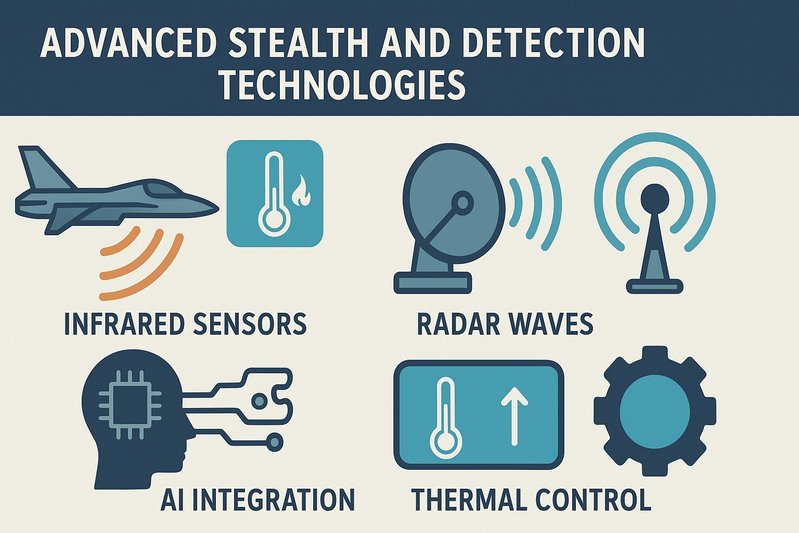
Space-based infrared eyes are proliferating, passive receivers are listening everywhere, and low‑frequency radars are punching through conventional shaping tricks. Together they are turning “invisible” into “seen later”—compressing stealth’s advantage from hours to minutes. That shift is real today in contested theaters and will intensify by 2030 as multi‑static networks, infrared search and track (IRST), and AI‑assisted fusion link weak cues into reliable tracks.
The contest is no longer about absolute invisibility. It’s about managing a window of delayed detection long enough to complete the mission while denying adversaries fire‑control quality. This analysis maps the new detection landscape and the counter‑counter‑stealth response: broadband signature reduction, thermal and plume control, low‑probability emissions, autonomous deception, distributed maritime quieting with long‑range cueing, and AI fusion. Readers will see how survivability is being re‑defined, which technologies matter most through 2030, and how doctrine and force design are adapting.
Research Breakthroughs
The detection landscape: low‑frequency, passive, and space‑enabled custody
Counter‑stealth no longer relies on a single sensor. It stacks modalities.
- Low‑frequency VHF/UHF radars leverage longer wavelengths to register returns where RCS‑tuned shaping is less effective. Fielded systems such as Nebo‑M integrate multiple bands to create early warning tracks that cue higher‑frequency sensors.
- Multi/bistatic and passive approaches exploit transmitters of opportunity and multilateration of emissions. Purpose‑built passive coherent systems and ESM networks (for example Twinvis and VERA‑NG) can create surveillance without radiating, keeping the sensor side survivable while degrading RCS‑centric stealth.
- Over‑the‑horizon/HF radars such as the Container system and Australia’s JORN provide continental‑scale early warning—enough to cue airborne and surface sensors against air and maritime targets.
- IRST proliferation on fighters and ships (IRST21, Legion Pod) adds a thermal channel that is notoriously difficult to suppress, especially in look‑up and maritime backgrounds.
- Space adds persistent custody. A growing low‑Earth‑orbit tracking layer detects and tracks missiles with low latency, while commercial RF geolocation constellations map emitters at scale. Both supply cues to theater networks without requiring stealthy aircraft to radiate. 🛰️
- Airborne UHF sensors like the E‑2D’s APY‑9 extend this fabric with long‑range surveillance that can detect and maintain tracks on low‑observable threats well enough for cooperative engagement.
This is why the survivability problem has shifted from “can I be seen?” to “how long until enough weak cues fuse into a fire‑control track?”
What the ‘window of delayed detection’ really means
Delayed detection, not invisibility, is the currency of survivability. Forces aim to:
- Stay outside the adversary’s fire‑control envelope for as long as possible, accepting that coarse tracks may exist.
- Bias operations toward passive sensing and LPI/LPD exchanges so emissions do not accelerate track quality.
- Vary routes, altitudes, and timing to avoid predictable geometries that help multi‑static and AI fusion correlate returns.
- Flood the battlespace with decoys, stand‑in jammers, and expendable remote carriers to saturate or mislead fusion engines.
In practice, this means stealthy shooters increasingly rely on offboard cueing, cooperative engagement, and remote weapons employment to keep their own signatures and emissions low, turning the detection clock into a race they can still win.
Broadband LO materials and embedded apertures: closing seams and bands
Low observability is widening from a narrow radar‑band game to broadband signature control. Advances concentrate on:
- Planform alignment, edge treatments, embedded sensors/antennas, and serrated doors to eliminate discontinuities that light up across bands.
- RAM/RAS and emerging absorber concepts to push reductions from the traditional X/Ku bands down toward VHF/UHF where possible.
- Integrated apertures that support passive bias and LPI/LPD links while avoiding external pods or protrusions that erode signatures.
Modern platforms embody this shift. The B‑21’s design emphasizes persistent penetration, open systems, and roles as a passive node in kill webs. Fifth‑generation fighters use internal carriage, shaping, RAM/RAS, and embedded apertures to maintain LO while exchanging data via directional, narrow‑beam LPI/LPD links such as MADL—preserving stealth without going radio‑silent.
Thermal and plume management: coatings, shielding, profiles
IRST and multispectral imagers raise the stakes for thermal control. Responses span:
- Engine installation strategies, masking, and nozzle shielding to reduce hot‑spot line‑of‑sight.
- Low‑emissivity paints and coatings tuned for relevant bands.
- Mission profiles that limit afterburning and high‑contrast exposures in known IR surveillance lanes.
- On ships, exhaust stack treatments and design features aimed at IR suppression, as seen on low‑observable surface combatants.
These measures don’t erase heat signatures; they manage them so that look‑angles, backgrounds, and ranges keep detections late, ambiguous, or non‑fire‑control quality.
Weapons signatures: minimizing boost and time‑on‑threat
The stealth contest extends to the weapon itself. Low‑observable standoff missiles such as JASSM variants and LRASM use shaping and seekers built for contested electromagnetic environments. Europe’s Storm Shadow similarly relies on shaping, materials, and low‑level ingress. Conceptually, survivability centers on:
- Route diversity and terrain masking to avoid predictable corridors that invite cross‑cueing.
- Minimizing boosting and plume time inside dense surveillance envelopes to shrink the thermal window.
- Cooperative cueing so weapons launch from outside the highest‑density sensing zones.
Autonomous deception: remote carriers for jamming, decoying, saturation
Autonomy is being weaponized to preserve stealth at scale. The logic is straightforward: push risk and emissions onto attritable teammates.
- Collaborative Combat Aircraft initiatives emphasize autonomy, affordable mass, and LO carriage for sensing and strike, complementing crewed sixth‑generation systems.
- Loyal‑wingmen like Australia’s MQ‑28A Ghost Bat advance teaming for stand‑in effects, sensor extension, and risk‑tolerant operations.
- European programs add a network of “Remote Carriers” to distribute survivable effects—stand‑in sensing, electronic attack, and decoying—through a combat cloud.
- Crewed platforms such as future NGAD and the B‑21 are expected to orchestrate these teams as passive, networked strike nodes.
The outcome is a deception layer that soaks up sensors, confuses multi‑static geometries, and forces adversaries to allocate weapons and attention to false targets.
AI‑enabled fusion: turning small cues into tracks
The finishing move is fusion. Joint kill‑web constructs aim to connect sensors and shooters across domains with resilient transports and data fabrics so that weak cues become actionable tracks.
- Demonstrated cooperative engagement has already shown stealth fighters contributing tracks for shipboard engagements while keeping their own emissions constrained.
- Airborne UHF radars feed wide‑area surveillance; space layers provide missile custody; commercial RF constellations map emitters; IRST fills in thermal details. Fusion engines correlate these into tracks without requiring LO aircraft to radiate.
- Electromagnetic spectrum superiority strategies encourage adaptive, LPI/LPD waveforms and automated spectrum management so survivable nodes can communicate when they must—without gifting easy intercepts.
In this architecture, survivability is a system property, not just a platform feature.
Roadmap & Future Directions
Priorities through 2030
Stealth endures, but its value will come from integration across spectrum and team constructs. Priority lines of effort that show the best return include:
- Broadband LO: materials, shaping, and embedded apertures that suppress VHF through Ku returns while simplifying maintenance and preserving availability.
- Thermal/plume management: coatings, shielding, and profiles that reduce IR cueing and shorten plume‑on‑threat time.
- Autonomy and attritable mass: loyal wingmen and remote carriers for stand‑in sensing, decoying, and jamming that protect high‑value crewed stealth assets.
- LPI/LPD networking and EM discipline: directional links like MADL, adaptive waveforms, and emissions scheduling tools aligned to joint spectrum operations.
- Offboard sensing and cooperative engagement: institutionalize UHF airborne radar, space tracking, and passive RF geolocation into kill webs so LO assets can remain passive longer.
- Maritime quieting with long‑range cueing: undersea stealth and surface LO paired with distributed unmanned sensing and long‑range weapons cued by offboard networks.
Test methods and metrics that matter
Specific classified metrics are unavailable. Practically, programs should be assessed on:
- How long they delay fire‑control quality across the sensor stack (from first cue to weapon‑quality track).
- Emissions discipline under load (data shared per unit time without compromising LPI/LPD).
- Thermal performance in relevant look‑angles and backgrounds (including plume‑on‑threat time for weapons).
- Cooperative engagement latency and reliability (track handoff quality across domains under EM contestation).
Realistic trials should combine UHF/VHF surveillance, passive/multi‑static sensors, IRST arrays, and space‑based contributors—mirroring the adversary stack rather than testing against single‑sensor surrogates.
Distributed maritime concepts: quieting paired with long‑range cueing
At sea, survivability will be earned by staying quiet and shooting far.
- Submarines remain the stealth kings by suppressing acoustic, magnetic, and electrical signatures through hydrodynamics, anechoic treatments, quieted propulsion, rafted machinery, and refined degaussing. Next‑generation designs pursue even higher stealth and payload to survive under proliferating ocean surveillance.
- On the surface, LO shaping, integrated masts, and IR suppression—exemplified by classes such as DDG‑1000—reduce exposure. Growth into long‑range hypersonic strike pushes engagements beyond adversary sensor envelopes.
- Task groups will lean on offboard cueing—airborne UHF radar, passive RF maps, and space tracking—plus Cooperative Engagement Capability to fire radar‑silent where possible, complicating OTH/HF cueing and passive triangulation.
The result is a maritime kill web where the quietest platforms carry the least emissions burden while still enabling long‑range, distributed fires.
Impact & Applications
Survivability redefined: operating inside a shrinking invisibility window
Commanders now plan around a shrinking window between first cue and fire‑control track. The practical playbook:
- Keep penetrators passive and directional: favor embedded apertures, onboard fusion, and narrow‑beam LPI/LPD links to share just enough.
- Separate sensors from shooters: let UHF E‑2D, space IR, and commercial RF networks generate the picture while stealth platforms deliver effects.
- Shorten exposure: route for terrain and background advantage, and minimize throttle/thermal spikes in known surveillance cells.
- Multiply deception: allocate remote carriers to stand‑in jamming, decoying, and saturation so fusion engines must wade through clutter.
Stealth platforms remain pivotal nodes—but as part of a choreography that assumes detection pressure and fights to keep it late, fragmented, and non‑actionable.
Doctrine and force design implications
Doctrine is converging on kill webs and disciplined spectrum operations. Joint constructs aim to connect sensors and shooters across domains with decision support so LO nodes can contribute without broadcasting. Allied concepts emphasize synchronized effects, dispersed operations, and survivable undersea forces—mirroring the same imperatives. In parallel, AUKUS and similar efforts elevate undersea stealth as a foundation for deterrence and strike in surveillance‑heavy theaters.
Force design follows:
- Invest in sixth‑generation families with collaborative combat aircraft and remote carriers baked in from the start.
- Field durable LO treatments and modular repairs to keep availability high; sustainment is survivability.
- Expand passive and UHF‑band sensing, space IR tracking, and RF geolocation—and make their data easy to fuse and fire from.
- Push maritime forces toward quiet, distributed postures with long‑range fires cued by offboard networks.
The side that treats stealth as a systems discipline—across spectrum, domains, and lifecycle—will own more of the precious minutes between first cue and first shot.
Conclusion
Low‑frequency radars, passive/multi‑static networks, IRST, and space‑based custody are compressing stealth’s invisibility into a narrower delay. Survivability now hinges on broadband signature control, thermal/plume management, emissions discipline, offboard sensing, autonomous deception, and AI‑assisted fusion into cooperative engagement. By 2030, the winning play will be a kill web that keeps survivable nodes passive, remote weapons unpredictable, and adversary fusion starved of fire‑control quality.
Key takeaways:
- Low‑observable design must be broadband and multispectral, not band‑specific.
- Thermal/plume control and emissions discipline are as decisive as RCS.
- Offboard sensing plus cooperative engagement let stealthy shooters stay silent longer.
- Autonomy scales deception and jamming to absorb risk and confuse fusion.
- Maritime survivability comes from quieting paired with long‑range, offboard‑cued fires.
Next steps for practitioners:
- Prioritize embedded apertures, LPI/LPD links, and onboard fusion that default to passive sensing.
- Integrate UHF airborne radar, space IR tracking, and commercial RF maps into routine targeting.
- Procure and exercise remote carriers alongside crewed stealth to refine deception TTPs.
- Design tests that pit forces against full sensor stacks—VHF to space—rather than single threats.
The counter‑stealth renaissance will not end stealth. It will reward those who treat invisibility as a window to be stretched by design, safeguarded by discipline, and exploited by a team. 📡