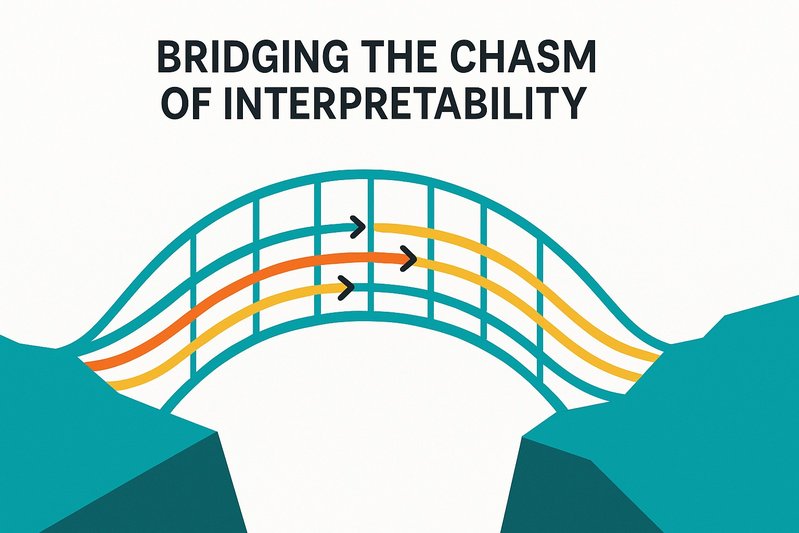
Causal Interpretability Crosses the Chasm
Emerging research directions that will redefine faithful explanations beyond 2026
Human-plausible rationales once passed for “interpretability,” but the community has learned the hard way that what sounds right often isn’t what models actually used. Attention heatmaps can look convincing yet fail causal checks, and chain-of-thought can be persuasive without being true to the model’s inner workings. In 2026, that gap is closing. A new wave of interventional, multi-method evaluation—exemplified by the LIBERTy framework—pushes explanations to meet a higher standard: demonstrate causal faithfulness or be treated as storytelling.
This article maps the near-future of faithful explanations. It traces the field’s cultural shift from narratives to mechanisms; highlights new data paradigms—process-grounded traces, multimodal justifications, and contrastive pairs; examines program-trace grounding; and explores environment-centric generalization, privacy-preserving instrumentation, and on-manifold counterfactual generation. We close with guidance on tool-augmented systems, how evaluation signals may shape training, safeguards against metric gaming, and open problems for 2026 and beyond.
Research Breakthroughs
From narratives to mechanisms: the interventional turn
The core idea is simple but stringent: an explanation is faithful if it captures the causal factors and pathways the model actually used, not just a plausible story. That standard compels interventions. At the input level, deletion–insertion protocols and AUC curves test whether features prioritized by an explanation are necessary and/or sufficient—faithful explanations trigger steep drops on deletion and strong gains on insertion. ROAR (remove and retrain) strengthens necessity claims by showing that removing allegedly important features still degrades performance even after retraining, controlling for the model’s ability to reweight alternatives.
Counterfactual dependence moves beyond erasure: minimal semantic edits—negation, quantifiers, or swapping a single attribute—should flip both the explanation’s attributions and the model’s output in the expected direction. CheckList formalizes these behavioral edits at scale. To avoid off-manifold artifacts from deletion, complementary insertion tests and human-validated counterfactuals help ensure edits are fluent and semantically well-formed.
Representation-level interventions bring causality inside the model. Activation/path patching substitutes internal activations from a counterfactual example at hypothesized mediators; if the output changes accordingly, those features are causal conduits. Mediation analysis and causal abstraction formalize pathway hypotheses and quantify direct/indirect effects. Sparse autoencoders (SAEs) promise finer-grained, semantically aligned feature ablations and patches, tightening the link between human concepts and internal circuits—while still demanding interventional confirmation before causal claims.
This triangulation—input-level perturbations, counterfactual robustness, and representation-level interventions—anchors the cultural shift. LIBERTy couples it with HELM-style transparency, multi-seed variance reporting, and preregistered protocols to make results credible and reproducible at 2026 scale. The result is an interventional bar that explanations must clear to be called faithful.
New data paradigms: process-grounded traces, multimodal justifications, and contrastive pairs at scale
Faithful evaluation needs the right supervision signals. Evidence-grounded datasets provide gold spans or sentences to test minimal sufficiency and necessity (ERASER, FEVER, HotpotQA). Process-supervised corpora like GSM8K and MATH enable step-level verification and step-wise counterfactual edits, crucial for probing chain-of-thought claims. Plausibility-only rationales (e.g., e-SNLI) remain useful but require explicit causal tests before drawing faithfulness conclusions.
Multimodal tasks extend the paradigm beyond text. VQA-X/ACT-X pair justifications with pointing, ScienceQA couples images and text with explanations, A-OKVQA injects world knowledge into VQA with rationales, VCR stresses visual commonsense, and FEVEROUS blends text with structured tables—each offering anchors to assess whether attributions match the modalities models actually used. Contrast sets and minimally edited adversarial/diagnostic pairs directly probe counterfactual dependence and explanation flips at scale.
LIBERTy also prescribes construction methods for 2026-ready datasets: ask annotators to mark minimal sufficient evidence and propose clean counterfactuals, validated by human review and automated checks; profile spurious correlations and define environment/subgroup splits following WILDS; and, where possible, validate process-level steps for correctness and minimality.
Program-trace grounding: executable reasoning and circuit-aligned references
As LLMs increasingly plan, call tools, and execute programs, explanations must align with what those tool-augmented systems actually did. LIBERTy evaluates tool-use and program traces by ablating tools or program steps and measuring downstream impact; by counterfactually editing tool outputs; and by grounding against explicit action histories (ReAct) or compiled, circuit-recoverable programs (Tracr). The metrics here are crisp: success under tool ablation, step necessity, and counterfactual flip rates due to intervened tool results. Representational faithfulness becomes tractable when the algorithmic structure is known, enabling pathway-level tests that connect narrative steps to causal mediators in the network.
Automated, on-manifold counterfactual generation for text and vision
Counterfactual edits are most convincing when they stay on the data manifold. LIBERTy’s protocols emphasize minimal semantic edits and complementary insertion tests to mitigate off-manifold artifacts. For dataset construction, it prescribes human-authored counterfactuals validated by reviewers and automated checks—providing a foundation for robust, scalable counterfactual evaluation. While specific end-to-end automation tools are not detailed, the combination of behaviorally defined edit templates (e.g., CheckList), contrastive pairs, and validation pipelines points toward semi-automated counterfactual generation pipelines across text and vision in the near term.
Roadmap & Future Directions
Environment-centric evaluation: predefined shifts that test generalization
Faithful explanations should de-emphasize spurious features that fail under distribution shift. WILDS-style environment splits operationalize this idea across real-world domains, quantifying whether attribution stability predicts performance stability when spurious cues weaken or flip. Invariant risk minimization offers a conceptual lens for judging whether models latch onto stable causal signals across environments. Even in vision’s ostensibly “simple” regimes, matched-distribution test sets like CIFAR-10.1 reveal generalization fragility—useful for testing if explanations are stable across subtly shifted inputs. LIBERTy bakes these environment-centric tests into benchmark construction and reporting, linking explanation behavior directly to causal generalization.
Privacy-preserving instrumentation: standardized hooks without leakage
Representation-level interventions are powerful, but exposing internal activations can raise safety and confidentiality concerns. LIBERTy supports evaluation in both black-box and white-box regimes and explicitly balances transparency with system security—calling for red-teaming of intervention logs and careful release practices. While specific hook APIs are not prescribed, the framework’s use of established interpretability tooling (e.g., activation patching with TransformerLens) suggests a path toward standardized, minimally revealing interfaces that enable mediation and patching tests without wholesale exposure of model internals.
Faithfulness in tool-augmented systems: edit tools, measure flips
In tool-use settings, explanations should cite steps that are provably necessary. LIBERTy’s protocol—ablate tools/program steps, counterfactually edit tool outputs, and measure flips—translates the abstract standard of causal faithfulness into concrete, automatable checks for ReAct-style systems and compiled programs. The result: step necessity becomes empirically testable rather than rhetorically asserted.
Closing the loop with training: using evaluation signals to shape causal reliance
While LIBERTy is an evaluation framework, its metrics are training-ready signals. ROAR-style performance drops after feature removal, ERASER’s sufficiency/comprehensiveness impacts, and mediator ACE estimates from activation patching provide gradients for shaping models toward robust causal reliance. Specific training recipes are not provided, but the bridge is clear: use the same interventions that validate faithfulness to reward stable causal mechanisms and penalize spurious shortcuts.
Guarding against metric gaming: triangulation over single scores
Single metrics invite overfitting. LIBERTy counters this with multi-pronged defenses: pair deletion with insertion; validate counterfactuals; use ROAR to control for adaptivity; run environment-shift tests; apply sanity checks to catch degenerate attributions; and confirm/falsify hypotheses via representation-level interventions. Preregistration, multi-seed variance reporting, and HELM-style transparency further reduce degrees of freedom and make metric gaming visible.
Impact & Applications
LIBERTy turns interpretability from art into accountable science. By unifying evidence-grounded and process-supervised datasets with interventional tests and environment-shift stressors, it provides a common yardstick for text and multimodal models alike [43–46]. The framework’s HELM-style reporting, model/data cards, and compute accounting make cross-model comparisons credible; its ethical guidance reminds us that in high-stakes domains, interpretable-by-design systems may still be preferable to post hoc explanations. The payoff: explanations that earn trust by surviving causal scrutiny—not by sounding good.
Practical Examples
Below are prototypical evaluation workflows grounded in LIBERTy’s prescribed tests and datasets. They illustrate how causal standards translate into concrete experiments; specific metrics are reported per metric definition, but global performance numbers are not provided here (specific metrics unavailable).
-
Counterfactual dependence in NLI: Take a premise–hypothesis pair and apply a minimal semantic edit (e.g., toggle a quantifier). A faithful explanation that cites the quantifier should change attribution accordingly, and the model’s label should flip or move in the expected direction. Complement with an insertion test to mitigate deletion artifacts, and confirm necessity by patching activations at tokens mediating the quantifier to those from the counterfactual; a corresponding output change strengthens the causal claim.
-
Minimal sufficiency/necessity in evidence-grounded QA: On FEVER or HotpotQA, remove the gold evidence spans and observe the drop in the model’s support/answer confidence (comprehensiveness). Isolating just the evidence (sufficiency) should retain the decision if the rationale is minimally sufficient. Deletion–insertion AUC for highlighted tokens adds a graded sensitivity view, while ROAR tests whether removing top-ranked features still hurts after retraining—bolstering claims of necessity.
-
Process-grounded reasoning for math: For a GSM8K item, verify step-level correctness of a chain-of-thought, then counterfactually edit a pivotal intermediate step and check whether the final answer and subsequent steps change as expected. Patch or ablate internal activations aligned to step tokens to test whether those steps were necessary mediators of the final answer.
-
Multimodal pointing and justification: In VQA-X/ACT-X, verify that the pointing aligns with the textual justification and that occluding the pointed region materially changes the answer. Counterfactual edits to the image or question—validated for on-manifold plausibility—should flip both attribution and output in coherent ways.
-
Tool-augmented traces: For a ReAct-style agent, ablate a tool call (e.g., remove its result) and measure whether the final answer fails; counterfactually alter the tool’s output and check for label flips. With Tracr-compiled programs, use known algorithmic structure to patch purported mediators and quantify mediator ACE, tying narrative steps to causal pathways.
Conclusion
Causal interpretability is crossing the chasm from plausible stories to verified mechanisms. LIBERTy’s interventional, multi-method blueprint—spanning counterfactual dependence, minimal sufficiency/necessity, environment robustness, and mediation—sets a higher bar and provides the scaffolding to meet it. New data paradigms, program-trace grounding, and environment-centric tests broaden coverage; representation-level interventions and SAEs tighten the causal lens; and HELM-style transparency plus sanity checks keep us honest. The next frontier is operational: tightening privacy-preserving instrumentation, scaling on-manifold counterfactual generation, and using evaluation signals to shape training.
Key takeaways:
- Plausibility is not faithfulness; interventional confirmation is required.
- Triangulation across input perturbations, counterfactuals, and activation-level interventions is the new norm.
- Evidence- and process-grounded datasets, plus contrast sets and environment splits, enable causal tests at scale.
- Tool-augmented systems must show step necessity via tool ablation and counterfactual tool edits.
- Transparency and preregistration curb metric gaming; in high-stakes settings, interpretable-by-design models remain a prudent choice.
Next steps for teams: adopt LIBERTy-style preregistration; add contrastive and environment-split data to your testbed; integrate deletion–insertion, ROAR, and activation patching into your evaluation harness; and pilot tool ablation for agents. Looking ahead, expect evaluation infrastructures to broaden across modalities and languages, and for training regimes to increasingly optimize what explanations prove causally true—not just what looks good.
—
Sources
- url: https://arxiv.org/abs/2004.03685 title: Towards Faithfully Interpretable NLP Systems relevance: Establishes the distinction between plausibility and faithfulness that underpins the shift to interventional standards.
- url: https://arxiv.org/abs/1911.03429 title: ERASER: A Benchmark to Evaluate Rationalized NLP Predictions relevance: Provides evidence-grounded metrics (comprehensiveness/sufficiency) central to minimal sufficiency/necessity tests.
- url: https://arxiv.org/abs/1704.03296 title: Interpretable Explanations of Black Boxes by Meaningful Perturbations relevance: Introduces deletion/insertion-style perturbations to test necessity/sufficiency while mitigating off-manifold artifacts.
- url: https://arxiv.org/abs/1806.07421 title: RISE: Randomized Input Sampling for Explanation of Black-box Models relevance: Supplies a perturbation-based attribution baseline and complements deletion–insertion AUC analyses.
- url: https://arxiv.org/abs/1806.10758 title: A Benchmark for Interpretability Methods in Deep Neural Networks (ROAR) relevance: Demonstrates remove-and-retrain protocols that strengthen causal claims of feature necessity.
- url: https://arxiv.org/abs/1909.12434 title: Learning the Difference That Makes a Difference with Counterfactual Examples in NLI relevance: Grounds counterfactual dependence tests via minimal semantic edits that should flip outputs and explanations.
- url: https://arxiv.org/abs/2005.04118 title: Checklist: A Behavioral Testing Framework for NLP relevance: Provides templated, behaviorally defined edits for scalable counterfactual testing.
- url: https://arxiv.org/abs/2202.05262 title: Locating and Editing Factual Associations in GPT relevance: Underpins activation-level interventions (patching/editing) to test causal mediators.
- url: https://github.com/neelnanda-io/TransformerLens title: TransformerLens relevance: Tooling for activation/patching protocols used in representation-level causal tests.
- url: https://transformer-circuits.pub/2023/monosemantic-features/index.html title: Towards Monosemanticity: Decomposing Language Models With Superposition relevance: Advances disentangled feature discovery (SAEs) that enable semantically aligned causal interventions.
- url: https://arxiv.org/abs/2106.12482 title: Causal Abstractions of Neural Networks relevance: Formalizes mediation/causal pathway analyses for internal mechanisms.
- url: https://arxiv.org/abs/2012.07421 title: WILDS: A Benchmark of in-the-Wild Distribution Shifts relevance: Establishes environment-level shifts to test invariance and spurious feature reliance.
- url: https://arxiv.org/abs/1907.02893 title: Invariant Risk Minimization relevance: Offers a conceptual basis for evaluating explanations under environmental heterogeneity.
- url: https://github.com/modestyachts/CIFAR-10.1 title: CIFAR-10.1 relevance: Provides a matched-distribution test set to probe generalization and explanation stability in vision.
- url: https://arxiv.org/abs/2211.09110 title: Holistic Evaluation of Language Models (HELM) relevance: Informs transparent, preregistered evaluation and reporting standards adopted by LIBERTy.
- url: https://arxiv.org/abs/1909.03004 title: Show Your Work: Improved Reporting of Experimental Results relevance: Supports multi-seed variance reporting, hierarchical modeling, and power analyses to prevent metric gaming.
- url: https://arxiv.org/abs/1810.03292 title: Sanity Checks for Saliency Maps relevance: Warns of explanation artifacts and motivates multi-method triangulation.
- url: https://arxiv.org/abs/1802.08129 title: Multimodal Explanations: Justifying Decisions and Pointing to the Evidence relevance: Anchors multimodal faithfulness via pointing-and-justification datasets.
- url: https://arxiv.org/abs/2209.09513 title: ScienceQA relevance: Multimodal QA with explanations used to evaluate cross-modal faithfulness.
- url: https://arxiv.org/abs/2206.01718 title: A-OKVQA relevance: Tests multimodal reasoning with world knowledge and rationales.
- url: https://arxiv.org/abs/1811.10830 title: Visual Commonsense Reasoning (VCR) relevance: Evaluates visual commonsense with rationales for multimodal explanation tests.
- url: https://arxiv.org/abs/2106.05707 title: FEVEROUS relevance: Blends unstructured text and tables for evidence-grounded multimodal verification.
- url: https://arxiv.org/abs/1809.09600 title: HotpotQA relevance: Supplies supporting facts for multi-hop, evidence-grounded faithfulness tests.
- url: https://arxiv.org/abs/1803.05355 title: FEVER relevance: Provides gold evidence for testing minimal sufficiency/necessity in fact verification.
- url: https://arxiv.org/abs/2110.14168 title: Training Verifiers to Solve Math Word Problems (GSM8K) relevance: Process-supervised data enabling step-level faithfulness checks in reasoning.
- url: https://arxiv.org/abs/2103.03874 title: Measuring Mathematical Problem Solving With the MATH Dataset relevance: Another process-supervised benchmark for step-level evaluation.
- url: https://arxiv.org/abs/2201.11903 title: Chain-of-Thought Prompting Elicits Reasoning in LMs relevance: Motivates process-level explanation checks and counterfactual step edits.
- url: https://openai.com/research/improving-mathematical-reasoning-with-process-supervision title: Improving Mathematical Reasoning with Process Supervision relevance: Establishes process-level supervision to evaluate and shape intermediate reasoning.
- url: https://arxiv.org/abs/2004.02709 title: Contrast Sets: A Test Suite for the NLP Community relevance: Provides minimally edited pairs to directly test counterfactual dependence.
- url: https://arxiv.org/abs/1902.10186 title: Attention is not Explanation relevance: Cautions against treating attention as causal without interventions, catalyzing the field’s shift.
- url: https://arxiv.org/abs/1906.03731 title: Attention is not not Explanation relevance: Nuances attention’s role while reinforcing the need for targeted interventions.
- url: https://arxiv.org/abs/2004.13735 title: Evaluating Faithfulness in NLP Explanations relevance: Surveys pitfalls and reinforces the need for causal validation of explanations.
- url: https://arxiv.org/abs/1810.03993 title: Model Cards for Model Reporting relevance: Supports transparent documentation accompanying causal evaluation.
- url: https://arxiv.org/abs/1803.09010 title: Datasheets for Datasets relevance: Guides dataset documentation critical for reproducible, causally grounded evaluation.
- url: https://aclanthology.org/Q18-1041/ title: Data Statements for NLP: Towards Mitigating System Bias and Enabling Better Science relevance: Encourages disclosure that supports environment-level and subgroup analyses.
- url: https://www.nature.com/articles/s42256-019-0048-x title: Stop Explaining Black Box Machine Learning Models for High Stakes Decisions and Use Interpretable Models Instead relevance: Reminds practitioners that in high-stakes domains, interpretable-by-design may trump post hoc explanations.
- url: https://arxiv.org/abs/2210.03629 title: ReAct: Synergizing Reasoning and Acting in Language Models relevance: Provides action histories for tool-augmented systems, enabling step necessity tests.
- url: https://arxiv.org/abs/2301.05062 title: Tracr: Compiled Transformers as a Laboratory for Interpretability relevance: Supplies circuit-grounded, executable programs to test representational faithfulness to algorithmic structure.
- url: https://arxiv.org/abs/1711.11279 title: Interpretability Beyond Feature Attribution: Quantitative Testing with TCAV relevance: Connects internal features to human concepts while underscoring the need for causal confirmation.
- url: https://arxiv.org/abs/1711.05611 title: Network Dissection: Quantifying Interpretability of Deep Visual Representations relevance: Maps neurons to concepts, motivating concept-level but causally validated analyses.