Catechol‑Composites, Radiopaque Tracers, and Aerosol Standards: The Next Decade of Hemostatic Powder Innovation
Legacy zeolite powders once stopped bleeding at a cost—exothermic burns—which catalyzed a wholesale pivot to kaolin gauze and biopolymer systems built for safety and speed. A decade later, starch‑based microporous powders are routine in operating rooms, and gas‑assisted catheters spread hemostats endoscopically within seconds [5,6,7,21]. Yet field guidelines still favor gauze for deep wounds and warn against aerosol risks in chaotic scenes [1,2]. The message is clear: powders work, but their next leap demands smarter materials, safer activation, better devices, harmonized aerosol science, and pragmatic evidence.
This article lays out a focused R&D roadmap. We synthesize the current state of sprayable biopolymer powders and detail a forward path centered on multi‑mechanism composites (catechol/tannic‑acid chitosan‑alginate), low‑dose nano‑activation under strict particulate controls, radiopacity by design, next‑gen applicators with gentle plumes and depth targeting, standardized aerosol metrics, pragmatic trauma trials with TEG/ROTEM endpoints, drug‑device combinations, and a regulatory playbook aligned to ISO 10993 and human factors.
Readers will learn what is technically feasible now, what should enter bench and animal testing next, the clinical studies that matter, and the regulatory and safety milestones needed to responsibly commercialize the next generation of hemostatic powders.
Research Breakthroughs
Multi‑mechanism materials that adhere, dehydrate, and activate
The strongest near‑term candidates are catechol‑ or tannic‑acid (TA) functionalized chitosan–alginate composites. Each component contributes a distinct lever:
- Chitosan: cationic amines agglutinate RBCs/platelets and form wet‑adhesive gels that resist washout—even when the enzymatic cascade is compromised by hypothermia, acidosis, or anticoagulation.
- Alginate: rapid ionic gelation plus Ca2+ release that supports the coagulation cascade and stiffens the forming barrier.
- Catechol/TA: “mussel‑inspired” wet adhesion (covalent/coordination bonding) and protein complexation that stabilize the plug under flow.
Composites that merge these features can unite three mechanisms—adhesion, dehydration/gelation, and cascade support—into a single spray‑on powder engineered as porous micro‑ or aerogel‑like particles for rapid wicking and coverage [13,14]. The design imperative is to push wet adhesion high enough to resist irrigation and arterial shear without incurring local toxicity; that balance is reachable with measured catechol or TA functionalization and careful control of chitosan’s degree of deacetylation [13,14].
Safer contact activation with tightly controlled particulates
Contact pathway boosters—kaolin and nanosilicates (synthetic smectites)—can shorten clot initiation (FXII activation) and strengthen fibrin networks, but they raise inhalation and embolization concerns if fine, respirable fractions are present [13,20]. The next decade’s “safe activation” concept hinges on:
- Low‑dose nanosilicates embedded within larger composite particles to reduce airborne fines while preserving catalytic surface area.
- Aerodynamic size control at the formulation and device level to minimize respirable fractions without sacrificing wound deposition.
- ISO 10993‑aligned biological evaluation expanded for aerosolized particulates (local/systemic toxicity, sensitization, and targeted inhalation/embolization studies).
Together, these elements allow contact activation to be harnessed responsibly rather than avoided wholesale.
Visibility by design: radiopaque tracers
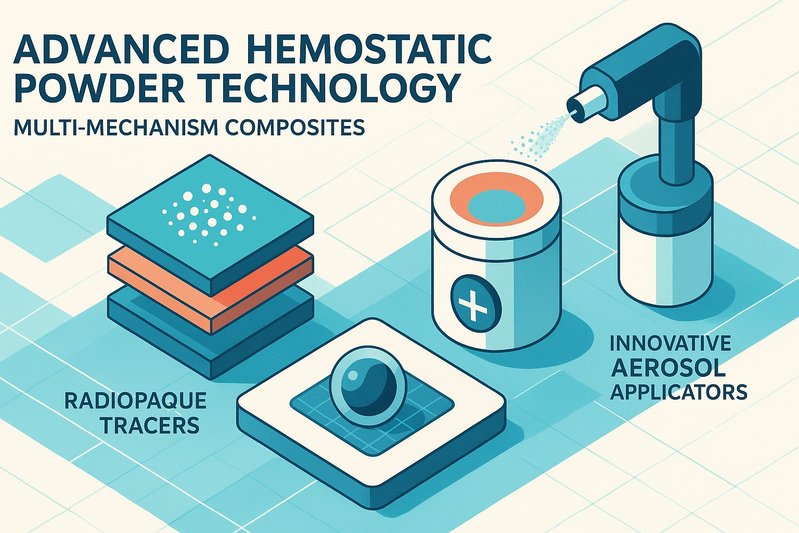
Residue management is a practical pain point: many powders are radiolucent, complicating intraoperative identification and postoperative imaging of retained material. The field should embed inert radiopaque tracers (e.g., barium‑bearing glass microspheres or iodine‑functionalized polymers) at trace levels that do not perturb hemostasis but enable fluoroscopic or CT visualization for targeted removal when needed. This directly addresses a recognized gap in residue identification and postoperative management [5,6,13].
Roadmap & Future Directions
Device innovations: gentle coverage, fewer clogs, deeper reach
Today’s OR bellows and endoscopic CO2‑assisted catheters already demonstrate controlled, broad coverage and reduced clogging in wet fields [5,6,7]. The next wave should prioritize:
- Moisture‑hardened, anti‑clog flow paths: hydrophobic linings, anti‑static design, and desiccant‑protected cartridges that resist caking in humid ORs and field conditions [5,6].
- Adjustable CO2 delivery: tunable pressure and pulse‑width control to expand coverage while lowering jet momentum that might dislodge early clots [6,7].
- Diffuser nozzles: engineered plumes that trade velocity for area, improving adherence to irregular wound beds.
- Tract‑targeting tips: long, flexible, side‑port catheters that deposit powder along narrow wound channels where gauze remains superior today [1,2].
Aerosol science standardization
The lack of harmonized aerosol test methods undermines comparability. A common framework should quantify:
- Plume geometry (cone angle, footprint at defined standoff distances)
- Respirable fraction (mass <10 µm aerodynamic diameter under intended use)
- Deposition depth metrics in wound models with controlled flow
- Cross‑applicator dose uniformity under humidity and temperature stress
Results should be tied to risk controls (airway protection, suction protocols) and post‑market surveillance using the FDA’s MAUDE database to catch rare inhalation or embolization events, feeding back into Instructions for Use (IFU) updates.
Trial design priorities: pragmatism with mechanistic endpoints
Civilian trauma centers are the right venue for pragmatic trials that mirror battlefield derangements without the logistics of combat trials. Protocol arms should model hypothermia, acidosis, and anticoagulation—the very conditions where mechanistic differences matter [9,10]. Beyond time‑to‑hemostasis, incorporate TEG/ROTEM to detect changes in initiation (R time), amplification (K/alpha), and clot strength (MA/MCF) aligned to material mechanisms and contact activators. Parallel large‑animal studies can validate aerosol deposition metrics and tract‑targeting efficacy before human enrollment.
Given current TCCC guidance that prioritizes hemostatic gauze for deep packing, trauma trials must explicitly include junctional/extremity tract wounds and standardized compression protocols to fairly challenge powders against the incumbent standard [1,2].
Drug‑device convergence with defined safety margins
Topical pharmacologics—including thrombin, rFVIIa, and tranexamic acid (TXA)—are compatible with particulate carriers, offering immediate fibrin formation or antifibrinolytic protection layered atop mechanical sealing. Future powders should:
- Encapsulate thrombin or rFVIIa for controlled release over minutes to hours to support fragile clots without systemic spillover.
- Embed TXA for local antifibrinolysis, especially in highly vascular beds.
- Define dose ceilings and local/systemic exposure windows via ISO 10993 and targeted pharmacology to avoid pro‑thrombotic risk [11,13].
Regulatory playbook and staged milestones
Regulatory success begins early:
- Build an ISO 10993 plan at concept stage for any novel chemistries (catechols, TA, radiopaque tracers, nanosilicates), including cytotoxicity, sensitization/irritation, systemic toxicity, genotoxicity as indicated, and—crucially—particulate inhalation/embolization testing for aerosolized delivery.
- Conduct human factors/usability studies for applicators (gloved operation, orientation misuse, airway protection steps) and encode explicit IFU instructions on intravascular avoidance and residue removal [1,2,22].
- Use gamma/EtO sterilization studies to show materials stability, recognizing gamma can reduce chitosan molecular weight and alter gel strength; choose modalities and doses that preserve function.
A realistic timeline:
- 0–2 years: bench aerosol metrics and ISO 10993 screens; first large‑animal bleed and deposition studies; finalize radiopaque tracer candidates [11,22,24].
- 2–5 years: pivotal animal studies under hypothermia/acidosis; first‑in‑human surgical adjunct trials; refine IFU from usability and aerosol data [5,6,7,17,21].
- 5–10 years: pragmatic civilian trauma RCTs with TEG/ROTEM; submission and iterative post‑market surveillance with MAUDE feedback loops [1,2,17,22].
Impact & Applications
Surgery and endoscopy: faster, safer, more visible
In the OR, microporous polysaccharide hemostats (MPH) such as Arista AH are widely adopted adjuncts under direct visualization, prized for rapid fluid sequestration and absorbability. In GI endoscopy, catheterized powders (starch‑based EndoClot PHS and mineral TC‑325) achieve high immediate hemostasis as bridge/adjunct therapies across diffuse mucosal bleeds [6,7,21]. Embedding radiopaque tracers will simplify intraoperative identification and selective removal of excess, mitigating mass‑effect risks without guessing where the powder sits [5,6]. Device refinements—diffusers with adjustable CO2—promise broad, gentle coverage that preserves early clot integrity [6,7].
Prehospital and combat care: closing the tract‑wound gap
For external junctional and extremity hemorrhage, TCCC still prioritizes hemostatic gauze for deep packing and compression synergy [1,2]. To credibly compete, powders must demonstrate reliable depth deposition, sustained adhesion under flow, and low embolization risk in narrow tracts. That means tract‑targeting tips, minimized respirable fractions, and clear IFU steps for airway protection and suction—validated with standardized aerosol metrics and monitored via MAUDE post‑market data [1,2,22]. The mechanistic strengths of chitosan (cascade‑independent sealing) under hypothermia and acidosis support this ambition, but only pragmatic trials can prove it [9,10,13].
Risk register: what to mitigate—and how
- Inhalation/embolization: limit fine fractions; characterize aerosol emissions; enforce airway protection; monitor MAUDE signals.
- Immunogenicity/allergenicity: screen animal‑derived gelatin/collagen and crustacean‑derived chitosan via ISO 10993 sensitization testing and clinical vigilance [11,13].
- Material stability: validate sterilization effects on polymer properties (e.g., chitosan chain scission under gamma) and shelf‑life moisture ingress controls.
- Exotherm legacy: maintain non‑exothermic mechanisms; communicate this safety profile versus historic zeolite risks.
Practical Examples
Before/after: where next‑gen powders move the needle
| Dimension | Today’s state | Next‑gen target | Why it matters |
|---|---|---|---|
| Wet adhesion under flow | Chitosan or TA functionalization used inconsistently; washout in high shear possible [13,14] | Catechol/TA‑functionalized chitosan‑alginate composites with tuned DDA and crosslinking | Resists irrigation and arterial spurts while forming a conformal barrier [13,14] |
| Cascade support | Dehydration (MPH), Ca2+ from alginate; variable contact activation [5,13] | Low‑dose nanosilicate contact activation with controlled aerodynamic size | Shorter initiation without aerosol hazards [13,20] |
| Visualization | Radiolucent residues complicate management [5,6] | Built‑in radiopaque tracers (CT/fluoro visible) | Targeted removal, postoperative tracking |
| Delivery | OR bellows and endoscopic CO2 catheters; clogging in humidity [5,6,7] | Moisture‑hardened, anti‑clog paths; adjustable CO2; diffuser nozzles | Dose uniformity, gentle coverage, fewer clogs [6,7] |
| Depth deposition | Gauze superior in tracts; powders risk embolization [1,2] | Tract‑targeting side‑port tips; standardized deposition depth metrics | Safe, effective use in junctional/extremity wounds [1,2] |
| Evidence & endpoints | Time‑to‑hemostasis; limited mechanism‑aligned metrics [5,7,21] | Pragmatic trials with hypothermia, acidosis, anticoagulation arms and TEG/ROTEM | Mechanism‑responsive evidence strategy [9,10,17] |
| Safety framework | ISO 10993 basics; ad hoc aerosol testing | ISO‑aligned particulate inhalation/embolization studies; MAUDE‑informed IFUs | Proactive risk control and surveillance [11,22] |
Example trial schema (pragmatic civilian trauma)
- Population: adult torso/junctional bleeds eligible for adjunctive topical hemostats; stratify by presence of hypothermia (<35°C), acidosis (pH ≤7.20), or anticoagulation.
- Arms: next‑gen catechol‑chitosan‑alginate powder vs kaolin or chitosan gauze standard of care; both with standardized compression.
- Endpoints: primary—time‑to‑hemostasis and rebleed at 60 min; secondary—transfusion units, TEG/ROTEM (R time, K/alpha, MA/MCF), aerosol exposure proxies (ambient particle counts during application).
- Safety: embolization screening (duplex when indicated), airway events, device malfunctions; IFU adherence; post‑discharge MAUDE reporting triggers.
Conclusion
The hemostatic powder category is poised for a step change. By converging catechol/TA‑functionalized chitosan‑alginate composites, carefully dosed nano‑contact activation, and radiopaque visibility with smarter devices and harmonized aerosol science, the field can expand beyond controlled OR and endoscopic settings into deeper, more complex wounds—without compromising safety. Success hinges on a pragmatic evidence plan that reflects real‑world derangements and on a regulatory strategy that integrates ISO 10993, human factors, and explicit IFUs from day one. The next decade’s winners will be those who build for adhesion and activation—and prove it with standardized aerosol and clot mechanics data. 💡
Key takeaways:
- Combine adhesion (catechol/TA‑chitosan) + dehydration/gelation (alginate/MPH) + contact activation (kaolin/nanosilicates) in one composite, with tight particulate controls [13,14,20].
- Engineer devices for moisture‑resilient, low‑momentum plumes and tract‑targeting deposition; standardize aerosol metrics [5,6,7,22].
- Design pragmatic trauma trials with hypothermia/acidosis/anticoagulation arms and TEG/ROTEM endpoints [9,10,17].
- Add radiopaque tracers for intraoperative/postoperative residue management [5,6,13].
- Anchor development in ISO 10993 programs, sterilization stability data, and MAUDE‑informed IFUs [11,22,24].
Next steps for R&D teams:
- Prototype catechol‑chitosan‑alginate powders with radiopaque tracers; characterize wicking, adhesion, and CT visibility.
- Build an aerosol test bench for plume geometry, respirable fraction, and tract deposition depth; iterate diffuser nozzles and CO2 controls.
- Launch ISO 10993 biocompatibility and targeted inhalation/embolization studies; select sterilization modalities to preserve polymer function [11,24].
- Plan large‑animal models under hypothermia/acidosis and design a multicenter pragmatic civilian trauma trial with TEG/ROTEM [9,10,17].
The coming decade will reward designs that are visible, verifiable, and verifiably safe—turning powders into precise, depth‑capable tools across surgery, endoscopy, and trauma.
Sources
- Deployed Medicine – Hemorrhage Control (TCCC): https://deployedmedicine.com/market/11/content/53 — TCCC guidance anchors field use, gauze preference, and IFU priorities.
- Joint Trauma System – Committee on TCCC (CoTCCC): https://jts.health.mil/index.cfm/committees/cotccc — Confirms current tactical recommendations and training implications.
- Baxter – Arista AH (Microporous Polysaccharide Hemostat): https://advancedsurgery.baxter.com/arista-ah — Illustrates OR use, absorbability, and workflow of MPH powders.
- EndoClot Plus – Polysaccharide Hemostatic System (PHS): https://endoclot.com/products/phs/ — Shows gas‑assisted catheter delivery and endoscopic applicability.
- Cook Medical – Hemospray (TC‑325) Endoscopic Hemostatic Powder: https://www.cookmedical.com/products/hemospray/ — Demonstrates gas‑assisted powder delivery and broad mucosal coverage.
- Kheirabadi et al., J Trauma 2011: https://pubmed.ncbi.nlm.nih.gov/21795879/ — Swine extremity hemorrhage comparison informing trial conditions and endpoints.
- Kheirabadi et al., J Trauma 2009: https://pubmed.ncbi.nlm.nih.gov/19854364/ — Efficacy under hypothermia and hemodilution guiding coagulopathy arms.
- FDA Guidance – Use of ISO 10993‑1: https://www.fda.gov/regulatory-information/search-fda-guidance-documents/use-international-standard-iso-10993-1-biological-evaluation-medical-devices-part-1 — Framework for biocompatibility planning including novel chemistries.
- Recent Advances in Hemostatic Materials for Wound Healing (Review): https://www.sciencedirect.com/science/article/pii/S2452199X20303639 — Synthesizes chitosan/alginate, MPH, and nano‑additives mechanisms and design.
- Mussel‑Inspired Tissue Adhesives for Hemostasis: https://onlinelibrary.wiley.com/doi/10.1002/adhm.202000711 — Supports catechol/TA functionalization for wet adhesion.
- Acute and Long‑Term Safety of Zeolite Hemostatic Agent in Swine: https://pubmed.ncbi.nlm.nih.gov/18090354/ — Documents exotherm risks that reshaped the field.
- Thromboelastography and ROTEM Review: https://www.ncbi.nlm.nih.gov/pmc/articles/PMC4373602/ — Justifies mechanism‑aligned trial endpoints.
- EndoClot PHS Clinical Experience: https://pubmed.ncbi.nlm.nih.gov/34224833/ — Clinical performance context for endoscopic powders.
- FDA MAUDE Adverse Event Database: https://www.accessdata.fda.gov/scripts/cdrh/cfdocs/cfmaude/search.cfm — Post‑market surveillance to inform IFU and risk controls.
- Effects of Gamma Irradiation on Chitosan Properties: https://pubmed.ncbi.nlm.nih.gov/19021290/ — Sterilization impact guiding materials and process choices.