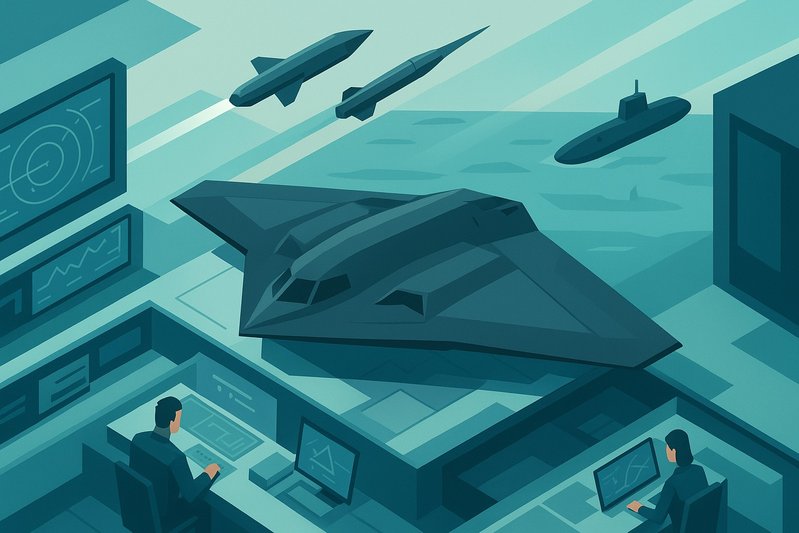
Affordable Low Observability Shifts Procurement Toward Attritable Mass and Undersea Endurance
Pentagon flight tests of a next‑generation stealth bomber, allied pushes for multi‑domain interoperability, and the arrival of hypersonic‑ready surface combatants are converging on a single budget reality: survivability is the new return on investment. In a world of proliferated sensors and long‑range precision fires, defense ministries are redirecting spend to low‑observable (LO) platforms and weapons that can survive, sense, and strike under emissions control while plugging into resilient kill webs.
The business calculus is clear. Stealth integration—when paired with offboard sensing and low probability of intercept/detection networking—extends the useful life of platforms and munitions and raises the odds that expensive assets will matter in combat. This article explains why LO integration continues to command budget share; how bomber recapitalization and sixth‑generation family‑of‑systems strategies shape portfolio choices; why attritable loyal wingmen and LO standoff weapons are central to scaling mass; and how maritime forces are doubling down on quiet submarines and distributed, hypersonic‑enabled surface fires. It also examines sustainment realities, industrial base opportunities, allied adoption pathways, and the risk‑management tools—spiral upgrades, open systems, and modularity—now baked into procurement strategies.
Survivability as ROI—and the Portfolio Shifts It Triggers
Stealth alone no longer guarantees invisibility, but integrated LO remains the surest way to preserve options inside dense sensing and counter‑access environments. Procurement leaders increasingly treat survivability as a portfolio‑level ROI metric: platforms and weapons that can remain undetected longer, operate under emissions control, and still close kill chains are the ones that justify premium budgets.
A shift to networked LO tradecraft underpins that calculus. Joint kill webs and LPI/LPD links enable survivable aircraft to contribute targeting while staying mostly passive; cooperative engagement lets one node sense while another shoots; proliferated space sensors furnish cues without forcing LO platforms to radiate. The effect is a multiplier: each stealth investment increases the efficacy of others across air and sea. Budgets follow that logic—prioritizing penetrating nodes and LO weapons, and backing architectures that keep those nodes relevant over time.
Bomber recapitalization and portfolio leverage
The stealth bomber recapitalization is the purest expression of survivability as ROI. A new penetrating strike platform has entered flight testing with an emphasis on persistent stealth, long‑range conventional attack, and open architectures designed for rapid modernization. Crucially, it is positioned as a node in joint kill webs, meant to work collaboratively with uncrewed teammates and standoff shooters. That portfolio role is what justifies the spend: the bomber is not just a single exquisite platform but a catalyst for a broader LO ecosystem across services.
That ecosystem logic extends to air wing design. When penetrating aircraft can passively sense and pass target tracks via LPI/LPD links, naval and ground‑based shooters can fire without exposing the most survivable assets. Demonstrated cooperative engagement between stealth fighters and naval combatants has validated the model. In budgeting terms, recapitalizing the bomber brings leverage—unlocking returns in the weapons portfolio, surface‑ship magazines, and joint C2.
Family‑of‑systems economics: crewed core plus collaborative teammates
Sixth‑generation air dominance strategies institutionalize this value logic. The family‑of‑systems approach anchors a crewed, survivable core aircraft to Collaborative Combat Aircraft (CCA) that add affordable reach, payload, and risk absorption. Requirements emphasize autonomy, LO carriage of sensors and weapons, and teaming with existing fifth‑gen fleets. For acquisition leaders, the economics are compelling: survivability on the crewed node, scale and adaptability on the uncrewed wing—procured at different cost curves, upgraded on different tempos, and combined to create effects greater than the sum of the parts.
Allies are converging on the same model. The UK‑Japan‑Italy GCAP and the Franco‑German‑Spanish FCAS both center on LO crewed platforms tightly integrated with uncrewed “remote carriers” or loyal wingmen, tasked with distributed sensing, jamming, and strike. This alignment matters for exportability, shared development, and interoperability premiums—particularly when paired with common approaches to emissions control and data sharing across coalitions.
Procurement Strategies for Affordable LO and Scalable Effects
If survivability is the ROI, affordable mass is the budget enabler. Leaders are shifting from a handful of exquisite stealth assets to portfolios that add attritable LO teammates and munitions—maintaining survivability while scaling capacity.
Attritable mass: loyal wingmen portfolios
The USAF’s CCA thrust prioritizes autonomy and cost‑effective LO payload carriage to extend the reach and protection of high‑value crewed aircraft. Loyal wingmen can take on stand‑in sensing, jamming, and decoy roles, conserving the emissions budget of the core stealth platforms and distributing risk under dense surveillance. Early allied experimentation mirrors this logic; one program fields a low‑observable loyal‑wingman focused on teaming, sensor extension, and stand‑in effects, underscoring how procurement can buy survivability and mass simultaneously.
At sea, a stealth‑informed tanker extends carrier air wing range, pushing refueling nodes outward so LO strike profiles aren’t forced to break emissions discipline near threats. Growth provisions for sensing roles create headroom to support cooperative engagement—again, a force‑multiplier logic that turns a single platform buy into portfolio leverage.
Weapons portfolios: low‑observable standoff at volume
LO weapons turn stealth platforms into strike multipliers. Long‑range cruise missiles designed with reduced RCS and advanced seekers enable standoff attacks against integrated air defenses; their naval variant adapts the approach for anti‑ship missions in contested electromagnetic environments. European designs achieve similar effects against fixed, high‑value targets. Russia’s widespread use of a reduced‑signature air‑launched cruise missile underscores both the value of LO standoff and the operational need for varied routing and deception against layered defenses.
For acquisition executives, the takeaway is straightforward: stockpiles of LO standoff munitions are the budget line that translates survivability into effects at scale. Specific production metrics are unavailable, but portfolio balance is shifting toward munitions that align with emissions‑disciplined kill webs and penetrate through passive and multistatic surveillance.
Sustainment realities: coatings, depot time, and availability
Sustainment is the tax on stealth—and a design brief for “affordable LO.” Fifth‑generation fleets face labor‑intensive coatings, structural access challenges, and supply constraints that pressure mission capable rates. Reforms are underway to reduce turnaround times and preserve LO quality in the field, but availability remains a gating factor for force planners.
Maritime sustainment brings its own imperatives: corrosion management in LO surface treatments, signature baselining for surface and subsurface fleets, and acoustic health monitoring to keep submarines quiet over long patrols. Design responses—more durable LO treatments, modular components, and rapid field repair—are moving from “nice to have” to selection criteria in procurement. Budgeteers increasingly value LO that can be maintained close to the point of need without eroding the very survivability they purchased.
Maritime Investment Thesis: Quiet Submarines and Distributed Surface Fires 🌊
Undersea forces remain the stealth benchmark, and the investment thesis is straightforward: when survivability equals presence, quiet submarines are the persistence buy. Modern SSNs suppress acoustic and magnetic signatures through hull shaping, coatings, quieted propulsion, and isolation of machinery. Future designs aim for higher speed, payload, and stealth specifically to prevail under peer‑level ocean surveillance.
Allies are locking this in at program scale. The AUKUS submarine enterprise couples UK design leadership with U.S. systems to deliver advanced SSNs emphasized for Indo‑Pacific missions. Lifecycle quieting and sophisticated sensors are not just technical features; they are central to a survivability‑at‑scale business case that justifies the cost over decades of service.
On the surface, stealth shaping and emissions discipline are now core to distributed maritime operations. The U.S. Navy’s Zumwalt‑class reduces radar and infrared signatures through faceting and composite structures and is set to integrate conventional prompt hypersonic strike—extending the engagement envelope and enabling fires from beyond adversary sensor networks. China’s Type 055 destroyer employs shaping and integrated masts to reduce returns, pairing those features with long‑range fires in roles that support both blue‑water and anti‑access tasks.
The connective tissue is cooperative targeting. Carrier groups and surface action groups can exploit offboard sensors—UHF airborne radar, passive stealth fighter tracks—to engage at range under emissions control. The investment case hinges on buying ships and aircraft that can serve as either a silent sensor or a remote shooter in a kill web, not merely on their individual radar cross‑section.
Allied Adoption, Industrial Base Upside, and Budget Risk Management
Interoperability premiums
Coalitions are aligning doctrine and architectures around multi‑domain integration, positioning LO platforms to operate as passive nodes within shared data fabrics. NATO’s move toward multi‑domain operations, the UK’s doctrine updates, and Australia’s strategic review all emphasize survivable undersea forces, long‑range strike, and resilient spectrum operations. Interoperability premiums accrue to allies who standardize on LPI/LPD links, cooperative engagement, and space‑enabled cueing: every compatible platform becomes a contributor to the shared survivability dividend.
Demonstrated cooperative engagements—stealth fighter tracks contributing to Aegis fires via Cooperative Engagement Capability (CEC)—offer a blueprint. As more F‑35 operators field that tradecraft, navies and air forces gain options to hold targets at risk without illuminating their most survivable assets. Space‑based missile tracking and commercial RF geolocation add cues that reduce emissions demands on LO nodes, reinforcing the value of aligning allied programs to common kill‑web principles.
Industrial base constraints and opportunities
Industrial realities shape what can be bought—and sustained—at scale. Sustainment burdens on fifth‑generation fleets reveal where supply chains and depots must modernize to preserve LO availability. Specific throughput metrics are unavailable, but the direction is clear: investments in durable coatings, spares, and field‑level repair capacity are preconditions for credible force generation.
On the opportunity side, allied programs expand the industrial frontier for LO. GCAP and FCAS create multinational pipelines for sixth‑generation technologies and uncrewed teammates; AUKUS formalizes a shared SSN architecture and cross‑pollination of sensors and combat systems. These programs are not just combat capabilities; they are industrial strategies that crowd in private and public capital around survivable force design.
Budget risk management: spirals, open systems, and modularity
Risk in LO programs is increasingly managed through architectural choices. New penetrating bombers are built with open architectures to enable rapid modernization—an implicit commitment to spiral upgrades against evolving threat radars and passive networks. LPI/LPD links like MADL and electromagnetic spectrum operations strategies further de‑risk the portfolio by protecting the emissions lifeline that makes stealth viable in the first place.
At the system‑of‑systems level, cooperative engagement and joint data fabrics like CJADC2 are risk‑spreading tools: they decouple sensors from shooters, offer redundant paths for kill chains, and provide graceful degradation under jamming or cyber pressure. Modularity—seen in the push for more durable LO treatments and replaceable components—contains sustainment risk by compressing repair timelines and preserving signature baselines in the field. Together, spiral modernization, open systems, and modular sustainment form the new procurement hedge against counter‑stealth advances.
Conclusion
Stealth integration is reshaping defense portfolios around survivability, scale, and interoperability. Penetrating bombers, sixth‑generation family‑of‑systems, loyal wingmen, and LO standoff weapons are converging with quiet submarines and hypersonic‑enabled surface combatants to create a force that can persist, sense, and strike under emissions control. The winners in this budget era will be programs that convert LO into networked, maintainable combat power—and coalitions that make those programs interoperable by design.
Key takeaways:
- Survivability is the ROI that justifies premium investment; networking and EM discipline multiply that value across portfolios.
- Recapitalized bombers and sixth‑gen families deliver leverage when paired with CCA and LO standoff weapons.
- Undersea forces remain the endurance buy; surface fleets gain relevance through LO shaping, EMCON, and hypersonic‑ready payloads.
- Sustainment is decisive; durable LO treatments, modular components, and field repair capacity determine availability.
- Open architectures, cooperative engagement, and LPI/LPD standards hedge against counter‑stealth and interoperability risks.
Next steps for program leaders and budgeteers:
- Prioritize platforms that enable offboard sensing and remote fires while preserving emissions discipline.
- Shift munitions portfolios toward LO standoff weapons and plan stockpiles accordingly; specific volume targets remain undisclosed.
- Invest in sustainment technology and industrial capacity that keep LO assets mission‑capable at scale.
- Align allied programs to common data fabrics and CEC‑style engagement concepts to maximize interoperability premiums.
Stealth will remain necessary but insufficient on its own. The advantage goes to those who buy survivability, design for affordability, and network for effects—then keep the whole enterprise maintainable under real‑world constraints.