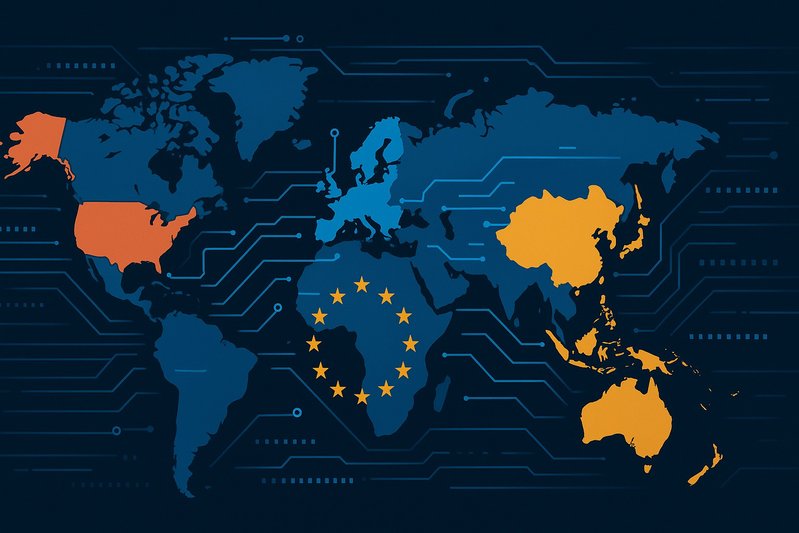
A Regional Overview of AI Infrastructure Deployment
Challenges and Strategies Across the US, EU, and Asia
Artificial intelligence (AI) has become a transformative force across industries, reshaping how businesses and governments approach data, infrastructure, and strategy. However, the deployment of AI infrastructure is far from uniform across regions. The US, EU, and Asia face distinct challenges and opportunities in building AI capabilities, exacerbated by geopolitical shifts, technological demands, and export controls impacting hardware availability. This article delves into these regional dynamics and examines how export controls are influencing AI infrastructure deployment and strategy globally.
The US: Leading the Charge
In the United States, major tech companies and hyperscalers like AWS, Google, and Microsoft anchor AI infrastructure initiatives, having secured priority access to advanced computing hardware through strategic partnerships with major chip manufacturers such as NVIDIA and AMD. These entities effectively dominate procurement pipelines, resulting in relative stability in acquiring advanced AI accelerators like NVIDIA’s H100 and H200 GPUs.
However, the scramble for AI accelerators creates ongoing pressure. The stringent demand for AI hardware, particularly for training workloads requiring high-bandwidth memory (HBM) and advanced packaging techniques, has led to sustained elevated pricing and challenging lead times. The US’s ability to secure a consistent supply of these components underscores the advantages of being home to leading AI technology innovators, yet it doesn’t completely shield the country from the global supply constraints that affect other regions.
EU Concerns: Infrastructure and Permitting
European Union nations approach AI deployment with an emphasis on regulatory compliance and ethical AI use, which has sometimes slowed infrastructure rollout compared to the US. While EU countries often access similar hardware through global manufacturers, completing AI infrastructure projects is more complicated by local regulations and permitting processes. These bureaucratic hurdles can delay facility readiness even when components are available, thus impacting the pace of AI adoption.
Moreover, Europe’s diverse power grid stability and energy policies pose challenges. As AI infrastructure requires significant energy, variances in local energy policies add complexity to establishing and operating large-scale AI clusters, further complicating already strained timelines for deploying HBM-rich AI accelerators.
Asia: Divergent Paths and Export Controls
Asia’s landscape is diverse, with countries like Japan, South Korea, and Taiwan benefiting from proximity to semiconductor manufacturing giants. These nations pioneer in AI infrastructure rollouts thanks to well-developed supply chains and government-backed initiatives. Japan and South Korea, in particular, leverage national programs to accelerate AI deployments, enhancing their competitive edge in AI innovation and application.
Conversely, China faces significant hurdles due to tightened US export controls, which restrict access to high-performance computing chips and related technologies. These restrictions, aimed at limiting technological advantages, force China to adapt by investing in domestic alternatives and sourcing from secondary markets. While these efforts aim to mitigate increased costs and longer lead times, they also foster regional innovation as Chinese companies develop their semiconductor capabilities, albeit under challenging constraints.
The Impact of Export Controls
US export controls on advanced computing technology represent a focal point of strategic tension, particularly impacting China’s access to NVIDIA’s A100 and H100 GPUs, driving higher street prices and exacerbating lead time issues. These controls alter the competitive dynamics within the semiconductor space, compelling affected nations to seek alternative solutions or accelerate independent technological advancements.
In regions like Taiwan and South Korea, the constraints reinforce existing partnerships with American firms, ensuring steady access to cutting-edge technology while simultaneously fostering local innovation to prevent reliance on single sources.
Conclusion: Navigating a Competitive Landscape
AI infrastructure deployment represents a critical arena where regional policies, technological availability, and geopolitical maneuvers intersect. As global demand for AI capabilities escalates, the intertwined challenges of advanced packaging, memory shortages, and strategic export controls create a volatile environment.
US tech giants leverage their influential partnerships to navigate these complexities, securing priority allocations of essential AI components. In contrast, the EU’s regulatory approach and China’s export control challenges highlight the broader implications of policy-making in technological advancement.
Strategic adaptability and robust international collaborations remain integral for these regions to meet rising AI demands. Firms must wisely manage procurement cycles, diversify technology sourcing, and remain agile to leverage AI’s transformative potential fully. Ultimately, the nations that strike the right balance between technology deployment and geopolitical strategy will likely lead the global AI race.
Key Takeaways:
- US Dominance: Strategic partnerships with leading chip manufacturers afford the US a resilient supply chain, albeit not without challenges amid a tight AI hardware market.
- EU Challenges: Regulatory and energy policy frameworks complicate AI infrastructure rollouts, necessitating strategic policy adaptations.
- Asia’s Dual Reality: While nations like Japan and South Korea advance rapidly, China faces significant export control challenges, prompting domestic innovation efforts.
- Strategic Controls: Export policies influence global AI deployment by limiting access to cutting-edge technologies, reshaping competitive dynamics and fostering regional adaptations.